
An air barrier stops air from moving through your walls, attic and floors. A vapor barrier, more accurately called a vapor retarder, slows the slow, invisible diffusion of water vapor through building materials. They are two different jobs, and most homes need the first one done well long before they need the second. In Chicagoland, getting this wrong is one of the quieter ways a house ends up with wet insulation, stained drywall and mold.
Below, we explain what each layer does, why plastic sheeting on the inside of a wall can backfire in our climate, and how to tell whether the moisture problem in your house is an air problem, a vapor problem or a plain leak.
TL;DR
- An air barrier blocks bulk airflow. A vapor retarder limits diffusion of water vapor. They are not interchangeable, and one does not replace the other.
- Air leakage moves far more moisture into a wall than diffusion does, so air sealing usually comes first.
- In Chicagoland’s cold climate, building scientists advise against Class I plastic sheeting on the interior of most wall assemblies, because it can keep a wet wall from drying.
- Insulation is not an air barrier. Fiberglass batts and blown-in cellulose let air pass through.
- If you already see mold, stains or musty smells, the barrier question comes second. Find and fix the moisture source first.
Table of Contents
- What an air barrier does
- What a vapor barrier (vapor retarder) does
- Air barrier vs vapor barrier: side by side
- Can one material do both jobs?
- Why Chicagoland is a special case
- Where the mistakes show up in real houses
- A homeowner’s decision guide
- Our perspective
- When barrier problems become a restoration job
- Need help with moisture damage in your home?
- FAQ
- Sources
What an air barrier does
An air barrier is the layer that keeps air from flowing through the building enclosure. That airflow matters because air carries water vapor with it. When warm, humid indoor air leaks into a cold wall cavity in January, the vapor can condense on the cold sheathing. Repeat that all winter and you have damp framing, which is where decay and mold start.
Two points that surprise homeowners:
An air barrier is a system, not a product. According to the Building America air sealing guide for contractors and homeowners, it relies on sheets or sheathing plus tapes, sealants and the connections between foundation, walls, windows, doors and roof. A gap anywhere weakens the whole thing. Wrapping one wall and ignoring the rim joist, the attic hatch and the plumbing penetrations does not give you an air barrier.
Insulation does not stop air. Fiberglass batts and blown-in cellulose are air-permeable. Wind and stack effect push air through them, and the moisture it carries can condense inside the assembly. Air barriers work best in direct contact with the insulation, because gaps between the two can set up convective loops that cause condensation.
Common air barrier materials
- Housewrap or fluid-applied membranes on the exterior, with taped seams
- Taped rigid foam or other sheathing
- Sealed drywall (the airtight drywall approach) on the interior side
- Spray foam, in the right thickness and location
- Caulk, gaskets and foam sealant at penetrations, top plates and rim joists
What a vapor barrier (vapor retarder) does
A vapor retarder reduces the rate at which water vapor diffuses through a material, driven by differences in vapor pressure. The building science community prefers “retarder” to “barrier” because the goal is to control vapor, not to seal it off completely.
Materials fall into classes by permeance, measured in perms. Per the Building Science Corporation vapor control layer sheet:
| Class | Permeance | Typical examples |
|---|---|---|
| Class I (vapor impermeable) | 0.1 perm or less | Polyethylene sheet, sheet metal, aluminum facing |
| Class II (vapor semi-impermeable) | 0.1 to 1.0 perm | Kraft-faced fiberglass batts, some coatings |
| Class III (vapor semi-permeable) | 1.0 perm or more | Latex paint on drywall, some housewraps and membranes |
The key phrase in that table is “or less” for Class I. A layer that stops essentially all vapor in one direction also stops the wall from drying in that direction.
Air barrier vs vapor barrier: side by side
| Air barrier | Vapor retarder | |
|---|---|---|
| What it stops | Bulk airflow | Diffusion of water vapor |
| How fast moisture moves | Fast and in large quantities | Slow and steady |
| Must be continuous? | Yes, every gap counts | Less critical, depends on the assembly |
| Can be vapor-permeable? | Yes, and often should be | By definition it limits vapor |
| Where it sits | Exterior, interior or within the assembly | Usually interior side in cold climates, but depends on the wall |
| Common mistake | Treating insulation as one | Using plastic sheeting everywhere |
The Department of Energy’s building science education page makes the key point: water vapor carried by air leakage is significantly more impactful than vapor diffusion through materials. That is why homeowners who add a vapor barrier to fix a damp wall often see no improvement. The air leaks were the real pathway.
Can one material do both jobs?
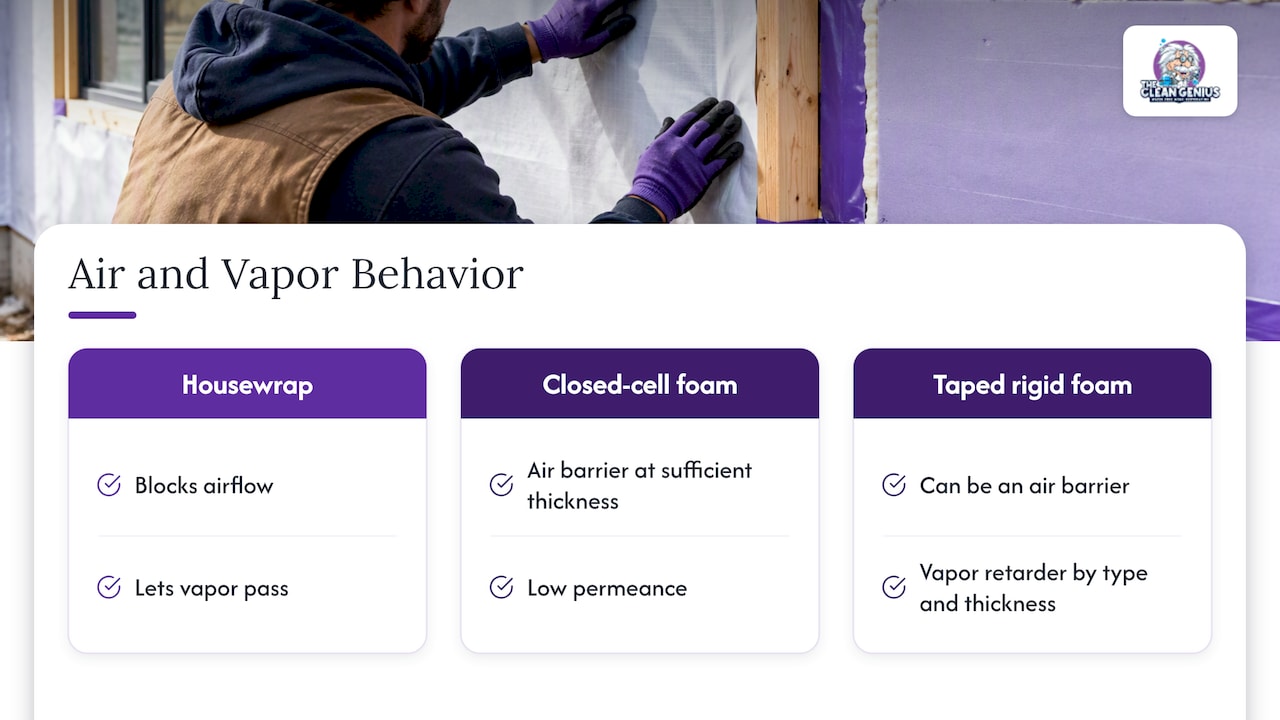
Yes. Many housewraps are designed to block airflow while letting vapor pass through. DuPont’s Tyvek HomeWrap data sheet describes a product that meets ASTM E2556 for vapor-permeable water-resistive barriers and ASTM E1677 and E2357 for air barrier performance. That combination is the point: stop the wind and the bulk moisture, but let the wall dry to the outside.
So when someone asks “Is Tyvek an air barrier?”, the accurate answer is that it can be, when it is a product rated for it and its seams, edges and penetrations are properly taped and flashed. A wrap that is stapled up loosely and left with open seams is a water-resistive layer at best.
Other materials blur the lines too. Closed-cell spray foam is both an air barrier and a low-permeance layer at sufficient thickness. Taped rigid foam sheathing can be an air barrier and, depending on thickness and type, a vapor retarder. Building America’s sheathing guide explains why permeance matters when you judge the whole wall’s vapor strategy.
Why Chicagoland is a special case
The Chicago area sits in Climate Zone 5A: cold winters, hot humid summers. That creates vapor drives in both directions. In winter, moisture pushes from the heated, humid interior toward the cold exterior. In summer, sun-heated siding and humid air can push moisture inward.
A Class I layer on the interior can handle the winter push but then traps moisture that gets in by any other route: a roof leak, a window flashing failure, a plumbing drip, or summer inward drive. The wall can no longer dry toward the inside. The building science guidance is to avoid Class I vapor control layers on the interior in most wall assemblies and favor Class II or III approaches that let the wall dry.
Two practical consequences for Chicagoland owners:
- Code and best practice are not always the same thing. Older codes and older builders often defaulted to a polyethylene sheet under the drywall. Current building science says the right answer depends on the whole assembly, including exterior insulation, sheathing type and cavity insulation. Ask a qualified local contractor or building professional before sealing wall cavities with plastic.
- Adding exterior insulation changes the math. The Building America guide for high-performance 2×4 walls in Climate Zones 3 to 5 notes that adding exterior insulation changes the moisture management strategy and calls for different vapor control methods and flashing details. A warmer cavity lowers condensation risk in winter.
The EPA’s moisture control guidance frames it as three principles: control liquid water, limit humidity and vapor migration by airflow and diffusion, and design so materials can dry. Note that blocking everything is not on the list.
Where the mistakes show up in real houses
We are a water and mold restoration company, not a building envelope designer, but we see the downstream result of these mix-ups in homes across Chicagoland. The patterns are consistent.
The attic
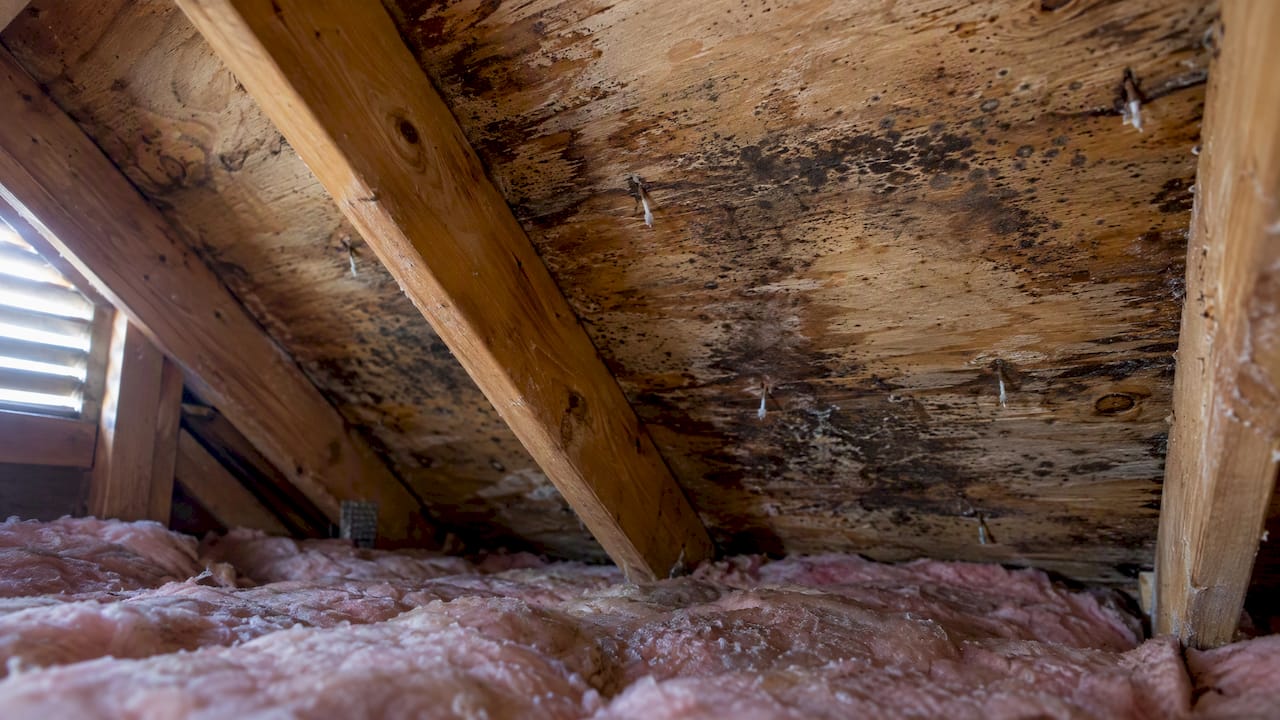
The attic is the most common place air leakage turns into a moisture problem. Warm indoor air escapes through recessed lights, the attic hatch, chimney chases and top plates. It hits cold roof sheathing and condenses, and you end up with damp insulation, frost on nails and dark mold on the underside of the roof deck. Adding more insulation over unsealed leaks does not fix it. The air sealing guide makes the same point: insulation is like a wool sweater, and wind still goes through it.
If you suspect this, read our guides on why attic moisture causes mold and attic mold prevention. If you are planning new insulation, our piece on attic insulation types for homeowners who air seal first covers the order of operations.
Walls with plastic behind the drywall
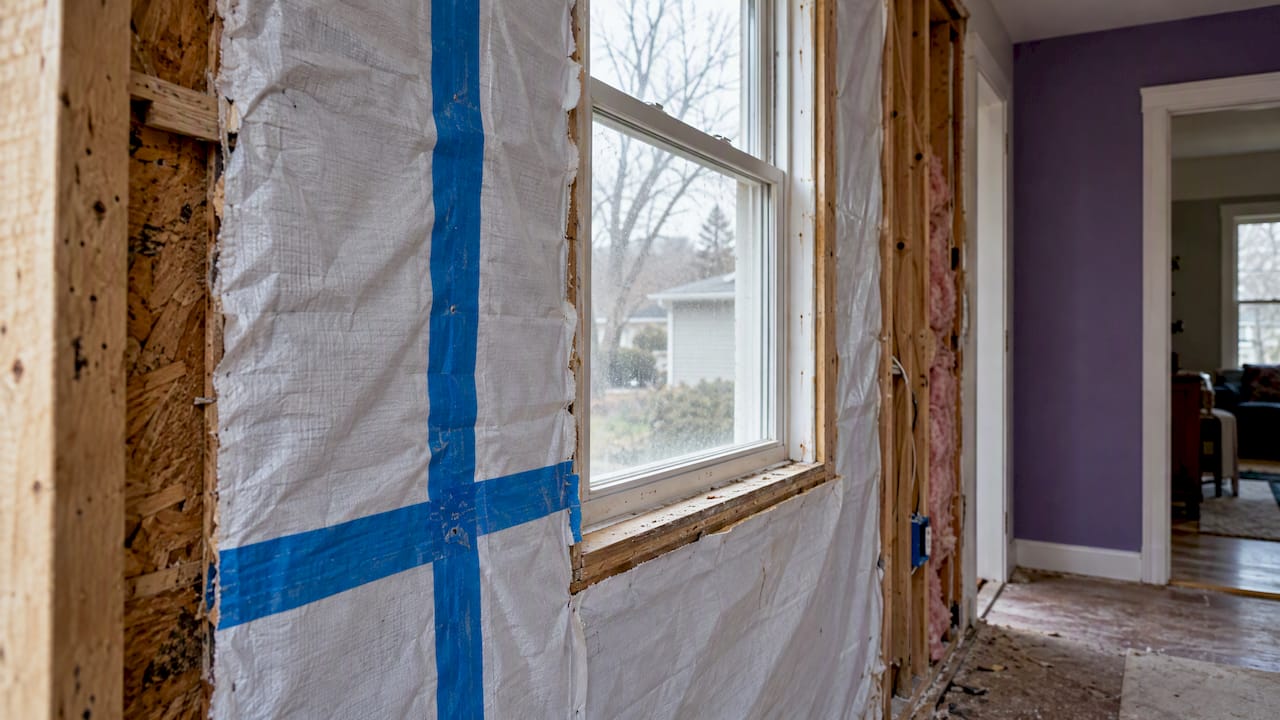
In a renovation, you open a wall and find a polyethylene sheet stapled to the studs. If the exterior sheathing behind it is stained or the bottom plate is dark, the plastic may have held moisture in. Replacing it with another layer of plastic, or adding a vinyl wallcovering on top of it, can repeat the problem.
Basements and below-grade walls
Basement walls get moisture from the soil and from indoor humidity condensing on cool concrete. Plastic sheeting taped to a wet foundation wall is a common DIY move, and it can hide a leak while keeping the material wet. If you see seepage, treat it as a water intrusion problem first. A basement window well leak is one example of a source that no barrier will fix.
Winter humidity
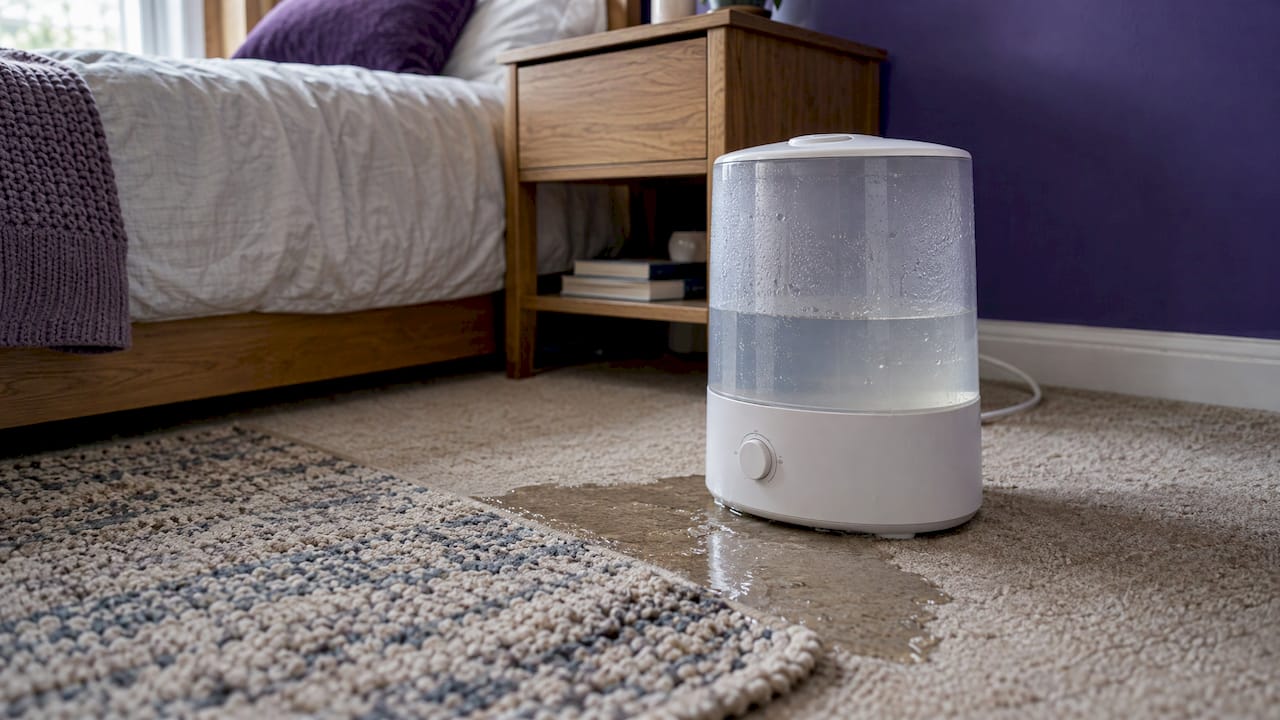
High indoor humidity raises vapor pressure and makes every leak worse. Aim for a measured, moderate level rather than guessing. HVAC specialists recommend keeping winter indoor humidity near 50% and measuring first, though in a cold Chicago January, lower settings are often needed to avoid window condensation. Watch your windows: if they fog or drip, your house is telling you something.
A homeowner’s decision guide
Use these questions to figure out what you are dealing with.
- Is liquid water getting in? Roof leak, plumbing, window or foundation. Fix this first. No barrier handles liquid water coming from a failure.
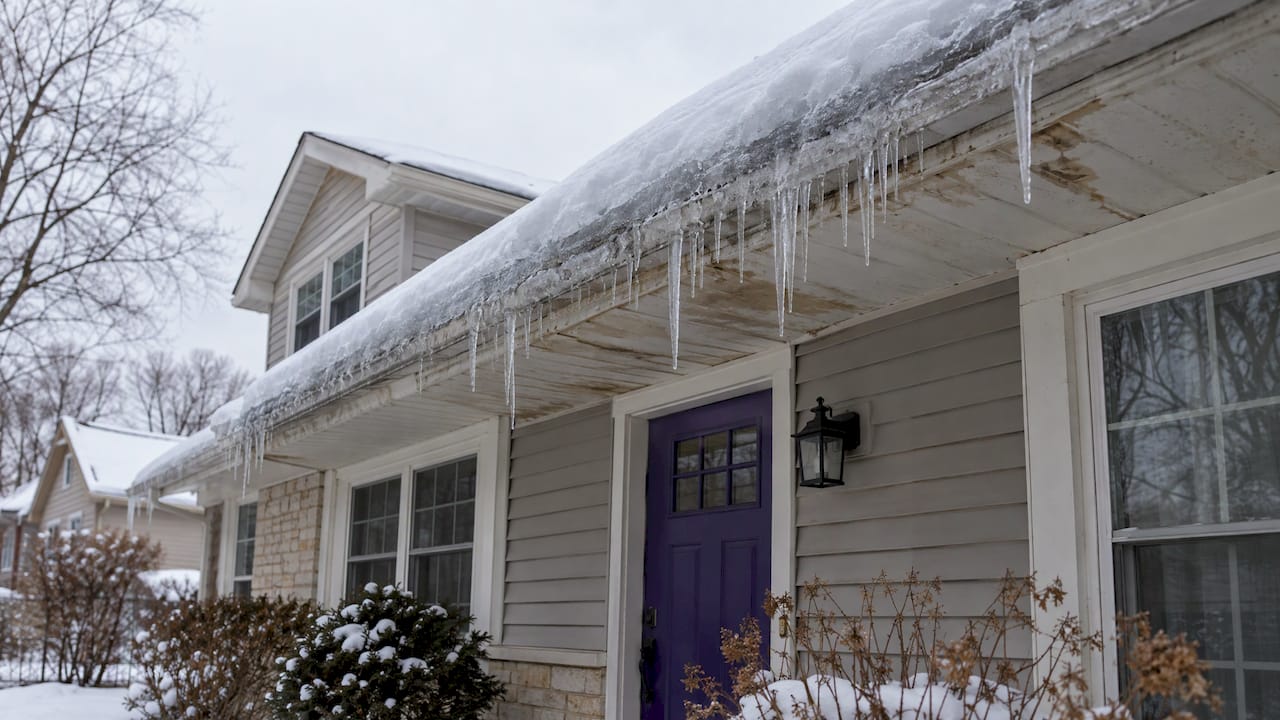
- Are there air leaks? Drafts, dust streaks on insulation, cold spots on walls, ice dams. Air seal before adding insulation or any vapor control.
- Is the house too humid? Measure with a hygrometer. Address ventilation and sources like unvented dryers or bathrooms.
- What is in the wall? Before adding plastic, paint with a low-perm product or any membrane, know your wall’s materials and whether it can dry in at least one direction.
- Are you adding exterior insulation or re-siding? That is the best moment to install a continuous, taped, vapor-permeable air and water control layer.
A useful rule from the research: you want an airtight envelope and walls that can breathe if water gets in. Locking moisture inside with impermeable layers is a primary driver of modern mold remediation jobs.
Our perspective
We are a family-owned restoration company, and we come to this topic from the wet end. When a homeowner calls us about mold in an attic or a damp wall, the cause is rarely a missing vapor barrier. More often, warm air has been leaking into a cold space for years, or a leak has soaked a wall that then could not dry.
Our view is simple. Stop the water, seal the air, and let the assembly dry. Do not add layers to a wall that is already wet, and do not close a wall back up until it is dry and the source is found. That is why our work starts with locating the moisture, measuring it and drying it properly, and why we explain the cause to you before we talk about any repair. When mold is involved, we use Pure Cloud dry-fog technology as part of remediation, and we work with your insurance directly when a covered loss is involved.
If you are planning an insulation or air sealing project, we would rather you get the sequence right the first time. Moisture problems are cheaper to prevent than to remediate.
— Jim
When barrier problems become a restoration job
Some signs mean you have moved beyond a building-science question:
- Visible mold on attic sheathing, framing or insulation
- Wet or stained drywall that returns after painting
- A musty smell in a closed wall or a finished basement
- Insulation that is matted, dark or damp
- Water staining after a roof leak or burst pipe
At that point, the wet materials need to be dried or removed, and any mold properly contained. For attic insulation with growth, our guide on mold on attic insulation and the EPA 10 sq ft rule will help you judge scale. For wall and ceiling moisture, see how we use moisture meters and drying logs on drywall. If you are weighing a DIY approach, professional vs DIY mold removal explains where the line sits.
Need help with moisture damage in your home?
The Clean Genius serves homeowners across Chicagoland, from Arlington Heights and Schaumburg to Naperville and Wheaton, and we are available 24/7 for emergencies. If you have found mold, a wet wall or damaged attic insulation, we can assess it on site and walk you through the options. See our mold removal and remediation services or our water damage restoration services, or start at thecleangenius.com.
FAQ
What is the difference between an air barrier and a vapor barrier?
An air barrier stops bulk airflow through the building enclosure. A vapor barrier, or vapor retarder, limits the slow diffusion of water vapor through materials. Air movement carries far more moisture into walls than diffusion does, so the two should never be treated as the same layer.
Should I install a vapor barrier in my Chicago-area home?
Not automatically. In Climate Zone 5A, the guidance is to avoid Class I plastic sheeting on the interior of most walls, because it can prevent drying. The right choice depends on your wall assembly, so check with a qualified local building professional before closing up any cavity.
Is Tyvek an air barrier?
Some Tyvek products are rated for air barrier performance and are also vapor-permeable, which lets the wall dry outward. It only works as an air barrier when the seams, edges and penetrations are sealed and installed to the manufacturer’s instructions.
Is insulation an air barrier?
No. Fiberglass batts and blown-in cellulose are air-permeable, so air moves through them. You need a separate sealed air barrier, such as taped sheathing, sealed drywall or spray foam, in contact with the insulation.
Can a vapor barrier cause mold?
Yes, if it traps moisture in a wall that gets wet from another source such as a roof leak, plumbing drip or air leakage. Mold can then grow on the wet side of the plastic. If you suspect this, have the wall opened and tested rather than adding another layer.
Sources
- Building Enclosure: Air Barriers vs Vapor Barriers, Building Science Education (U.S. Department of Energy)
- BSC Information Sheet 310: Vapor Control Layer Recommendations (Building America)
- Building America Best Practices Vol. 10: Air Sealing, A Guide for Contractors to Share with Homeowners
- Guide to Insulation Sheathing (Building America)
- Construction Guide: Next Generation High Performance Walls, Climate Zones 3-5, 2×4 Walls
- Moisture Control Guidance for Building Design, Construction and Maintenance (EPA)
- DuPont Tyvek HomeWrap product data sheet