
Replacement Cost Value almost always pays more than Actual Cash Value because RCV skips depreciation entirely, while ACV subtracts it based on your item’s age and condition. RCV claims typically arrive in two payments; ACV claims arrive as one. Before you assume you’re covered either way, pull out your declarations page and check whether your dwelling and personal property sections list ACV or RCV. That one line determines what check you’ll actually receive.
TL;DR:
- Replacement cost value typically pays more and in two installments, but homeowners must document repairs to receive the recoverable depreciation payment.
- Actual Cash Value deducts depreciation based on the item’s age, wear, and condition, often leaving homeowners short of full replacement costs.
- Policies usually value the dwelling as RCV but may default to ACV for personal property and roofs older than 15 to 20 years, unless endorsements are added.
- Proper documentation, including detailed invoices and timely notifications, is crucial to ensure full recovery under either valuation method.
- Insurance claims can impact future premiums and renewal values, with RCV claims generally resulting in higher premiums due to larger payouts.
Table of Contents
- Understanding ACV: What Actual Cash Value Really Pays
- Understanding RCV: How the Two-Stage Payout Works
- The Math: Two Examples That Show the Real Gap
- Where ACV and RCV Show Up on Your Policy
- Choosing Between ACV and RCV: What Actually Matters
- Your Step-by-Step Checklist After a Loss
- How Restoration Contractors Support Your RCV Claim
- Renewal Time: How Your Valuation Choice Follows You
- Fighting a Depreciation Decision You Disagree With
- Where ACV and RCV Both Fall Short
- What Homeowners Consistently Get Wrong Here
- How The Clean Genius Helps You Recover Every Dollar You’re Owed
- Sources
Understanding ACV: What Actual Cash Value Really Pays
Actual cash value is the replacement cost of your damaged property minus depreciation, calculated at the moment of the loss. The National Association of Insurance Commissioners defines it as reimbursement for current market value after depreciation, not the price of buying something new.
Depreciation gets calculated using a few standard factors:
- Age of the item or structure component
- Wear and tear from normal use
- Expected useful life for that category of item (a roof and a laptop depreciate on very different schedules)
- Condition at the time of the loss, including any pre-existing damage
Because ACV factors in all of that, the check you get rarely covers what a replacement actually costs today. That gap is the real risk with ACV coverage, and it’s the reason experts warn that cumulative depreciation after a major loss, like a house fire, can leave homeowners far short of what they need to rebuild.
Understanding RCV: How the Two-Stage Payout Works
Replacement cost value covers what it costs to replace your damaged property with something of like kind and quality, brand new, with no deduction for depreciation. It excludes land value and doesn’t track fluctuating market prices; it’s strictly about materials and labor to rebuild or replace, according to the NAIC.
Here’s what usually happens after you file an RCV claim:
- Insurer pays the ACV amount first. Even on an RCV policy, most carriers cut an initial check based on depreciated value, according to North Carolina’s Department of Insurance.
- You repair or replace the property. This is where documentation matters most.
- You submit proof. Contractor invoices or store receipts go to the insurer showing the work was completed.
- Insurer releases recoverable depreciation. The difference between the ACV check and full replacement cost gets paid out as a second payment.
- You may need to notify the insurer early. Some carriers require a formal “intent to repair” notice, sometimes within 180 days of the loss.
Miss that documentation step, and the second check never comes.
The Math: Two Examples That Show the Real Gap
Numbers make this concrete faster than definitions do.
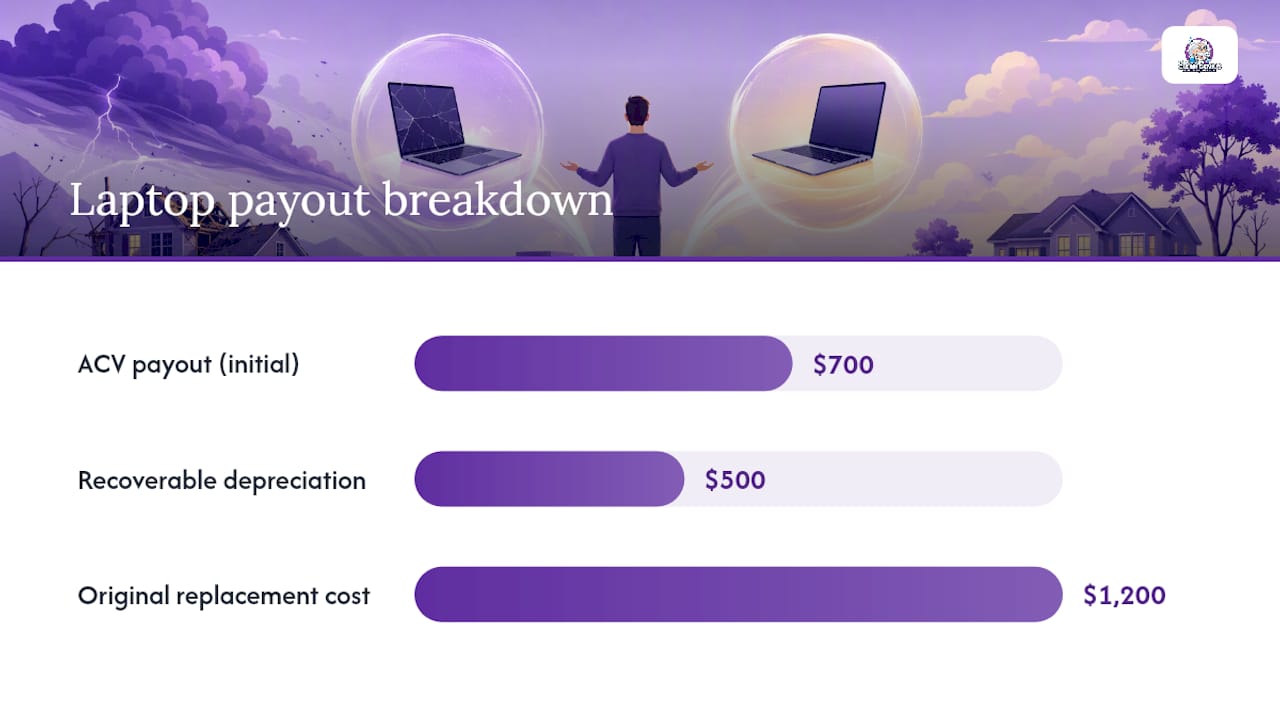
A damaged laptop, three years old. Say it cost $1,200 new and has depreciated to $700 by the time it’s damaged. Under ACV, you receive $700 minus your deductible. Under RCV, the insurer first cuts a check for that same $700, then releases the remaining $500 (minus your deductible, applied once) after you buy a replacement laptop and submit the receipt.
A roof, 12 years old, destroyed by wind. Replacing it costs $18,000. RCV pays the initial $10,800, then the remaining $7,200 once the new roof is installed and invoiced.
That second payment under RCV is never automatic. Skip the invoice, and:
- The insurer has no proof the work happened
- Recoverable depreciation typically stays unpaid, according to NerdWallet’s analysis
- Your “RCV policy” effectively pays out like an ACV policy
Where ACV and RCV Show Up on Your Policy
Most standard HO-3 homeowners policies split valuation methods by category, and the defaults surprise a lot of people.
- Dwelling (Coverage A) is usually RCV on an HO-3 policy, per MoneyGeek’s breakdown.
- Personal property (Coverage C) often defaults to ACV unless you’ve added an endorsement.
- Older homes or HO-8 policies may value the dwelling itself on an ACV basis, since replacement cost can exceed market value on older construction.
- Roofs are a common exception. Insurers frequently cap roofs older than 15 to 20 years at ACV, even when the rest of the dwelling carries RCV.
- Endorsements can change your defaults. An RCV endorsement for contents, scheduled property coverage for high-value items, or extended/guaranteed replacement cost riders all shift the math in your favor, usually for a modest premium bump.
Check your declarations page section by section. Dwelling, other structures, and personal property can each carry a different valuation method on the same policy.
Choosing Between ACV and RCV: What Actually Matters
Neither option is objectively better. It depends on your home’s age, your contents’ value, and how much risk you’re willing to carry.
RCV makes sense when:
- Your home or belongings are newer and worth replacing at full price
- You have high-value contents (electronics, furniture, appliances) where depreciation would hit hard
- You’d rather pay more now than risk a shortfall after a major loss
ACV makes sense when:
- You’re managing a tight premium budget
- Your contents are older and already worth less than replacement cost
- You’re insuring a rental property or secondary home where full replacement isn’t the goal
The premium gap is real but variable. NerdWallet’s sample quotes found RCV upgrades adding anywhere from $260 to $2,200 a year, depending on location and home size. Upgrading personal property specifically to RCV tends to run cheaper, often $25 to $50 a year as an endorsement.
Pro Tip: Run the math on your specific contents before assuming ACV saves you money. If your electronics, appliances, and furniture are under five years old, the depreciation hit under ACV can easily exceed what an RCV endorsement would have cost you in premium.
Your Step-by-Step Checklist After a Loss
Recoverable depreciation only gets paid to homeowners who document the claim correctly. Follow this order:
- Document everything immediately. Photos, video, and a written inventory of damaged items, before cleanup starts.
- Notify your insurer promptly. Delays can complicate both the ACV and RCV portions of your claim.
- State intent to repair or replace in writing, if your policy requires it, and note the deadline your insurer gives you.
- Get written estimates from licensed contractors before work begins.
- Keep every receipt and invoice for repairs, materials, and replacement items.
- Submit proof of completed work to trigger the recoverable depreciation payment.
- Track your deadline. Some insurers cap the window to claim recoverable depreciation at 180 days from the date of loss.
A checklist built for water damage claims specifically walks through the documentation side in more detail, and it’s worth reviewing before you file anything. Homeowners who skip step six are the ones who call their insurer months later asking why the second check never showed up.
How Restoration Contractors Support Your RCV Claim
Restoration companies sit at the exact point where documentation determines payout. A detailed scope of work, a line-itemed invoice, and dated before-and-after photos give the insurer exactly what it needs to release recoverable depreciation without a fight.
Homeowners who bring in a restoration professional early, rather than after a dispute starts, tend to see fewer delays. The invoice becomes the proof of replacement the policy requires, and a well-documented scope makes it harder for an adjuster to argue the work wasn’t necessary or wasn’t completed as claimed.
- Detailed pre- and post-work documentation
- Line-itemed invoices that match insurer requirements
- Direct coordination with adjusters to keep claims moving
- 24/7 emergency response so damage gets documented before it worsens
Companies with 25-plus years of combined experience handling insurance coordination know which paperwork triggers a fast release and which invoices get kicked back for missing detail.
Renewal Time: How Your Valuation Choice Follows You
Your ACV or RCV election doesn’t just affect one claim. It follows you into renewal, and it can shape your premium for years afterward.
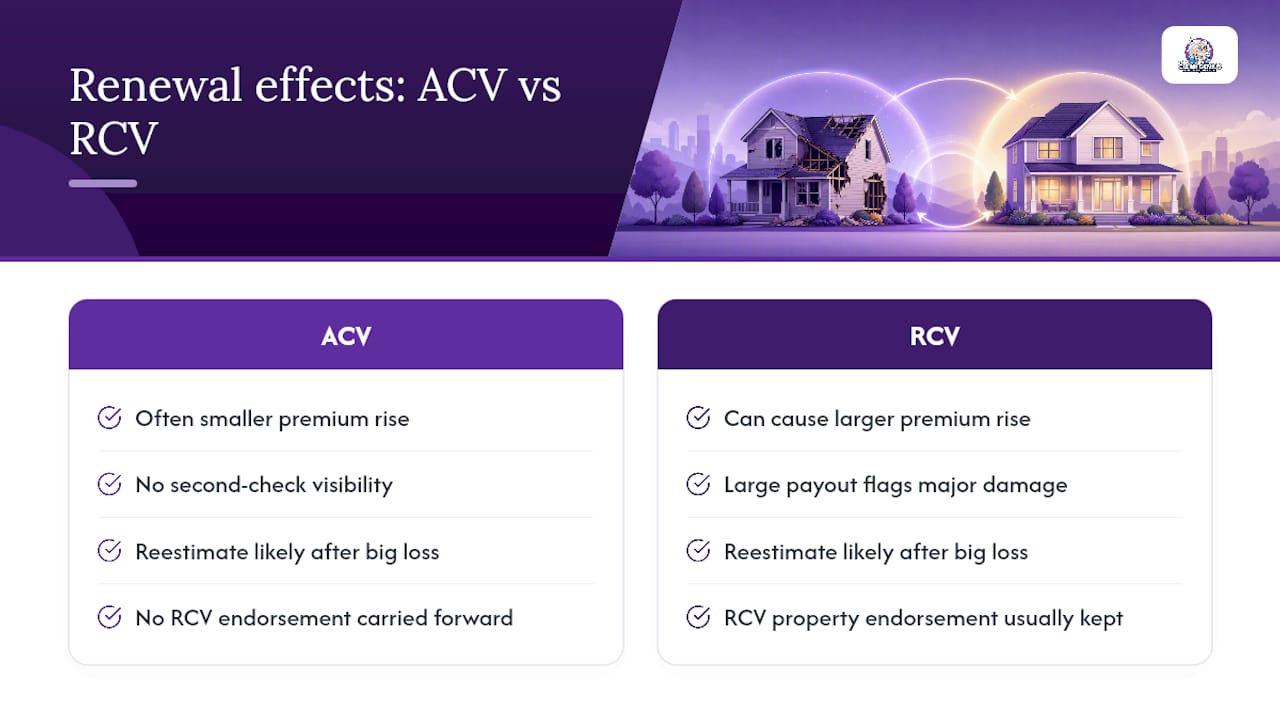
Filing an ACV claim tends to be cheaper for the insurer since there’s no second payout to track, which sometimes translates into a smaller premium increase at renewal compared to a full RCV claim on the same loss. But the bigger renewal factor is usually claim frequency and severity, not valuation method alone. A large RCV payout on a roof claim, for instance, can trigger a premium reassessment simply because the insurer now sees your home as having sustained major damage, regardless of whether the payout came in one check or two.
There’s a second, quieter effect: after any total-loss or near-total-loss claim, insurers frequently reassess your dwelling’s replacement cost estimate for the next policy period. If construction costs in your area have climbed, and they usually have, your coverage limit and premium can both rise at renewal even without a new claim. Homeowners who upgraded personal property to RCV also tend to see that endorsement carried forward automatically, so the modest annual cost becomes a permanent line item unless you actively remove it.
If you’re shopping for a new policy after a claim, ask directly how the insurer’s underwriting treats your claim type. Some carriers weigh water and fire claims more heavily than others, and a company that handled your restoration and insurance coordination well the first time can often flag which pitfalls to expect at renewal.
Fighting a Depreciation Decision You Disagree With
Depreciation schedules aren’t always applied fairly, and insurers know most policyholders never push back.
Start by requesting the itemized depreciation worksheet from your adjuster. Insurers are generally required to show how they calculated depreciation on each item or component, not just hand you a lump reduced number. If the worksheet applies a depreciation rate that seems too aggressive for the item’s actual age or condition, that’s your opening.
Practical steps that actually move the needle:
- Compare against manufacturer or industry lifespan data. If your roof was rated for 30 years and the insurer depreciated it as if it had a 15-year lifespan, that discrepancy is worth challenging directly.
- Get an independent contractor estimate. A second, detailed scope of work from a licensed contractor often carries more weight than a phone call disputing the number.
- Request a written explanation for any depreciation rate that seems inconsistent with similar items elsewhere in the claim.
- Escalate to a supervisor if the adjuster won’t budge, then file a formal appeal through the insurer’s internal process.
- Contact your state department of insurance if the insurer won’t reconsider. Consumer divisions like OPIC in Texas exist specifically to help homeowners who feel a valuation was applied incorrectly.
Most successful appeals come down to paperwork, not persuasion. An adjuster is far more likely to revise a number when you hand over a competing estimate than when you simply argue the original figure feels low.
Where ACV and RCV Both Fall Short
Neither valuation method covers everything, and knowing the gaps matters as much as knowing the definitions.
RCV won’t pay full replacement cost if your dwelling coverage limit is too low to begin with. If your policy caps at $300,000 and it actually costs $380,000 to rebuild after a total loss, RCV language doesn’t rescue you from being underinsured. That’s a coverage-limit problem, not a valuation-method problem, and it’s worth reviewing your limit against current local construction costs every couple of years.
Roofs are the most common blind spot. Even a policy with RCV across the board frequently reverts to ACV for roofs past a certain age, and homeowners often don’t discover this until after a claim. Some exclusions apply regardless of valuation method entirely, like gradual damage, wear and tear, or maintenance neglect, none of which either ACV or RCV was ever designed to cover.
Personal property sublimits create another gap. Even with an RCV endorsement on contents, categories like jewelry, art, and collectibles often carry separate, lower sublimits that RCV doesn’t override. And recoverable depreciation itself has a shelf life: most policies set a window, commonly around six months, after which the right to collect the withheld difference simply expires if you haven’t completed repairs. Read your policy’s exclusions section as carefully as its valuation section. The definitions matter less than the fine print sitting underneath them.
What Homeowners Consistently Get Wrong Here
The conventional advice treats ACV versus RCV like a simple upgrade decision: pay more, get more. That framing misses the part that actually determines outcomes, which is what happens after the loss, not before it.
An RCV policy with a homeowner who never submits invoices pays out exactly like an ACV policy. I’d argue the valuation method on your declarations page matters less than most articles suggest, and the documentation process matters more than almost anyone tells you upfront. Insurers aren’t hiding this. They’re just not volunteering it either.
If you take one thing from this, prioritize building a paper trail before you file, not after an adjuster asks for one. Photograph everything, save every estimate, and treat the receipt from your contractor as the single most valuable document in the entire claim. The gap between ACV and RCV on paper is often smaller than the gap between homeowners who documented their claim well and those who didn’t.
— Jim
How The Clean Genius Helps You Recover Every Dollar You’re Owed
Getting the full RCV payout depends on documentation that holds up under an adjuster’s review, and that’s exactly where a restoration company earns its place in the process. Restoration companies can provide 24/7 water damage restoration services and supply detailed scopes of work, dated photos, and itemized invoices suitable for insurance submission.

Beyond water damage, restoration teams may coordinate fire, smoke, and mold restoration with documentation standards aimed at reducing delays in recoverable depreciation claims. Such coordination with your insurance carrier can help streamline the claims process. If you’re dealing with active damage right now, request an estimate or emergency response through Thecleangenius’s water damage restoration page and get a documented scope of work started before more depreciation stacks up against you.
Sources
- What’s the difference between actual cash value coverage and replacement cost coverage?
- Actual cash value vs. replacement cost value
- Actual cash value vs replacement cost
- HO-3 policy: what homeowners should know