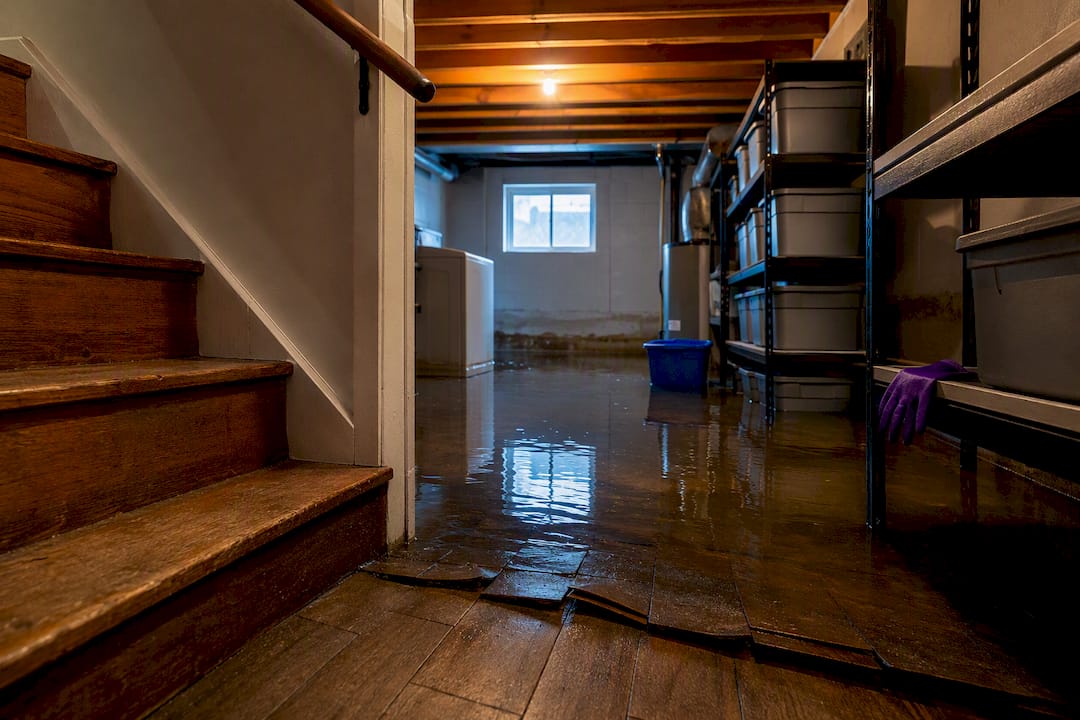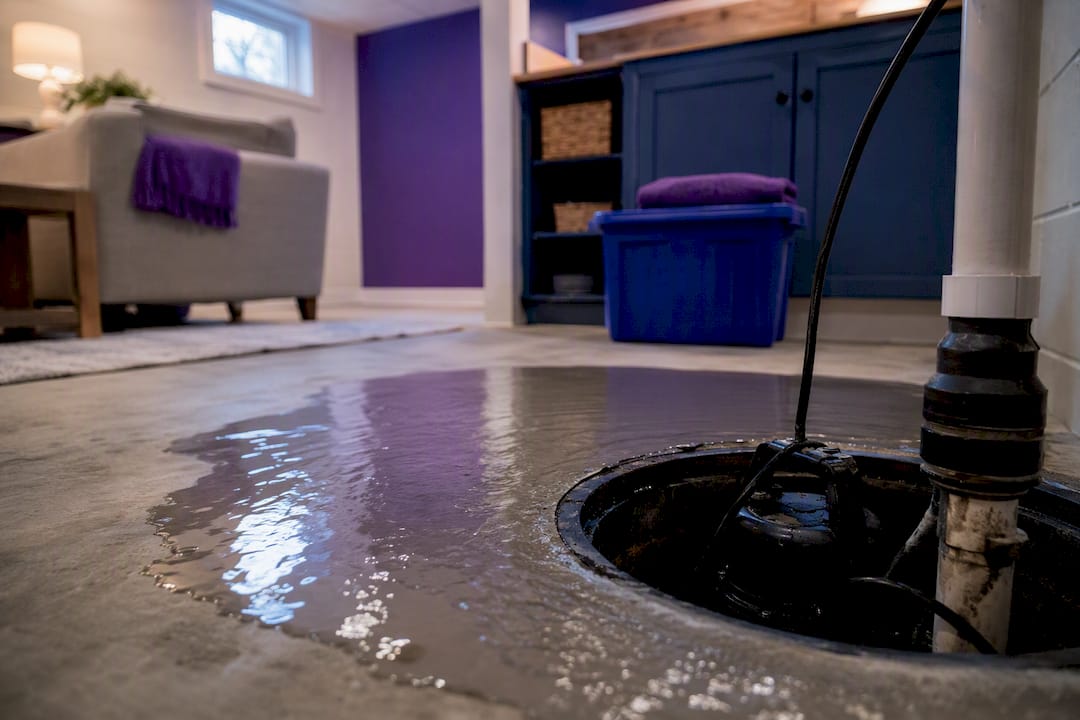

Standard homeowners insurance usually excludes sump pump backups, so a failed pump that floods your basement often leaves you paying out of pocket unless you added a water-backup endorsement. That optional add-on covers the resulting damage to floors, drywall, and belongings. It typically does not pay to replace the pump itself.
TL;DR:
- Water backup coverage typically limits payouts to between 5,000 and 25,000 dollars, covering damage to floors, drywall, and belongings but not the sump pump itself.
- Claim denials often result from the absence of an endorsement, lack of maintenance records, delayed reporting, or confusion between flood and backup damages.
- Installing a battery backup pump and water-level alarm can significantly reduce the risk of sump pump failure and consequent claim issues.
- Proper documentation, including photos, receipts, and prompt insurer contact, improves the chances of quick and successful claim approval.
- Coverage costs vary based on home risk factors like age, local infrastructure, and climate, but the premiums are generally modest compared to potential repair expenses.
Table of Contents
- Sump Pump Failure Insurance: What the Water-Backup Endorsement Actually Covers
- When Standard Homeowners Insurance Covers Water Damage (and When It Doesn’t)
- How Much the Endorsement Pays and Where the Coverage Gap Sits
- Why Sump Pump Insurance Claims Get Denied
- What to Do Immediately After Sump Pump Failure
- Sump Pump Maintenance That Keeps Claims (and Basements) Clean
- What Happens When a Restoration Crew Handles Your Claim
- How Coverage Differs From One Insurance Provider to the Next
- Choosing the Right Coverage for Your Home’s Risk Profile
- Does Adding This Coverage Raise Your Homeowners Insurance Premium?
- Author perspective: the mistakes that actually sink claims
- How The Clean Genius Handles Sump Pump Failure and Insurance Coordination
- Sources
Sump Pump Failure Insurance: What the Water-Backup Endorsement Actually Covers
The fix most homeowners need is officially called “water backup” coverage, though you’ll also see it labeled “sewer and sump pump overflow” depending on the carrier. It exists because standard homeowners policies were never built to handle backups. They’re written to cover sudden, accidental water damage from inside your home, not water that comes up through a drain or floor because a pump quit during a storm.
Progressive’s guidance on water backup describes it as an optional endorsement that steps in when your regular policy won’t. Common scenarios it addresses include:
- A sewer line backs up into your basement during heavy rain.
- Your sump pump fails or gets overwhelmed and water overflows the basin.
- A clogged drain tile system pushes groundwater back into the house.
Without this endorsement attached to your policy, all three of those situations are typically your problem to solve financially.
When Standard Homeowners Insurance Covers Water Damage (and When It Doesn’t)
Your base homeowners policy still does real work. It generally covers sudden, accidental water events that originate inside your home. Think a washing machine hose that bursts, a pipe that cracks in a cold snap, or a water heater that fails overnight and floods the utility room.
What it won’t touch:
- Water that backs up through a sewer line or sump pump system.
- Flooding from an external source like a rising river, overflowing lake, or heavy surface water pooling around your foundation.
- Damage tied to a municipal service line failure, which sometimes needs its own separate endorsement.
Flood damage from outside sources requires a distinct policy altogether, typically through the National Flood Insurance Program or a private flood carrier, since Policygenius notes water-backup coverage does not substitute for flood insurance. Confusing the two is one of the most common and costly mistakes homeowners make when they assume they’re covered.
How Much the Endorsement Pays and Where the Coverage Gap Sits
Once triggered, water backup coverage generally reimburses damage to your structure, flooring, drywall, and a portion of your personal property, similar to how a standard water damage claim would be handled. What it usually skips is the sump pump itself.
Liberty Mutual’s policy language confirms this split directly: the endorsement addresses the water damage a failed pump causes, not the mechanical failure of the pump.
Endorsement limits typically run from $5,000 to $25,000, according to Policygenius, though availability and pricing shift by insurer and state. A few things to weigh when picking a limit:
- Estimate worst-case repair costs for your specific basement: flooring, drywall, trim, and any finished space.
- Add in replacement value for stored belongings, furniture, or a finished home office if your basement is used that way.
- If you want the pump itself insured against sudden mechanical failure, look at an equipment breakdown endorsement as a separate line item, since that’s the coverage built for hardware failure rather than water damage.
Choosing a limit near the low end because it’s cheaper is how homeowners end up covering a five-figure repair gap out of pocket.
Why Sump Pump Insurance Claims Get Denied
Insurers deny more sump pump claims over preventable issues than over legitimate coverage gaps. Understanding the common triggers protects you before a failure ever happens.
- No endorsement on file. If water backup coverage was never added, the claim gets denied on the exclusion alone, regardless of how sudden or severe the damage was.
- Flood versus backup confusion. Water that entered from outside the home, not through a backed-up drain or failed pump, falls under flood insurance, and a homeowners claim for it will be rejected.
- Neglected maintenance. Westfield points out that adjusters look for evidence of a maintained system. A pump that failed because of years of neglect reads very differently than one that failed suddenly.
- Delayed mitigation or reporting. Waiting days to report damage or call a restoration crew lets an insurer argue the loss worsened due to inaction.
- Illegal plumbing connections. Sump systems tied into code-violating drainage setups can void coverage outright.
Keep maintenance logs, receipts for pump service or replacement, and dated photos of your equipment. That paper trail is often the difference between an approved claim and a denied one.
What to Do Immediately After Sump Pump Failure
The first few hours after discovering a flooded basement determine how smoothly your claim moves.
- Cut power to affected outlets if water is anywhere near electrical systems, and confirm the area is safe to enter.
- Stop the source if you can. Check the breaker, float switch, and discharge line before assuming the pump is a total loss.
- Photograph and video everything before you move or discard anything, including the pump itself, the water line on the walls, and any damaged belongings.
- Gather documentation: maintenance receipts, the pump’s serial number and purchase date, and any prior service records.
- Call your insurer to open a claim and ask directly whether water backup coverage is active on your policy.
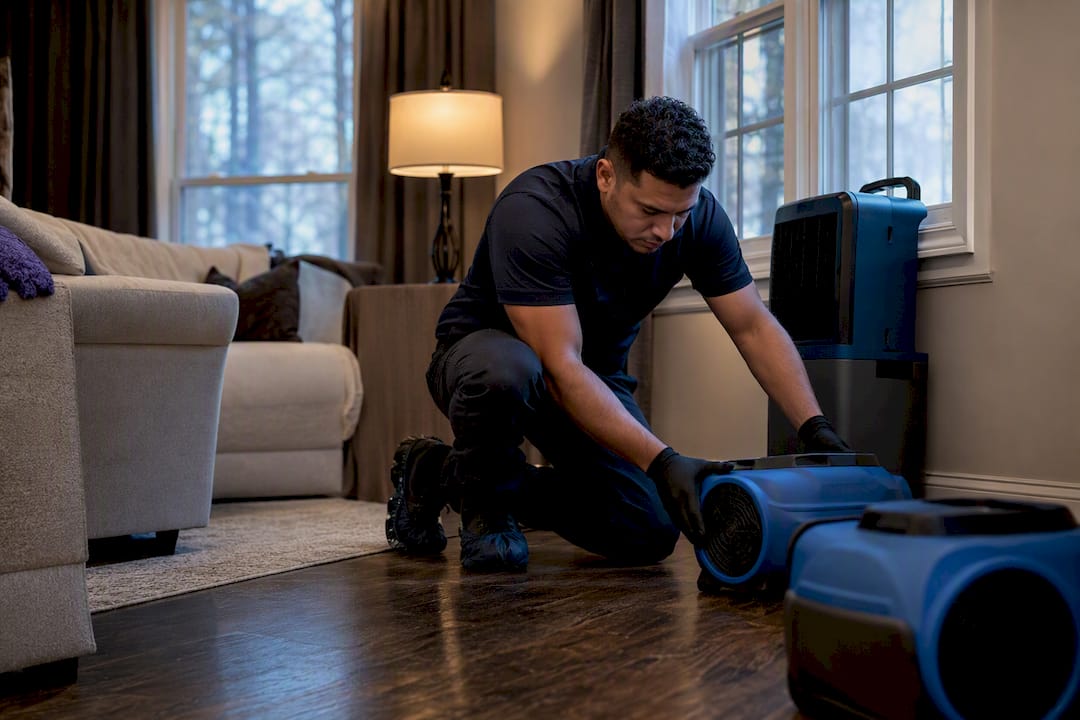
- Bring in a restoration contractor for extraction and drying as soon as possible, since standing water and trapped moisture compound damage by the hour.
Pro Tip: Take a wide shot of the entire room before touching anything, then close-ups of the waterline and the pump. Adjusters weigh photographed timelines heavily when deciding how quickly you acted.
A basement flood cleanup checklist covering the first 24 hours can help you move through these steps without missing something an adjuster will ask about later.
Sump Pump Maintenance That Keeps Claims (and Basements) Clean
Most failures trace back to the same handful of preventable causes: dead batteries, stuck float switches, or a pump that simply wasn’t tested in years.
- Test the pump manually every three to four months by pouring water into the basin and watching it cycle.
- Install a battery backup system, especially if you live somewhere prone to power outages during storms, since Progressive specifically recommends this as a low-cost way to cut overflow risk.
- Add a water-level alarm that alerts you before the basin overflows, not after.
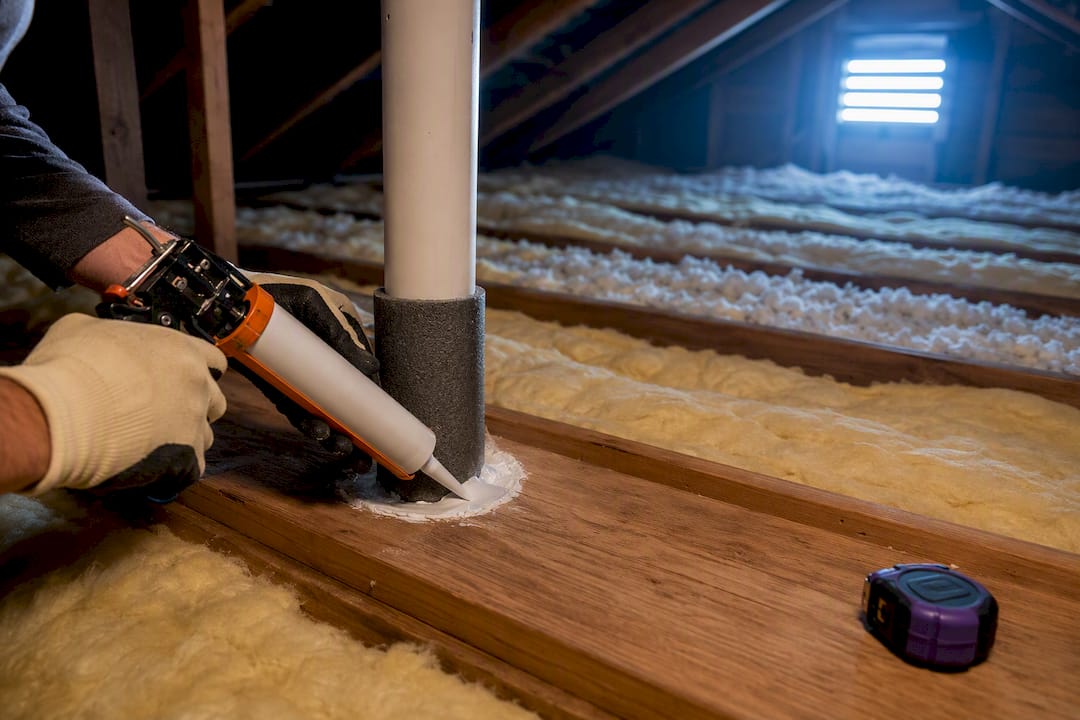
- Check the discharge line and install a check valve to stop backflow into the basin.
- Consider a secondary pump as backup for the primary unit in high-risk homes.
Pro Tip: If your area loses power more than once or twice a year, a battery backup pump isn’t optional. It’s the cheapest insurance policy you’ll ever buy, and it works even when the grid doesn’t.
What Happens When a Restoration Crew Handles Your Claim
Certified restoration teams do more than extract water. On arrival, crews run moisture mapping to find water that has already migrated into wall cavities and subfloors, areas a homeowner would never catch on a visual inspection alone.
That documentation becomes the backbone of your claim. Typical contractor deliverables include:
- Moisture readings and thermal imaging showing the true extent of water intrusion.
- Time-stamped photos of the loss before, during, and after mitigation.
- A written scope-of-work estimate itemizing what needs to be dried, removed, or replaced.
Some contractors bill the insurer directly once a claim is approved, while others require homeowners to pay upfront and seek reimbursement. Ask which model a company uses before you sign anything.
Restoration companies that provide moisture mapping and a written scope of work often speed adjuster approvals for mitigation expenses, because the documentation removes the guesswork adjusters otherwise have to do themselves.
Mold risk climbs fast once water sits in a basement for more than 24 to 48 hours, which is why mold remediation after a sump failure often gets scheduled in the same visit as extraction rather than as a separate, later call.
How Coverage Differs From One Insurance Provider to the Next
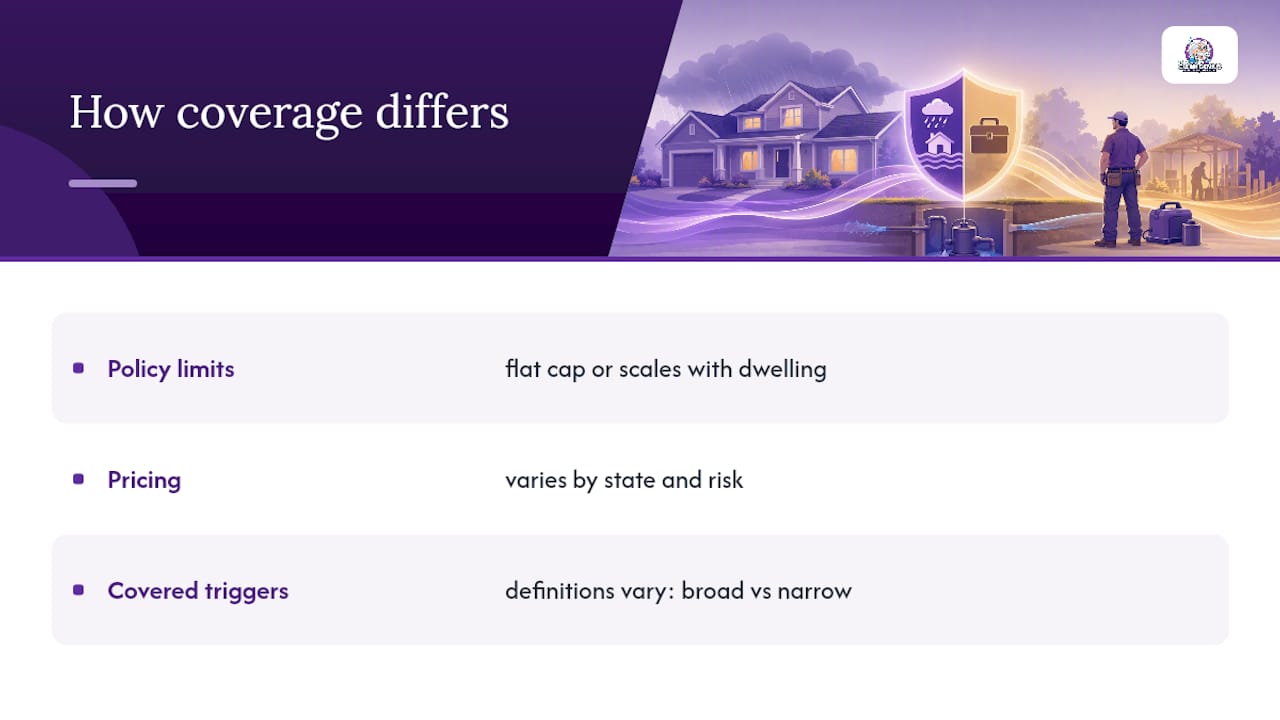
Not every carrier treats water backup the same way, and the differences show up in three places: limit options, pricing, and what counts as a covered trigger.
Some insurers cap water backup endorsements at a flat number regardless of your home’s value, while others scale the limit alongside your dwelling coverage. A few carriers bundle water backup automatically into higher-tier policy packages, while others sell it strictly as an add-on you have to request by name. That distinction matters because homeowners sometimes assume they’re covered simply because they have a comprehensive-sounding policy, only to find the endorsement was never actually added.
Pricing also varies by state and by how the insurer assesses your specific flood and backup risk. A home in a neighborhood with older municipal sewer infrastructure or a history of local basement flooding will typically see a higher premium for the same coverage limit than a home in a lower-risk area.
Definitions of what triggers coverage differ too. Some policies define “sump pump failure” broadly enough to include overflow from any cause, mechanical or storm-related. Others narrow it to specific circumstances, like requiring the pump to have been in working order at the time of loss. Reading the endorsement’s exact policy language, not just the marketing summary on an insurer’s website, is the only way to know precisely what your specific policy promises. When in doubt, ask your agent directly whether “water backup” and “sump pump overflow” are treated as the same trigger or listed as separate, sometimes differently limited, coverages within your policy.
Choosing the Right Coverage for Your Home’s Risk Profile
Picking a coverage limit isn’t a one-size decision. It should follow a quick, honest assessment of your specific property.
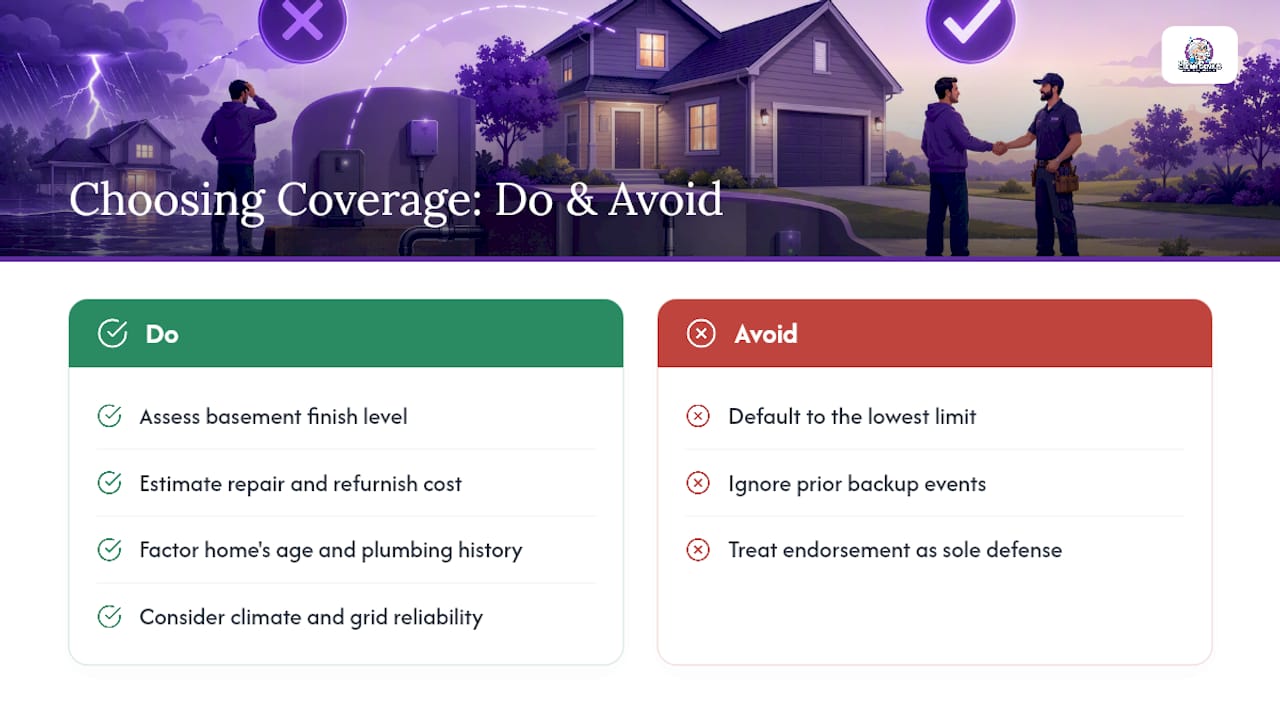
Start with your basement’s finish level. An unfinished basement with a concrete floor and minimal storage carries far less exposure than a finished lower level with carpet, drywall, and a home office. Estimate what it would cost to fully repair and refurnish that space, then use that number as your floor when selecting an endorsement limit rather than defaulting to whatever the lowest option is.
Factor in your home’s age and plumbing history. Older homes with aging sewer laterals or a history of previous backups are statistically more likely to see a repeat event, which argues for a higher limit and possibly a secondary backup pump as a physical safeguard.
Consider your local climate and power grid reliability. Homeowners in areas prone to severe thunderstorms or extended outages face a compounded risk: the storm that floods your yard is often the same event that cuts power to your primary pump. That’s the scenario a battery backup system is built for, and it’s worth pricing into your overall risk plan rather than treating the endorsement as your only line of defense.
Finally, talk to your agent about how your specific limit compares to the typical $5,000 to $25,000 range other homeowners in your area carry. If your risk profile sits above average, it often makes sense to buy above that range rather than assume the standard limit will be enough.
Does Adding This Coverage Raise Your Homeowners Insurance Premium?
Adding a water backup endorsement does increase your premium, but the increase is modest relative to the coverage gap it closes. Because it’s typically sold as a low-cost add-on rather than a full separate policy, most homeowners see a manageable bump in their annual premium rather than a dramatic jump.
The exact increase depends on the limit you choose, your home’s location, and your insurer’s underwriting standards for basement and sewer risk in your area. A home in a region with older infrastructure or frequent storm activity will generally see a higher cost for the same limit than a home in a newer development with modern drainage systems.
It’s worth weighing that premium increase against the alternative: a denied claim for basement flood damage with no endorsement to fall back on, which can run into the tens of thousands of dollars in repair and replacement costs. Viewed that way, the added premium functions less like a expense and more like a small, predictable cost that protects against a much larger, unpredictable one.
Some homeowners also find that bundling water backup with other protective measures, like installing a battery backup pump or a water-level alarm, can influence how an insurer prices the endorsement, since those upgrades reduce the likelihood of a claim in the first place. Ask your agent directly whether documented pump upgrades affect your quote before assuming the price is fixed.
Author perspective: the mistakes that actually sink claims
The claims that get denied rarely fail because of unclear policy language. They fail because homeowners wait, skip photos, or assume flood insurance and water backup are the same thing. A quick checklist: confirm your endorsement is active, test your pump quarterly, photograph everything before cleanup, save every maintenance receipt, call your insurer same-day, and bring in a restoration crew fast. Speed and paperwork win more claims than any policy fine print.
— Jim
How The Clean Genius Handles Sump Pump Failure and Insurance Coordination
A failed sump pump doesn’t wait for business hours, and neither do we. Thecleangenius runs 24/7 emergency response across Chicagoland, which means the gap between a flooded basement and a crew on-site is measured in hours, not days, when every hour of standing water adds to your repair bill and your claim.

Our certified teams handle extraction, structural drying, and mold-prevention treatment using Pure Cloud dry-fog technology on the same visit, and we document every step with moisture readings, timestamped photos, and a written scope of work your insurer can act on immediately. That documentation is often what separates a fast claim approval from weeks of back-and-forth with an adjuster. We also work directly with insurance companies on your behalf, so you’re not stuck translating policy language while your basement sits wet.
If your sump pump has failed or you’re dealing with any basement flooding right now, start with our water damage restoration services page to see how quickly we can get a crew to your door.
Sources
- Does Home Insurance Include Water Back-up Coverage? | Progressive
- Water Backup Coverage | Liberty Mutual
- What Is Water Backup Coverage? – Policygenius
- Sump Pump Failure Insurance: What You Need To Know | Westfield