
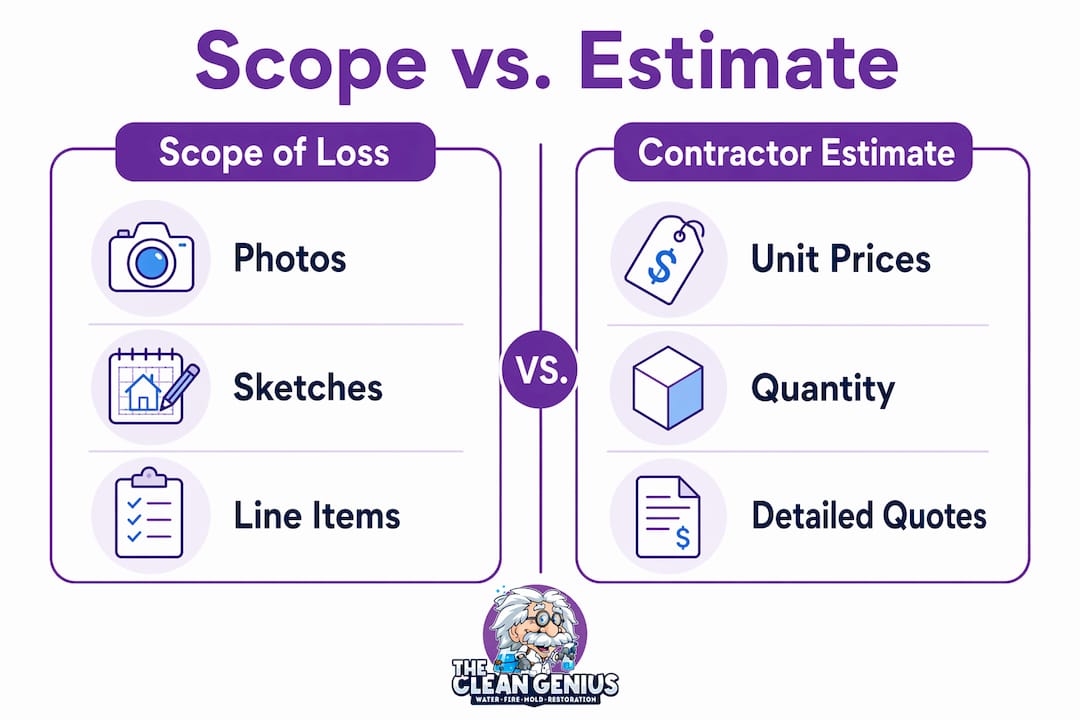
A scope of loss is the insurer’s claims document, a line-by-line inventory of every damaged component, its repair method, and its unit cost, typically built in Xactimate by the adjuster. A contractor’s estimate is a repair bid that becomes the basis for a construction contract. These two documents look similar, but they serve entirely different purposes, and confusing them is the single most common reason homeowners end up with a short payment.
The practical differences at a glance:
- Audience: The scope goes to the insurer; the estimate goes to the homeowner and contractor.
- Purpose: The scope sets the initial claim payment; the estimate prices the actual repair work.
- Format: Scopes use Xactimate line items and regional pricing; estimates may use any format.
- Legal role: The scope is a claims document; the estimate becomes a repair contract if signed.
- When to act: If your adjuster’s scope and your contractor’s estimate don’t match, address the scope first. A short scope means a short check, regardless of what your contractor charges.
If you see a mismatch, request an Xactimate-format scope or ask your contractor to submit a formal line-item supplement before any repair work begins.
Table of Contents
- What is a scope of loss and what must it contain?
- What a contractor’s estimate is and how it works
- Why the difference matters for your claim payment
- Who prepares each document and when to call a public adjuster
- What a complete scope of loss should include
- Common scoping mistakes that lead to disputes
- How to get an accurate scope and an adjuster-friendly estimate
- How long does the scoping and estimating process take?
- What to do when the insurer’s scope is short
- How Thecleangenius handles scopes, estimates, and insurance communication
- Key Takeaways
- The part most homeowners learn too late
- Thecleangenius is ready to review your scope
- Useful sources
What is a scope of loss and what must it contain?
A scope of loss is a line-item claims document that identifies every damaged component, the repair method, the quantity, and the unit cost. Adjusters build it, often in Xactimate, and carriers use it to calculate the initial payment. Think of it as the financial backbone of your claim: the quality of this document largely determines whether you get paid fairly or spend months in a dispute.
A complete scope must include:
- Measurements and quantities: Linear feet of drywall, square footage of flooring, number of ceiling tiles, all stated explicitly.
- Material specifications: Grade of flooring, drywall finish level, paint sheen, and any code-required upgrades.
- Unit costs: Xactimate pulls these from a ZIP-code pricing database, so regional labor and material rates are built in.
- Photos linked to line items: Each damaged area should have a corresponding photo that confirms the scope entry.
- Sketches or diagrams: Floor plan sketches with room dimensions prevent quantity disputes later.
- Moisture readings and drying logs: For water losses, these document the extent of saturation and justify drying-day charges.
- Narrative condition notes: A written description of pre-loss condition and how the damage occurred.
The California Department of Insurance notes that a scope differs from a finished estimate in two specific ways: it does not necessarily list prices, and it records raw counts and measurements rather than calculated quantities. That distinction matters because it means the scope is a starting point, not a final number.
Pro Tip: Insist that the adjuster’s scope include photos linked to each line item and a sketch with room dimensions. If either is missing, you have no baseline to challenge quantity errors later.

What a contractor’s estimate is and how it works
A contractor’s estimate is a repair bid. When a contractor walks your property and quotes the job, that document is their price to perform the physical work. If you sign it, it becomes a contract.
A typical estimate includes:
- Labor and material allowances: Broken down by trade (demo, framing, drywall, flooring, painting).
- Project sequence: The order in which trades will work, which affects scheduling and subcontractor costs.
- Allowances vs. line items: Some contractors use allowances for finish selections (flooring, fixtures) rather than exact line items, which can create budget surprises later.
- Contractor terms and warranties: Payment schedule, warranty on labor, and dispute resolution language.
The procedural difference is significant. The scope of loss is a claims document that determines what the insurer pays. The contractor’s estimate is a commercial agreement between you and a builder. Experts note that conflating the two is the most common error homeowners make, and it costs them money. A contractor can quote a higher amount for repairs while the adjuster’s scope only acknowledges a lower figure, leaving a substantial gap that doesn’t disappear because you signed a contract. It comes out of your pocket unless you correct the scope first.
Why the difference matters for your claim payment
The scope of loss sets the initial payment. Every line item the adjuster omits is money the carrier does not owe, at least not until you supplement. Industry data suggests that many adjuster-written scopes capture only about 50–65% of actual repair costs, leaving a frequent gap homeowners must close through supplements or appeals.
Common payment gaps include:
- Detach/reset labor: Moving a refrigerator or range to replace flooring behind it is a real labor cost. Adjusters routinely omit it.
- Wall cavity drying: If moisture penetrated behind drywall, the scope should include drying days for the cavity, not just surface readings.
- Pack-out and storage: Moving contents out of a damaged area, storing them, and returning them is a separate line item category.
- Demo and haul-away: Tear-out labor and dumpster costs are frequently underquantified.
| Claim Component | Typically in Scope of Loss | Typically in Contractor Estimate |
|---|---|---|
| Emergency mitigation (extraction, drying) | Yes | Sometimes |
| Structural demo/tear-out | Yes | Yes |
| Drying days and equipment rental | Yes | Rarely |
| Reconstruction (framing, drywall, flooring) | Yes | Yes |
| Contents pack-out and storage | Yes | Rarely |
| HVAC/duct cleaning | Sometimes | Sometimes |
| Permits and code upgrades | Sometimes | Yes |
| Overhead and profit (O&P) | Sometimes | Yes |
Statistic: Industry estimates indicate adjuster scopes frequently cover only about 50–65% of actual repair costs. That means a $100,000 repair job may generate an initial payment of $50,000–$65,000 before any supplement work.
The practical lesson: focus on getting a complete scope before you argue about unit prices. Lowballing usually reflects a limited acknowledged scope rather than purely low pricing. Fix the scope, and the payment follows.
Who prepares each document and when to call a public adjuster
Who writes what:
- Insurer’s staff adjuster: Prepares the initial scope of loss, usually at the inspection visit. Treat this as a starting point, not a final answer.
- Restoration contractor: Produces the repair estimate after mitigation is complete and the full extent of damage is visible.
- Public adjuster or independent estimator: Hired by the homeowner to prepare a competing scope or supplement. Useful for complex losses, multi-trade jobs, or disputed scopes.
The timeline matters. The adjuster’s scope is written at inspection, often before mitigation reveals hidden damage. The contractor’s estimate comes 24–72 hours after mitigation, once drying logs and moisture maps are complete. That sequence creates a natural gap: the adjuster scoped what was visible; the contractor is pricing what actually needs to be fixed.
Restoration companies that submit quotes in Xactimate format make life easier for adjusters, who can compare or import line items directly. A PDF summary from a contractor, by contrast, may sit unreviewed for weeks. Understanding how a restoration company works with insurance can help you choose the right partner from the start.
When to hire a public adjuster: if the gap between the insurer’s scope and your contractor’s estimate exceeds 20%, or if the carrier denies a trade category entirely (HVAC, plumbing, electrical), bring in a licensed public adjuster. They work on contingency, typically a percentage of the additional recovery, and they know how to build a supplement the carrier cannot easily dismiss.
Pro Tip: Request that your contractor provide Xactimate output or a line-item export, not just a PDF summary. When both sides use the same format, supplement approvals move significantly faster.

What a complete scope of loss should include
Use this as your audit checklist when reviewing the adjuster’s scope.
Mitigation line items:
- Water extraction (gallons or hours)
- Air mover and dehumidifier rental days
- Antimicrobial treatment
- Moisture readings and drying logs
Structural demo and repair:
- Drywall removal (square feet, finish level)
- Insulation removal and replacement (type, R-value, square feet)
- Framing repair (linear feet)
- Subfloor repair or replacement (square feet)
Finishes and materials:
- Flooring (square feet, material grade)
- Trim and baseboard (linear feet)
- Paint (square feet, number of coats, sheen)
- Cabinetry and fixtures where applicable
Systems and specialty work:
- Plumbing repairs
- Electrical repairs
- HVAC/duct cleaning or replacement
- Mold testing or remediation if applicable
Soft costs:
- Permits
- Code-upgrade line items (e.g., GFCI outlets, egress windows)
- Overhead and profit (O&P), typically 10% overhead and 10% profit for general contractors
Documentation layer:
- Photos indexed to each line item
- Floor plan sketch with room dimensions
- Moisture map and drying logs
- Any specialist reports (structural engineer, industrial hygienist)
A complete scope should include photos, sketches, moisture readings, and narrative condition notes linked to line items. Hidden-damage risk areas, behind baseboards, under flooring transitions, inside wall cavities, need to be documented before demo removes the evidence.
| Line Item Category | In Scope of Loss | In Contractor Estimate |
|---|---|---|
| Demo/tear-out | Yes | Yes |
| Drying days | Yes | Rarely |
| Detach/reset appliances | Sometimes | Yes |
| Reconstruction (drywall, flooring) | Yes | Yes |
| Contents pack-out | Yes | Rarely |
| Permits and code upgrades | Sometimes | Yes |
| O&P | Sometimes | Yes |
Common scoping mistakes that lead to disputes
The most frequent errors aren’t random. They follow a pattern.
- Surface-only inspections: The adjuster scopes what’s visible and misses saturated wall cavities, wet insulation, or damaged subfloor. Hidden damage is the leading cause of claim disputes, and delayed documentation limits your ability to prove it.
- Missing detach/reset labor: Flooring replacement behind a refrigerator requires moving the appliance. That’s a billable line item (“Detach/Reset Refrigerator”) that adjusters routinely omit.
- Incorrect square-footage assumptions: Adjusters sometimes use permit records or tax assessments rather than actual field measurements. A 12×14 room is 168 square feet, not 150.
- Limited drying days: Carriers may allow two or three drying days when the actual drying log shows five or six. Each day represents equipment rental costs.
- Non-Xactimate formats: Contractor quotes not in Xactimate format are harder for carriers to evaluate and can stall supplement approvals for weeks.
- Omitted cavity or hidden work: Poor-quality sketches, missing labor entries, and overlooked cavity work are among the most common technical errors in field scoping.
How lowballing actually works: the carrier doesn’t necessarily use low unit prices. They use limited quantities. An adjuster who scopes 200 square feet of drywall when 400 square feet were damaged pays half the drywall cost at any unit price. That’s why a line-item audit beats a price argument every time.
Pro Tip: When you spot a missing line item, photograph the area, note the specific Xactimate entry name (e.g., “Detach/Reset Range”), and submit it as a supplement with indexed photos. Adjusters find specific line-item rebuttals much harder to deny than general complaints about the total.
How to get an accurate scope and an adjuster-friendly estimate
Follow these steps in order, before repairs begin.
- Preserve evidence immediately. Don’t remove damaged materials until they’re photographed and documented. Learn the emergency response steps that protect both your home and your claim.
- Photograph everything before mitigation. Shoot wide angles and close-ups of every affected room. Capture moisture meter readings on walls, floors, and ceilings with the meter visible in the frame.
- Keep all drying logs. Your restoration contractor should provide daily moisture readings. These logs justify drying-day charges and document the extent of saturation.
- Request Xactimate-format output from your contractor. Xactimate is the industry-standard estimating software; most carriers use its ZIP-code pricing database and expect line-item scopes in that format. A contractor who can produce Xactimate output gives you a document the adjuster can compare directly.
- Use a sketching tool for accurate measurements. If your contractor doesn’t provide a floor plan sketch, tools like magicplan let you capture room dimensions with a smartphone camera. Accurate measurements prevent quantity disputes.
- Provide supporting documents proactively. Moisture maps, plumber reports, and specialist assessments submitted with the initial claim reduce back-and-forth later.
Packaging a supplement:
- A short cover letter explaining what was missed and why
- Indexed photos (Photo 1: wet insulation above kitchen ceiling, etc.)
- Line-item logic (specific Xactimate entry, quantity, and justification)
- Supporting invoices or specialist reports
Submitting documentation in Xactimate format drastically reduces friction because adjusters can compare or import line items directly. A well-organized supplement package can move from submission to approval in days rather than weeks.
Pro Tip: Match your contractor’s line items to the adjuster’s format. When both documents use Xactimate entries, the supplement review becomes a line-by-line comparison rather than a format translation exercise.
How long does the scoping and estimating process take?
Typical timeframes:
- Adjuster’s initial scope: Written at the inspection visit, usually within 3–7 days of the claim being filed.
- Contractor’s estimate: Typically delivered 24–72 hours after mitigation is complete and the full damage picture is clear.
- Supplement review: Anywhere from one to four weeks, depending on carrier responsiveness and the complexity of the documentation.
- Appraisal process: If the claim goes to appraisal, expect 30–90 days.
What slows the process:
- Hidden damage that requires specialty reports (structural engineer, industrial hygienist, mold testing)
- Multi-trade coordination (plumbing, electrical, HVAC all in the same loss)
- Non-Xactimate contractor formats that require manual review
- Incomplete documentation at initial submission
What drives additional costs:
- Regional pricing variation (Xactimate uses ZIP-code rates, so labor costs in Chicago differ from rural markets)
- Complexity of visible versus hidden damage
- Code-upgrade requirements triggered by the repair scope
- O&P for general contractor coordination of multiple subcontractors
Statistic: Industry data suggests adjuster scopes frequently cover only about 50–65% of actual repair costs, which means most claims require at least one supplement cycle before the payment reflects the true repair cost.
What to do when the insurer’s scope is short
Work through this sequence before accepting any settlement.
- Perform a line-item audit. Compare the adjuster’s scope to your contractor’s estimate, entry by entry. Note every missing line item by its specific name.
- Collect evidence for each gap. A photo of the wet insulation, a moisture reading behind the baseboard, a drying log entry. Index each piece of evidence to the specific line item it supports.
- Get an Xactimate-format contractor scope or supplement. This is the document the carrier can actually work with.
- Submit a formal supplement. Include a cover letter, indexed photos, line-item logic, and any supporting invoices or specialist reports. Supplements that include a short cover letter, indexed photos, and clear line-item logic are the most effective way to recover additional payment.
- Follow up in writing. Request written confirmation of receipt and a timeline for review.
- Request appraisal if the carrier stalls. Most homeowners policies include an appraisal clause. Each side hires an appraiser; the two appraisers select an umpire; the umpire resolves disagreements. It’s faster and cheaper than litigation.
When to escalate:
- The carrier denies an entire trade category (HVAC, plumbing) without explanation.
- The gap between the insurer’s scope and your contractor’s estimate exceeds 20%.
- The carrier refuses to acknowledge hidden damage that your photos and moisture logs document.
Common insurer responses and how to answer them:
- “That’s not covered.” Ask for the specific policy exclusion in writing. Many denials cite exclusions that don’t actually apply to the loss.
- “The price is too high.” Shift the conversation to quantities. If the scope lists 200 square feet of drywall and your contractor measured 400, the price per square foot is irrelevant.
- “We already paid for that.” Request a line-item breakdown showing exactly where that cost appears in the scope.
Questions to ask your adjuster or contractor:
- What specific Xactimate entries cover the drying equipment rental?
- Does the scope include detach/reset labor for all appliances in the affected area?
- Are code-upgrade costs and permits included?
- Does the scope reflect the actual measured square footage or an estimated figure?
- Is O&P included, and if not, why?
How Thecleangenius handles scopes, estimates, and insurance communication
Thecleangenius brings over 25 years of combined restoration experience and more than 400 five-star reviews to every water damage claim in Chicagoland. The team works directly with insurance carriers, submitting Xactimate-format estimates and line-item supplements that adjusters can review and import without format translation.
The process is evidence-first:
- Photo-indexed scoping: Every line item in the estimate is linked to a corresponding photo taken before any demo work begins.
- Moisture mapping: Digital moisture readings are logged daily and provided as part of the drying documentation, justifying every drying-day charge.
- Sketches and measurements: Room dimensions are field-measured and included in the estimate package, eliminating quantity disputes.
- Direct adjuster communication: The team communicates directly with the carrier’s adjuster, submitting supplements and responding to questions without routing everything through the homeowner.
- Emergency availability: Thecleangenius is available 24/7, which matters because documenting water damage before secondary damage develops is critical to a complete scope.
Pro Tip: When Thecleangenius coordinates with your carrier, expect Xactimate supplements to be submitted within 24–48 hours of discovering hidden damage, with drying logs attached. That speed reduces the supplement review cycle significantly.
Key Takeaways
The scope of loss controls the initial payment, and most adjuster-written scopes cover only about 50–65% of actual repair costs, making a line-item audit and a formal supplement the most reliable path to a fair settlement.
| Point | Details |
|---|---|
| Scope vs. estimate | The scope of loss is the insurer’s claims document; the contractor’s estimate is a repair bid. Fix the scope first. |
| Under-scoping is common | Industry data shows adjuster scopes often cover only about 50–65% of actual repair costs, requiring supplements. |
| Xactimate format matters | Requesting Xactimate-format output from your contractor speeds supplement approvals and reduces carrier friction. |
| Line-item audit is your tool | Compare the adjuster’s scope to your contractor’s estimate entry by entry; photograph and index every gap. |
| Thecleangenius | Serves Chicagoland with Xactimate-format estimates, photo-indexed scopes, and direct adjuster communication. |
The part most homeowners learn too late
Most of the homeowners who end up fighting their insurance company for months made the same mistake at the start: they accepted the adjuster’s scope as a finished document rather than a first draft.
The scope of loss is written at inspection, often before mitigation has revealed what’s actually behind the walls. By the time a contractor pulls drywall and finds saturated insulation, rotted subfloor, or mold growth, the adjuster has already moved on to the next claim. The homeowner is left holding a scope that doesn’t reflect the real damage, a contractor estimate that does, and no clear path between the two.
The fix is straightforward but requires discipline. Document everything before it’s touched. Get the contractor’s estimate in Xactimate format. Submit a supplement with indexed photos and specific line-item logic, not a general complaint about the total. Adjusters respond to specifics. “The scope omits Detach/Reset Refrigerator, see Photo 14” is a rebuttal. “Your number is too low” is not.
One more thing worth saying plainly: the appraisal clause in most homeowners policies is underused. If a supplement stalls and the carrier won’t move, invoking appraisal is often faster than people expect and far less expensive than litigation. Know it’s there before you need it.
Thecleangenius is ready to review your scope
When the adjuster’s number doesn’t match your contractor’s quote, the gap usually lives in the scope, not the unit prices. Thecleangenius provides Xactimate-format estimates, photo-indexed documentation, and direct communication with your carrier’s adjuster so that supplements move quickly and nothing gets left out.

The team serves Chicagoland around the clock, handling everything from emergency water extraction to full reconstruction, and working directly with your insurer at every step. If you’ve already received a scope that looks short, or if you’re just starting a claim and want it done right from the beginning, Thecleangenius can review your situation and tell you exactly what’s missing.
Visit the water damage restoration page to see the full range of services, or use the restoration company selection checklist to know what to ask any contractor before you hire. Call or contact Thecleangenius today for a free assessment.
Useful sources
- Scope of Loss Documentation for Insurance Repairs, Insurance Repair Authority: Defines the scope of loss and its required components; useful for understanding what a complete claims document must include.
- Scope of Loss, Xactimate Glossary, CapOut: Explains Xactimate’s role in scope preparation and the industry data on under-scoping frequency.
- Water Damage Insurance Claim Guide, WaterDamageRestorationPricing: Step-by-step guidance on documenting and filing a water damage claim, with specific advice on Xactimate format.
- Insurance Estimate Too Low? Property Claim Checklist: Practical system for identifying gaps in an adjuster’s estimate and building an effective supplement package.
- Water Damage Claim Disputed? PropertyUmpire: Covers the appraisal process and homeowner options when a claim dispute cannot be resolved through supplements alone.
- Residential Property Claims Guide, California Department of Insurance: Primary regulatory source explaining the scope of loss process, the difference between a scope and a finished estimate, and homeowner rights during the claims process.
- Difference Between a Scope of Loss and an Estimate, United Policyholders: Plain-language explanation of how a scope and an estimate differ, written for homeowners navigating a property insurance claim.
- What Is a Scope of Loss in an Insurance Claim? LegalClarity: Detailed breakdown of scope components, depreciation mechanics, and the supplement process for hidden damage.