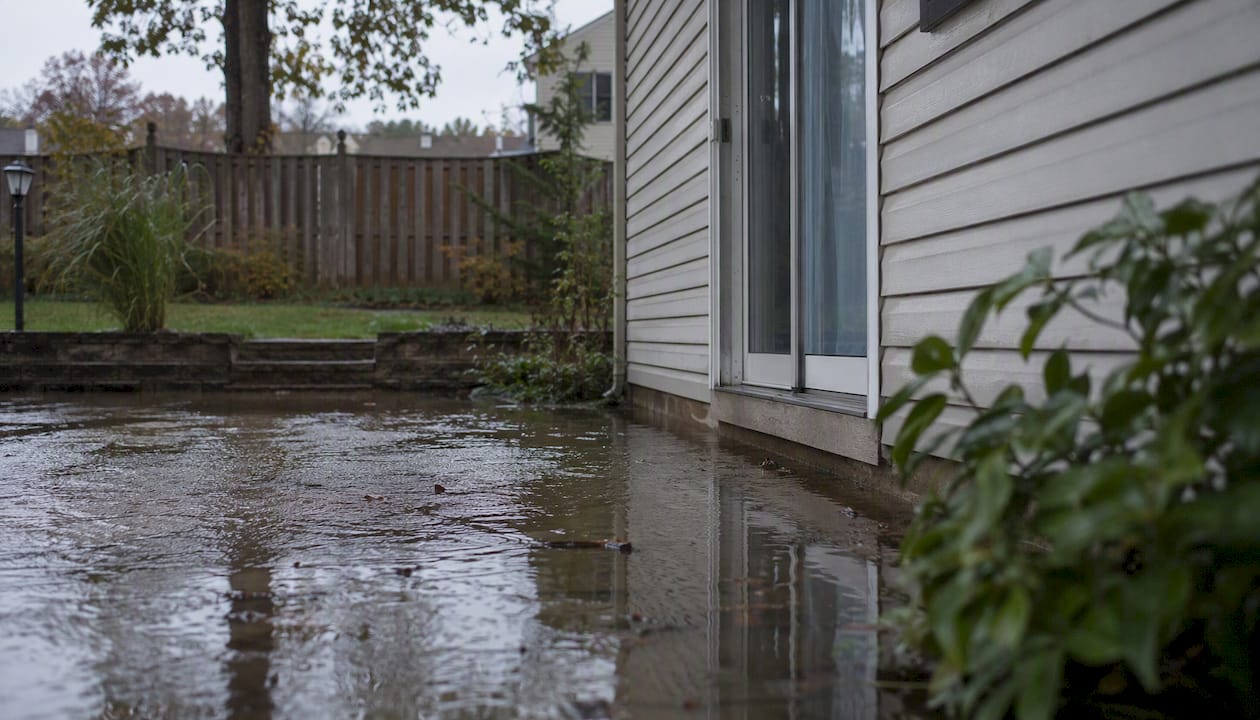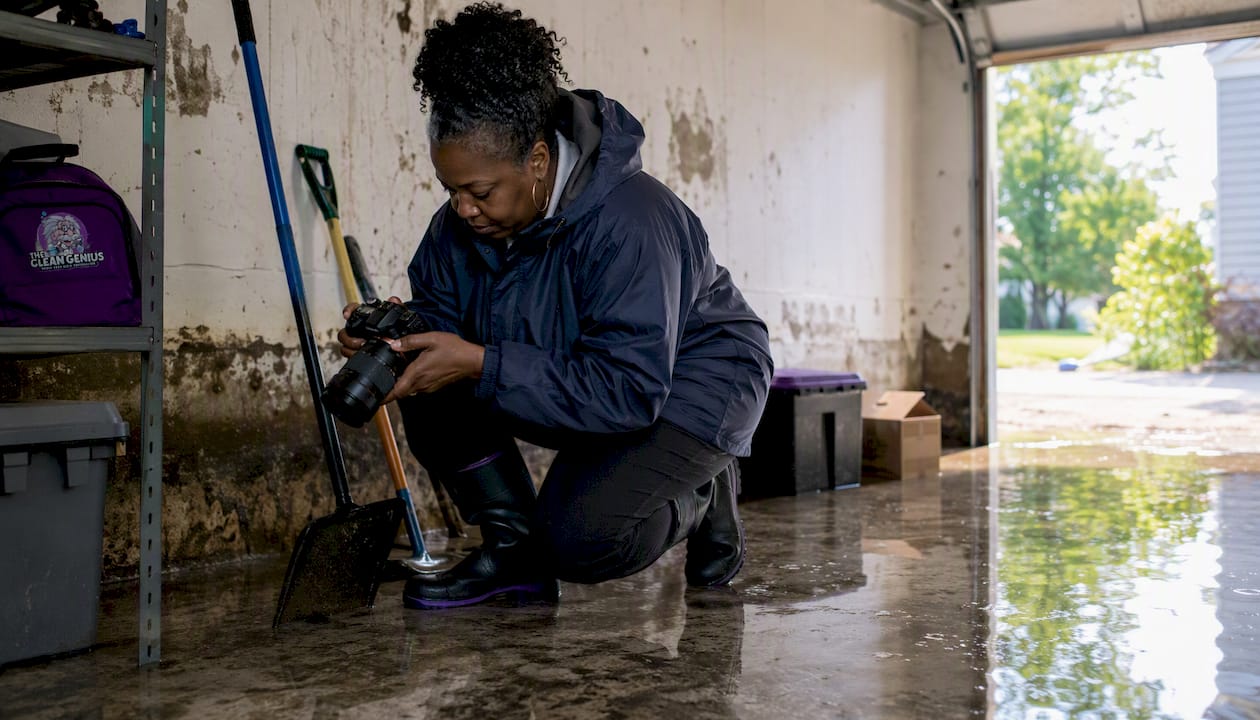

When your basement is filling with water, the single most important call you can make is to a 24/7 local restoration crew. Thecleangenius responds across Chicagoland around the clock, dispatching certified technicians for immediate water extraction, contamination containment, and insurance-ready documentation. The team handles everything from emergency water damage restoration to full structural drying and sewage cleanup, serving Chicago and surrounding suburbs including Arlington Heights, Naperville, Lake Zurich, Schaumburg, Elgin, and dozens more communities.
Here is what you get when the crew arrives: fast extraction, Category 1–3 water classification, engineered drying with calibrated equipment, and a moisture map that your insurance adjuster can actually use.
- 24/7 emergency dispatch across Chicagoland
- Water extraction and containment for all water categories, including sewage backup
- Structural drying using LGR dehumidifiers, air movers, and thermal imaging
- Insurance-ready documentation: moisture maps, daily logs, timestamped photos
- Direct insurance coordination from first call through final invoice
Table of Contents
- What should you do immediately after flooding?
- How does the flood cleanup and restoration process work?
- How long does flood cleanup and drying actually take?
- How do you work with insurance after a flood?
- What credentials should you verify before hiring a flood cleanup contractor?
- What does flood cleanup cost in Chicago?
- Why choose Thecleangenius for flood cleanup in Chicago?
- Do Chicago flood cleanups require permits or follow local regulations?
- Where can you get emergency housing during flood cleanup?
- Key Takeaways
- What Chicago flood cleanup actually looks like on the ground
- Thecleangenius is ready when you need flood cleanup in Chicago
- Useful sources for Chicago homeowners
What should you do immediately after flooding?
Safety comes before anything else. Do not flip a light switch, plug in a device, or step into a flooded room until the power to that area has been shut off at the breaker by a qualified electrician or confirmed safe. Floodwater and live electricity are a fatal combination.
Once you have addressed power, work through this list:
- Shut off utilities at the main panel and gas meter if you can do so safely and without entering flooded areas.
- Move undamaged valuables to higher ground or dry rooms before water spreads further.
- Document everything with your phone: wide shots of each affected room, then close-ups of waterlines, damaged materials, and any visible sewage or debris. Turn on timestamps in your camera settings.
- Stay out of contaminated water. Floodwater can carry dangerous bacteria from overflowing sewage and agricultural runoff; skin contact alone is not the primary risk, but ingesting anything contaminated is.
- Keep generators outside. The CDC warns that gas-powered generators must be placed at least 20 feet from any building opening — never in a basement, garage, or enclosed porch. Carbon monoxide builds up fast and kills silently.
- Do not attempt DIY cleanup for Category 2 or 3 losses (gray water, sewage, or storm-driven floodwater) or when you are unsure about structural integrity.
Safety callout: The CDC advises that electricity should not be used in flooded areas until a professional confirms it is safe. This applies to outlets, appliances, and HVAC systems — not just overhead lights.
Pro Tip: Shoot three or four wide-angle photos of each room first, then move in for close-ups of the waterline on walls, damaged flooring, and any visible contamination. Capture the timestamp on screen if possible. These few minutes of documentation can prevent weeks of insurance disputes.
For losses larger than a small, clean-water spill on a hard floor, call professionals. IICRC-guided thresholds indicate that Category 2–3 water, saturated porous materials, or affected areas over 10 square feet require professional intervention.
How does the flood cleanup and restoration process work?
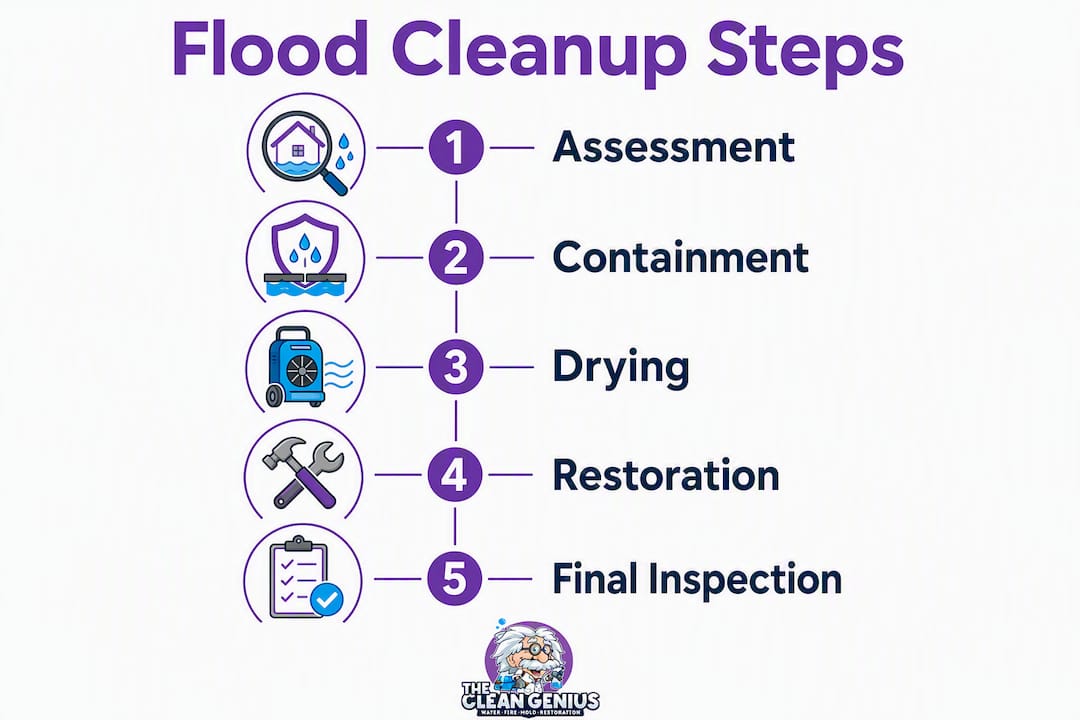
Water damage restoration is an engineered process, not a cleanup job. Proper restoration depends on psychrometrics and correct equipment sizing, not just running fans until things feel dry. Here is the sequence a professional crew follows:
- Assessment and water classification. The crew classifies the water source using IICRC S500 categories: Category 1 (clean water from a supply line), Category 2 (gray water with contaminants), or Category 3 (black water from sewage or floodwater). This classification drives every decision that follows.
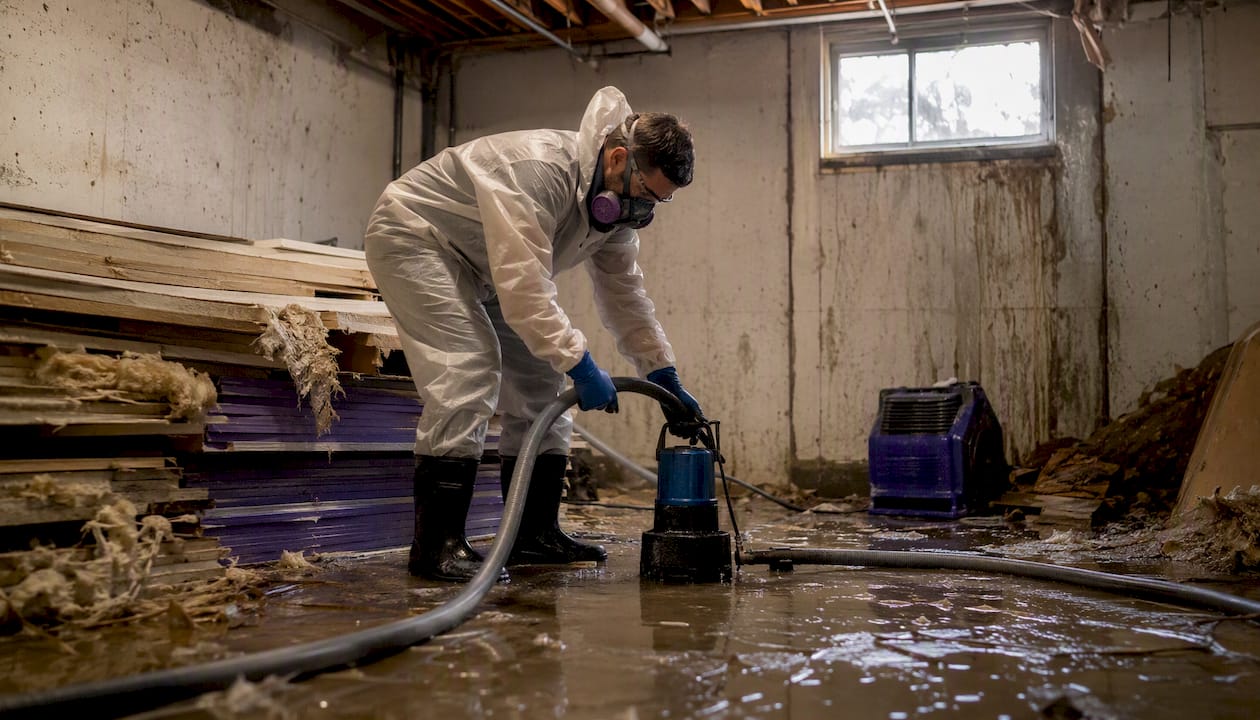
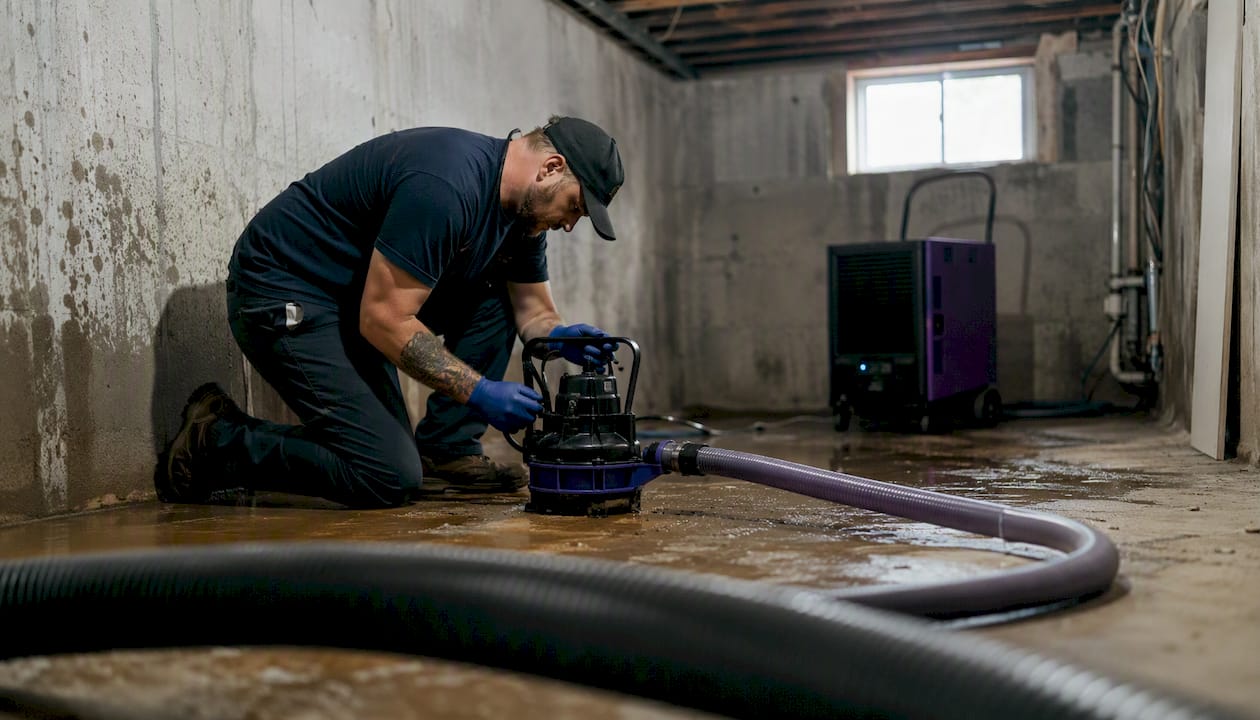
- Extraction. Truck-mounted extractors and submersible pumps remove standing water. The faster this happens, the less secondary damage occurs.
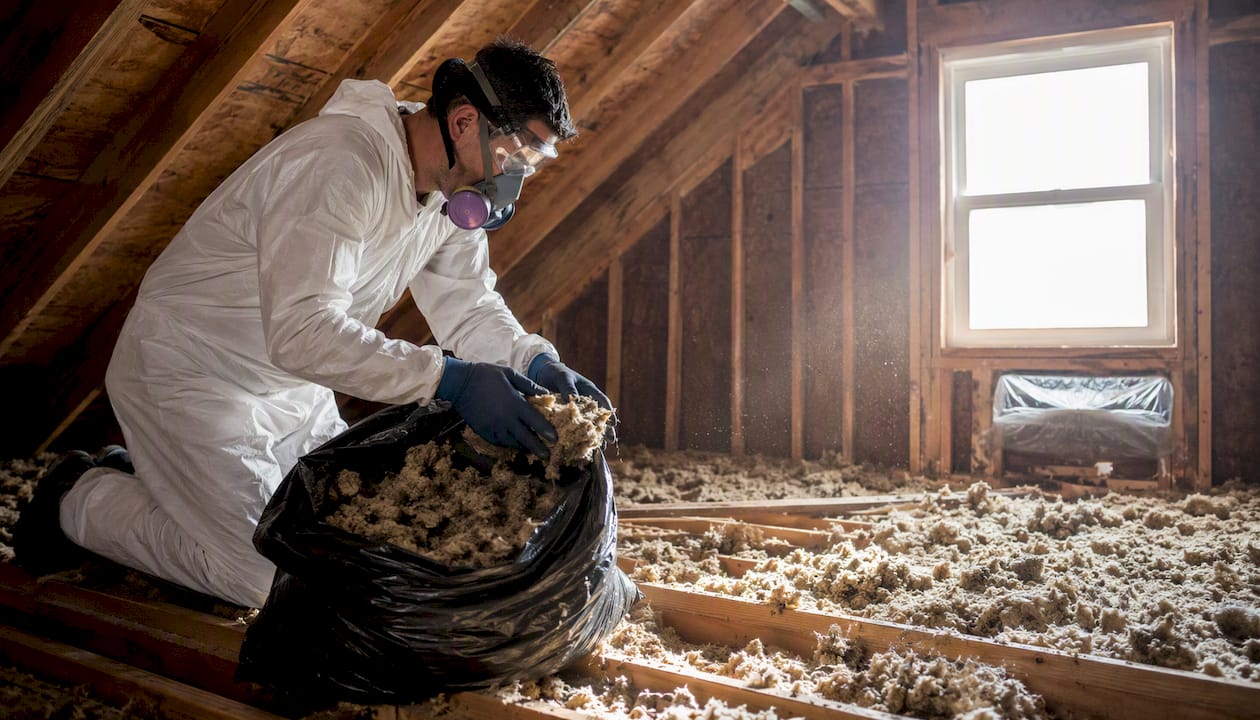
- Controlled demolition (when required). Saturated drywall, insulation, and flooring that cannot be dried in place are removed. This is not optional for Category 2–3 losses — leaving contaminated porous materials behind creates mold and health hazards.
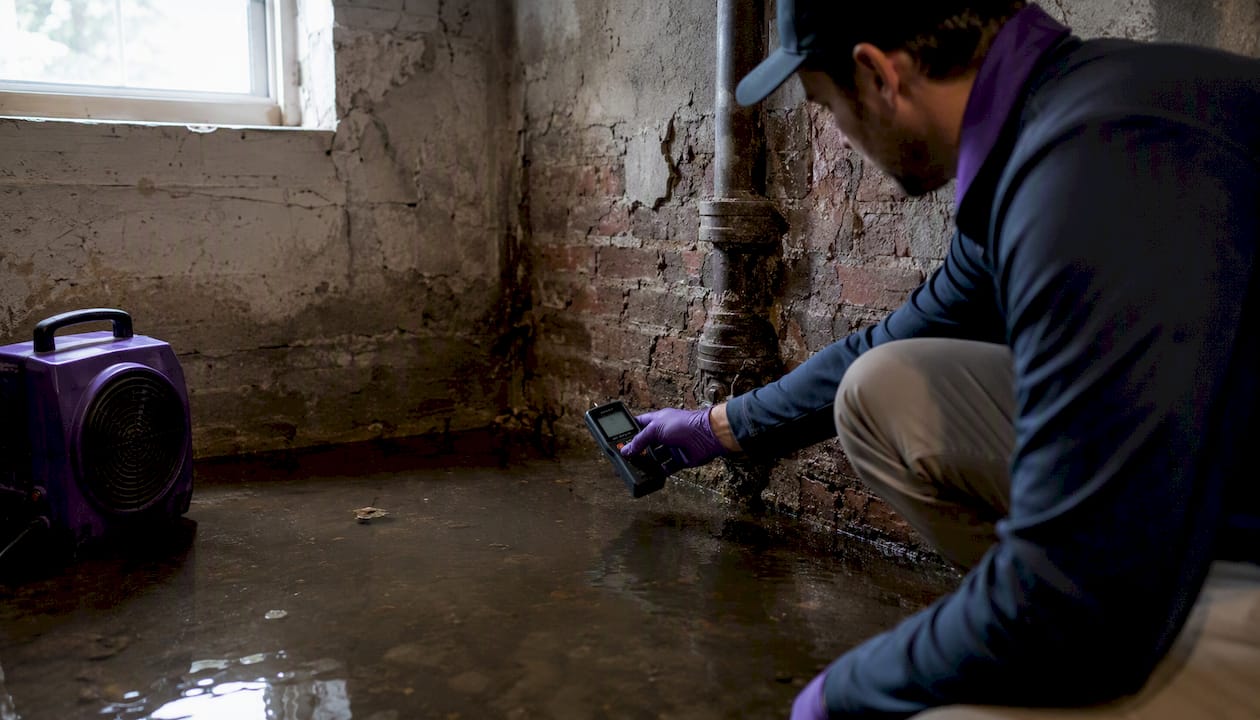
- Equipment placement for structural drying. Air movers, low-grain refrigerant (LGR) dehumidifiers, HEPA air scrubbers, and desiccant units are positioned based on calculated drying loads, not guesswork. Thermal imaging cameras and pin/pinless moisture meters identify hidden saturation behind walls and under floors.
- Antimicrobial treatment. For Category 2–3 losses, EPA-registered disinfectants are applied to affected surfaces after extraction and demolition.
- Content pack-out and cleaning. Salvageable contents are inventoried, packed, and cleaned off-site when the structure needs to be cleared for drying.
- Daily monitoring. Technicians return each day to record pin/pinless moisture readings on affected and unaffected comparison areas, plus temperature and relative humidity. These readings form the daily dry log.
- Final verification and repair coordination. Once materials reach the IICRC S500 dry standard, equipment is removed and reconstruction scheduling begins.
The initial moisture map is a floor-plan diagram showing every affected area and its baseline moisture readings. Insurance adjusters rely on this document and the subsequent daily logs to verify that drying was necessary, properly executed, and complete. Without documented psychrometric data, adjusters frequently dispute or reduce claims.
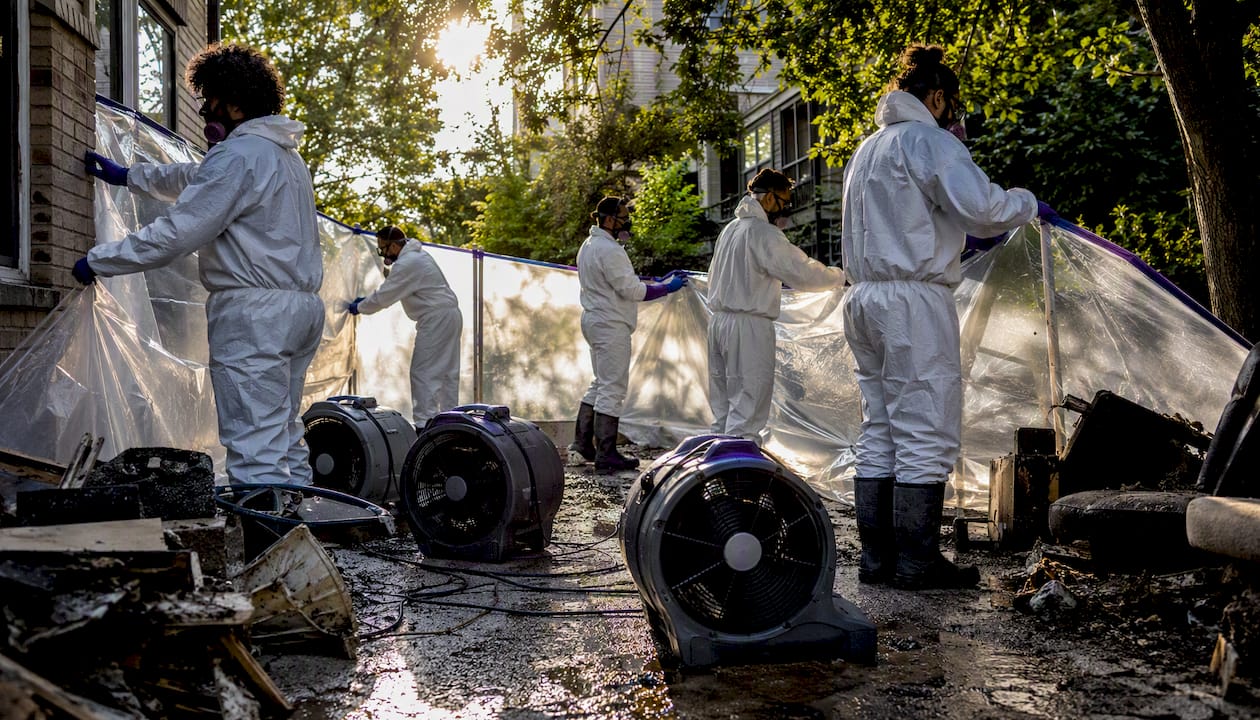
For Category 3 losses, the crew works under strict containment protocols: full PPE, negative air pressure where required, HEPA filtration during demolition, and documented waste disposal. These steps should be disclosed in writing before work begins.
How long does flood cleanup and drying actually take?
The honest answer: it depends on the water category, the drying class, and what your home is built from. Here is a realistic breakdown:
- Extraction: Hours to one full day for most residential losses.
- Structural drying, Category 1: Typically 3–5 days with proper equipment in place.
- Structural drying, Category 2: Usually 5–7 days, longer if walls or subfloor are involved.
- Category 3 or large multi-room losses: 7–14+ days, especially when demolition is required before drying can begin.
- Daily monitoring visits: Every day until dry standard is confirmed.
- Reconstruction: Scheduled after verified dry readings, typically 1–4 weeks depending on scope.
Chicago-specific factors can push these timelines longer. Older homes with plaster walls, brick construction, and original hardwood floors hold moisture far longer than modern drywall. Basement slab construction and the city’s high water table mean that even after extraction, ambient humidity stays elevated. Sewer backup losses, which are common in Chicago’s combined sewer system during heavy rain, almost always require demolition before drying can start, adding days to the timeline.
For a deeper look at how psychrometric principles affect equipment sizing and drying duration, that resource explains the math behind why a properly sized dehumidifier outperforms three undersized units every time.
How do you work with insurance after a flood?
Documentation is the difference between a paid claim and a disputed one. Before any restoration work begins, ask your contractor for a written scope. After work starts, the following records should be generated automatically by any reputable firm:
- Initial moisture map with baseline readings on all affected surfaces
- Daily dry logs recording pin/pinless meter readings, temperature, and relative humidity on affected and reference areas
- Photo and video logs with timestamps at each monitoring visit
- Equipment serial numbers and installation/removal dates
- Itemized scope with line items for extraction, demolition, antimicrobial application, equipment-days, monitoring visits, and disposal
- Written change orders for any scope additions
Adjusters use daily logs to verify the necessity and progress of mitigation. A contractor who cannot produce these records is a liability to your claim, not an asset.
Pro Tip: Request a Certificate of Insurance (COI) that explicitly does not exclude “water mitigation” or “restoration” work. Many general contractors carry policies that exclude these activities entirely, meaning their coverage will not apply to your job. Ask to be listed as an additional insured when the scope is large.
The IICRC S500 standard is the industry benchmark that defines what documentation is required and why. When a contractor references S500 compliance, they are committing to this level of record-keeping. Billing that matches equipment logs and documented readings is also far less likely to trigger an audit or dispute from your carrier.
For a full walkthrough of what to gather and when, the water damage insurance claim checklist covers each document type with practical guidance.
| Document | Purpose | When Created |
|---|---|---|
| Initial moisture map | Baseline evidence of affected areas | Day 1, on arrival |
| Daily dry logs | Proof of drying progress for adjuster | Each monitoring visit |
| Photo/video log | Visual record with timestamps | Day 1 and each visit |
| Itemized scope | Justifies each line item billed | Before work begins |
| Equipment log | Matches billing to actual usage | Throughout drying phase |
What credentials should you verify before hiring a flood cleanup contractor?
The most common homeowner mistake after a flood is hiring the first contractor who shows up at the door. Storm-chaser contractors often solicit door-to-door immediately after events and may leave before completing quality work. A 10-minute vetting call prevents weeks of problems.
Vetting checklist:
- IICRC firm certification number (verify at iicrc.org)
- Certificate of Insurance covering general liability and workers’ compensation, with no exclusion for water mitigation
- State contractor license (Illinois requires licensing for certain restoration work)
- Verifiable local business address and phone number
- Recent reviews or references from jobs in your area
Questions to ask on the call:
- What is your expected response time to my address?
- Will you provide an initial moisture map and daily dry logs?
- What equipment will you place, and how many units?
- How do you handle Category 3 or sewage-contaminated losses?
- How do you coordinate with my insurance carrier?
Red flags to watch for:
- Pressure to sign a contract before any inspection or assessment
- Vague or lump-sum pricing with no line items
- Claims of drying in 24 hours without any psychrometric testing
- Missing COI or a policy that excludes restoration work
- No local office, no verifiable reviews, or an out-of-state phone number
Pro Tip: Before authorizing any demolition, request the contractor’s written scope that ties the water classification (Category and Class) to the specific actions proposed. A legitimate firm will provide this without hesitation. If they push back, that is your answer.
What does flood cleanup cost in Chicago?
Cost depends on several variables, and any contractor who quotes a flat price before seeing the property is guessing. The main drivers:
- Water category: Category 3 (sewage, floodwater) costs significantly more than Category 1 due to PPE, demolition, and disposal requirements.
- Drying class: Higher classes require more equipment and more days on-site.
- Square footage affected: A single flooded room versus a full basement plus first floor are entirely different scopes.
- Required demolition: Removing and disposing of drywall, insulation, flooring, and cabinetry adds labor and material costs.
- Equipment-days: Each air mover, dehumidifier, and air scrubber running for multiple days adds to the total.
- Content pack-out and cleaning: Off-site content handling is billed separately.
- Antimicrobial application: Justified for Category 2–3 losses; should be line-itemed.
- Local permits: Chicago and some suburbs require permits for structural work; ask upfront.
For a small, clean-water basement loss with no demolition, costs are substantially lower than a multi-room Category 3 event requiring full demo, HEPA filtration, and content pack-out. Itemized estimates let you verify that each line item matches the documented scope and equipment logs.
One critical coverage note: standard homeowner insurance policies typically exclude flood damage caused by rising water or storm surge. That coverage requires a separate flood insurance policy, often through the National Flood Insurance Program (NFIP). Sewer backup coverage is also frequently a separate rider. Confirm your coverage before assuming the full bill is covered.
Why choose Thecleangenius for flood cleanup in Chicago?
Thecleangenius is a family-owned restoration company with over 25 years of combined experience and more than 400 five-star reviews across Chicagoland. The team is available 24/7 and can mobilize to Chicago, Lake Zurich, Naperville, Schaumburg, Elgin, Arlington Heights, and surrounding suburbs.
- 24/7 emergency response — with local crews, not a national call center
- IICRC-aligned processes — covering water classification, containment, and engineered drying
The Pure Cloud dry-fog system is particularly effective after sewage backups and Category 3 losses where conventional wet disinfection would re-saturate dried materials. It delivers EPA-registered disinfectant as a fine dry fog that penetrates cavities and surfaces without adding moisture, making it a practical tool for odor elimination and surface disinfection after the structural drying phase is complete.
Thecleangenius has handled hundreds of Chicago-area flood and water damage jobs, from single-room burst-pipe losses to full-basement sewage backups in older Chicagoland homes. Every job gets a moisture map on day one and a daily log until the structure is verified dry. See examples of successful water damage restoration from real Chicagoland properties.
Do Chicago flood cleanups require permits or follow local regulations?
Yes, and the answer varies by scope and municipality. In the City of Chicago, structural work that involves removing load-bearing elements, altering plumbing, or modifying electrical systems typically requires a permit from the Chicago Department of Buildings. Water mitigation work (extraction, drying, and antimicrobial treatment) generally does not require a permit on its own, but any reconstruction work that follows often does.
Chicago’s combined sewer system is a recurring factor in basement flooding. When a sewer backup is the source of damage, the Metropolitan Water Reclamation District of Greater Chicago (MWRD) and the City of Chicago’s Basement Flooding Partnership program are relevant resources. The city has funded programs to help homeowners install overhead sewers, backflow preventers, and sump pumps to reduce repeat flooding, and some of these improvements require permits and licensed plumbers.
For suburban Chicagoland communities, permit requirements vary by municipality. Lake Zurich, Naperville, Schaumburg, and other suburbs each have their own building departments. A reputable local contractor will identify permit requirements during the scope phase and pull the necessary permits before reconstruction begins. If a contractor tells you permits are not needed for significant structural work, verify that independently with your local building department.
Where can you get emergency housing during flood cleanup?
Displacement during a multi-day or multi-week restoration is a real possibility, especially for Category 3 losses or whole-floor flooding. Here are the main options:
- Homeowner’s insurance additional living expenses (ALE) coverage: Most standard homeowner policies include ALE coverage, which pays for hotel, rental, and meal costs above your normal living expenses while your home is uninhabitable. File this claim immediately and keep all receipts.
- FEMA Individual Assistance: After a federally declared disaster, FEMA’s Individual Assistance program can provide temporary housing funds, home repair grants, and other support. Check DisasterAssistance.gov for active declarations in Cook County and surrounding counties.
- City of Chicago Emergency Housing Assistance: The City of Chicago’s Department of Housing administers emergency rental and housing assistance programs. Contact 311 or visit chicago.gov/housing for current program availability.
- Illinois Housing Development Authority (IHDA): IHDA administers state-level emergency housing programs that may apply during declared disasters.
- Red Cross: The American Red Cross provides emergency shelter and short-term housing assistance after disasters; call 1-800-RED-CROSS or visit redcross.org.
For multi-unit properties, coordinating tenant displacement and building access during restoration requires clear communication. Property managers handling mail and package logistics during extended restoration can work with services like Postal Solutions in Chicago to maintain building operations while crews are on-site.
Key Takeaways
Flood cleanup in Chicago requires immediate professional response, documented drying, and verified credentials to protect both your property and your insurance claim.
| Point | Details |
|---|---|
| Call 24/7 immediately | Every hour of standing water increases structural damage and mold risk; call a local crew now. |
| Safety before entry | Shut off power and gas before entering flooded areas; keep generators 20 feet from all openings. |
| Require documentation | Insist on an initial moisture map and daily dry logs — adjusters need this data to approve claims. |
| Verify credentials | Confirm IICRC firm certification, a COI without water mitigation exclusions, and a local license. |
| Thecleangenius | 24/7 Chicagoland response, 400+ five-star reviews, moisture mapping, and Pure Cloud dry-fog technology. |
What Chicago flood cleanup actually looks like on the ground
Chicago basements are their own category of problem. The water table is high, the sewer system is old, and a heavy rain event can push sewage back through floor drains before a homeowner even knows there is a storm. When a crew arrives at a flooded Chicago property, the first five minutes are spent on classification, not extraction. Is this a clean supply-line break, or is there sewage in the water? The answer changes the entire scope: PPE requirements, containment decisions, what gets demolished, and how the job gets billed to insurance.
Older Chicagoland homes, particularly those built before 1970, often have plaster walls, original hardwood, and brick foundations that hold moisture in ways modern construction does not. Thermal imaging on day one frequently reveals saturation behind walls that look dry to the eye. That is why daily moisture readings matter more than a visual inspection, and why a crew that skips the meter readings is not doing restoration. They are doing cleanup, which is a different thing entirely.
Thecleangenius is ready when you need flood cleanup in Chicago
When water is in your home, the clock is running. Mold can begin developing within a couple of days of a water event, and the longer saturated materials stay wet, the more demolition a proper restoration requires.

Thecleangenius dispatches 24/7 across Chicagoland. After your call, here is what happens next:
- Emergency crew dispatched to your address
- On-site assessment and water classification on arrival
- Signed scope provided before any work beyond emergency extraction begins
- Moisture map created on day one
- Daily monitoring visits with documented readings
- Direct coordination with your insurance carrier through final invoice
The team brings IICRC-aligned processes, documented moisture mapping, HEPA-safe procedures, and Pure Cloud dry-fog technology for disinfection and odor control when the job calls for it. For 24/7 emergency water damage restoration in Chicagoland, contact Thecleangenius now. You can also visit the flooding and storm damage service page for a full overview of what the response covers.
Useful sources for Chicago homeowners
- CDC: Guidelines for Cleaning Safely After a Disaster — consult for PPE guidance, floodwater health risks, and safe re-entry procedures after any flood event.
- CDC: Safety Guidelines for Reentering Your Flooded Home — covers mold, sewage contamination, and structural safety checks before re-entry.
- CDC: Returning Home After a Flood — generator safety, electrical hazards, and step-by-step return guidance.
- IICRC S500: Standard for Professional Water Damage Restoration — the industry standard that defines water categories, drying classes, documentation requirements, and contractor obligations.
- CDC: Homeowner’s and Renter’s Guide to Mold Cleanup After Disasters — practical mold prevention guidance for homeowners in the weeks after a flood.