
You can remove cigarette odor permanently only by removing or thoroughly cleaning the materials that hold the smell, not by covering it up. That means deep cleaning walls, fabrics, and HVAC systems rather than relying on candles or sprays. Start today with ventilation, filter changes, and laundering soft items, and skip ozone machines entirely: they carry real health risks in occupied homes.
TL;DR:
- Cross ventilation with windows and box fans reduces airborne smoke particles by about 74 percent temporarily, but deeper cleaning is necessary for lasting results.
- Effective cleaning involves replacing HVAC filters, vacuuming surfaces thoroughly, and washing walls and fabrics with specific chemistry sequences that target nicotine residues.
- Surface cleaning alone cannot fully remove thirdhand smoke residues embedded in porous materials, which may require replacing furniture or drywall.
- Ozone machines and ionizers are unsafe and ineffective for embedded smoke odor removal, as they can produce harmful byproducts and do not significantly reduce nicotine levels.
- Persistent smoke smell after DIY efforts indicates contamination in hidden reservoirs like ductwork or deeply stained surfaces, often requiring professional remediation.
Table of Contents
- Immediate steps to reduce smoke odor right now
- How do you clean walls, floors, and closets room by room?
- What cleaning products and dilutions actually remove smoke residue?
- How do HEPA filters, activated carbon, and HVAC upgrades help?
- Why ozone machines and ionizers are the wrong fix
- When does the job need a professional remediation team?
- How do you keep the smell from coming back?
- How a restoration team approaches smoke odor removal
- What should you realistically expect from this process?
- Getting professional help for stubborn smoke odor
- Sources
- FAQ
Immediate steps to reduce smoke odor right now
Before you touch a bottle of cleaner, focus on the actions that cut airborne odor fast and stop the smell from spreading to rooms that are still clean. These moves will not solve embedded odor on their own, but they buy you breathing room while you plan the deeper work.
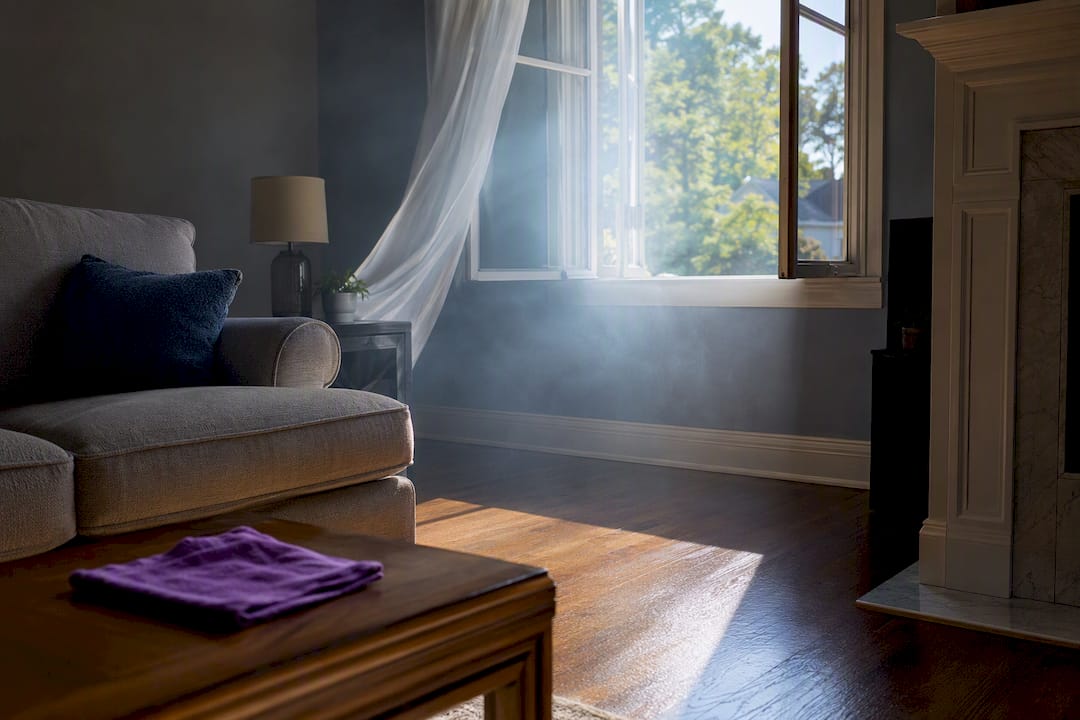
Open windows on opposite sides of the house to create cross ventilation. A house-scale study of smoke contamination found that opening windows cut airborne volatile organic compounds by roughly 74% almost immediately, though the effect faded once the windows closed. Use box fans in windows to pull air through faster, and check outdoor air quality first if you live somewhere with heavy pollution or wildfire smoke, since you do not want to trade one air problem for another.
While the house airs out, work through this checklist:
- Replace every HVAC or furnace filter in the house, even if it looks fine, since smoke particles can clog filters faster than dust alone.
- Run the HVAC fan continuously for a few hours to pull smoke-laden air through the new filter.
- Gather small fabric items, curtains, throw pillows, clothing, bedding, and bag them separately for laundering rather than letting them sit in closets absorbing more odor.
- HEPA-vacuum every hard and soft surface starting at the ceiling and working down, so dislodged particles do not resettle on surfaces you already cleaned.
- Vacuum slowly and overlap each pass, since smoke particles are small enough to hide in carpet fibers and fabric weaves that a quick pass will miss.
Work room by room rather than jumping around. Start in the space where smoking happened most, usually a living room or bedroom, then move outward to bedrooms, hallways, and closets. HVAC ducts and closets are easy to forget but act as reservoirs that reintroduce odor days after you think the job is done.
Pro Tip: Vacuum before you wipe surfaces, not after. Wiping first just smears settled particles into the material instead of lifting them out.
How do you clean walls, floors, and closets room by room?
Ventilation and vacuuming handle loose particles, but cigarette smoke also bonds chemically to surfaces, which is why a wipe-down with a standard household cleaner often leaves a faint smell behind. Thirdhand smoke research shows that these residues persist in dust and on surfaces for months or years and can reemit odor compounds well after the room looks clean, which is why the cleaning method matters as much as the effort you put in.
Hard surfaces: walls, ceilings, and trim
Walls and ceilings absorb smoke residue into paint and, over time, into the drywall itself. Wash from the top down using a degreasing cleaner, then rinse with a clean cloth and water before the residue dries back into the surface. Painted trim and doors usually respond well to this treatment, but textured or heavily soiled ceilings sometimes need a fresh coat of odor-blocking primer before repainting. If a wall still smells after two or three cleaning passes, that is usually a sign the paint itself has absorbed nicotine deep enough that repainting, not rewashing, is the fix.
Soft materials: carpet, upholstery, mattresses, and curtains
Fabrics hold odor longer than any hard surface in the house because smoke particles work into fibers and padding.
- HEPA-vacuum carpets and upholstery slowly, in overlapping passes, before applying any wet treatment.
- Sprinkle baking soda over carpets and mattresses, let it sit for several hours, then vacuum it up to pull out some surface odor before deeper cleaning.
- Steam clean carpets and upholstered furniture where the fabric can tolerate moisture, since heat helps break down residue that dry vacuuming alone leaves behind.
- Send curtains and washable slipcovers through a full laundry cycle rather than spot cleaning them.
- Replace mattresses, heavily soiled carpet padding, or upholstery that still smells after cleaning, since foam and padding trap residue that surface treatments cannot reach.
Closets, cabinets, and hidden spaces
Empty closets and cabinets completely rather than cleaning around what is stored inside them. Wipe shelves, rods, and interior walls, paying attention to corners where dust and residue collect undisturbed. Bag clothing and linens that were stored in a smoking household for washing, and consider whether older items, coats, blankets, out of season clothing, are worth cleaning at all versus replacing.
Baseboards, vents, and small gaps
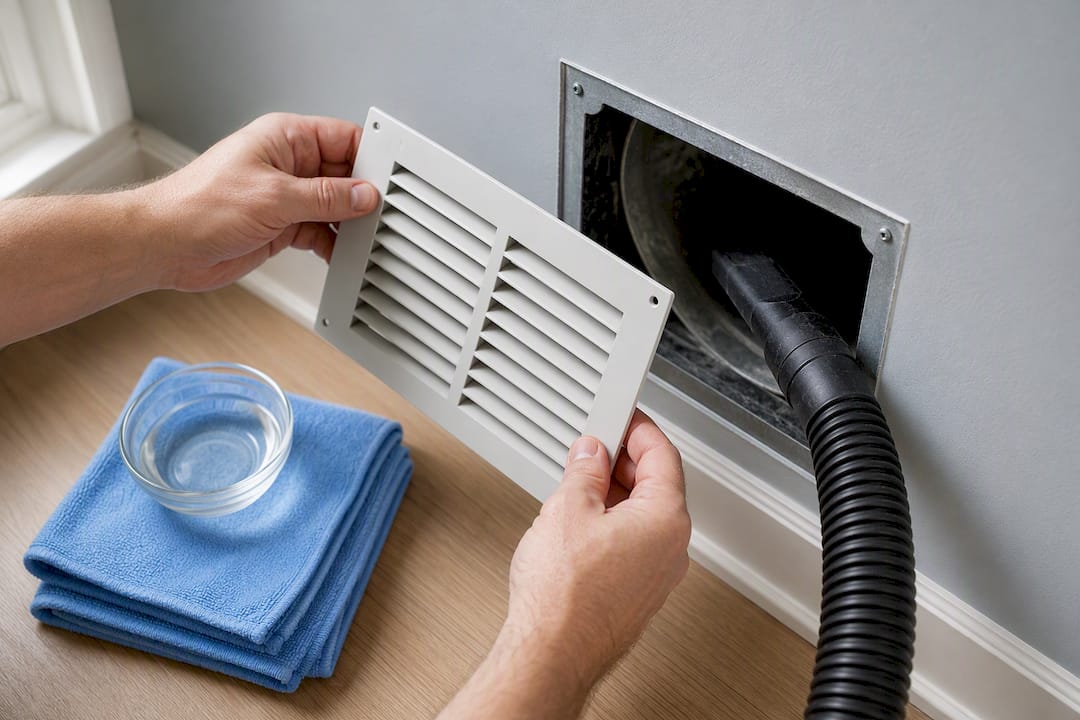
Smoke particles settle into places most people skip: baseboards, window tracks, vent covers, and outlet plates. Remove vent covers and wash them separately, and vacuum the duct opening behind them before reinstalling. These small, forgotten surfaces are a common reason a freshly cleaned room still carries a faint smell a week later.
Pro Tip: Test any cleaner on a hidden patch of wall, carpet, or fabric first. Some degreasers and steam treatments can pull color out of dyed fabric or dull painted finishes.
What cleaning products and dilutions actually remove smoke residue?
The cleaning chemistry matters more than the elbow grease behind it. Nicotine residue is slightly alkaline when fresh but becomes more resistant to plain water over time, which is why a single-solution wipe-down often falls short.
A 2021 peer-reviewed remediation study in multiunit housing tested a two-stage cleaning sequence: an alkaline degreaser followed by an acidic rinse. Researchers used Simple Green diluted 1:10 with water as the alkaline stage, followed by distilled white vinegar diluted 1:3 as the acidic rinse, with a dwell time of one to two minutes on nonporous surfaces before wiping and rinsing clean.
Statistic Callout: A 2021 peer-reviewed remediation study documented partial but meaningful reductions in surface nicotine and dust loadings using this two-stage sequence. That confirms alternating cleaning chemistries outperforms a single wipe-down, though the study also found the approach often needs repeating and cannot fully reach residue embedded deep in porous materials.
Follow this sequence carefully:
- Apply the alkaline cleaner first, let it sit for the recommended dwell time, then wipe and rinse before it dries.
- Follow with the acidic rinse on the same surface, again wiping clean rather than letting it dry into the material.
- Never mix cleaning products directly, especially anything containing bleach with an acidic rinse, since the combination can produce dangerous fumes.
- Work with windows open and gloves on, since repeated exposure to degreasers and vinegar fumes can irritate eyes and airways in an enclosed room.
Trisodium phosphate, TSP, is sometimes used by professionals for heavily soiled walls and trim before repainting, but it is caustic, requires gloves and eye protection, and should only be used with good ventilation and according to label dilution rates. It is a stronger option than most homeowners need for routine odor cleaning.
Baking soda and activated charcoal are useful adjuncts, not solutions. They absorb some surface odor temporarily, which helps between deep cleanings, but neither one removes the residue that is actually causing the smell.
How do HEPA filters, activated carbon, and HVAC upgrades help?
Cleaning removes odor sources, but filtration handles what is still floating in the air, and the two work on different problems. EPA’s guide to air cleaners explains that HEPA filtration captures particles effectively, but smoke odor also comes from gaseous compounds that many HEPA filters do not remove. Removing those gases requires a filter with substantial activated carbon media, which is why a plain HEPA purifier often leaves a lingering smell even after it clears visible haze.
- Choose a portable air cleaner rated with a CADR for tobacco smoke that matches your room’s square footage, and run it continuously during the first weeks of remediation.
- Look for units combining HEPA filtration with a real activated carbon stage rather than a thin carbon prefilter, since carbon mass affects how much gas the unit can actually absorb before it saturates.
- Replace HVAC filters with a higher MERV-rated filter if your system supports it, and change it again after a few weeks once initial cleaning stirs up settled particles.
- Have ductwork inspected if the house was smoked in for years, since duct interiors can hold residue that recontaminates filtered air every time the system runs.
- A DIY box fan with a MERV filter taped to the intake side can help in a pinch, but it moves far less air than a purpose-built unit and should not be treated as a substitute for a proper air cleaner.
Filtration works best as a supporting layer on top of source cleaning, never as the main fix. Run it while you clean, and keep it running for weeks afterward while remaining reservoirs finish releasing their residue.
Why ozone machines and ionizers are the wrong fix
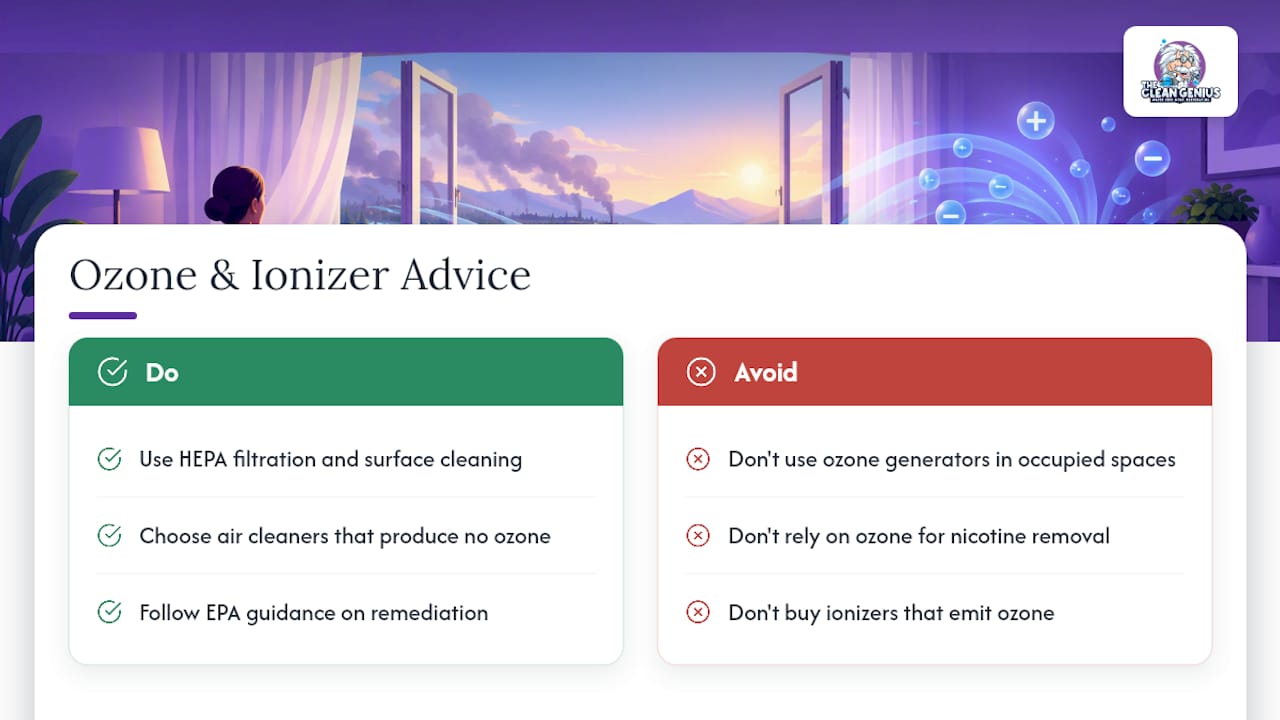
Ozone generators are marketed as a fast fix for smoke odor, but the evidence says otherwise. The EPA warns against using ozone generators in occupied spaces, noting they can produce lung irritants and other potentially harmful byproducts, and the agency does not recognize ozone as an approved remediation method for homes people are living in.
Peer-reviewed testing backs up that caution on effectiveness as well as safety. Laboratory experiments on ozone remediation found that ozone removed some polycyclic aromatic hydrocarbons but little nicotine from aged carpet and generated short-term potentially hazardous byproducts in the process.
Ozone is not an approved general remediation solution for occupied homes, and evidence does not show significant reductions in nicotine loading in aged materials from high-concentration ozone treatments.
EPA and peer-reviewed remediation research
Ionizers and electrostatic precipitators carry a related risk, since some models generate ozone as a byproduct of operation rather than as an intended feature. If you are shopping for an air cleaner, look for a model that avoids ozone generation entirely rather than one marketed for its ionizing effect. For a fuller breakdown of why these devices fall short, see our explanation of ozone treatment for odor removal. Safer alternatives are the filtration and surface cleaning methods already covered: they take more effort, but they do not put anyone’s lungs at risk.
When does the job need a professional remediation team?
Some smoke contamination is beyond what a homeowner can fix with a vacuum and a bottle of degreaser. Watch for these signs that point toward professional help:
- The odor returns within days of thorough cleaning, which usually means residue has soaked into materials you cannot reach, like wall cavities or subflooring.
- You can see yellow or brown nicotine staining on ceilings, walls, or window frames that persists after washing.
- The smell is noticeable through HVAC vents even after filter changes, which points to duct contamination that a homeowner cannot clean without specialized equipment.
- The house was smoked in heavily for years rather than occasionally, since long-term exposure drives residue deeper into porous materials.
- A household member has asthma, COPD, or another respiratory condition that makes lingering odor a health concern rather than just a nuisance.
A professional remediation crew typically works through containment of the affected area, a deep clean of hard surfaces using commercial-grade equipment, HVAC and duct cleaning, and targeted replacement of drywall, insulation, or carpet padding that cleaning cannot save. You can see a full breakdown of that sequence in our explanation of the fire odor removal process. Costs vary widely depending on the scope of contamination and whether materials need replacing rather than cleaning; our breakdown of smoke damage cleanup costs walks through typical ranges homeowners can expect. When you call for an estimate, ask about insurance, certifications, the equipment they plan to use, and whether they can provide references from similar jobs.
How do you keep the smell from coming back?
Remediation only holds if you change the habit that caused the problem in the first place.
- Set a firm no-indoor-smoking rule and treat outdoor smoking areas as separate from the house entirely, including clothing worn while smoking.
- Wash or air out clothing worn while smoking before it touches furniture, bedding, or closets, since fabric picks up residue fast.
- Keep changing HVAC filters on a regular schedule rather than waiting until they look dirty, and run a HEPA vacuum over carpets and upholstery every few weeks during the first months after remediation.
- Weigh replacement against repeat cleaning: if an item needs a third or fourth deep clean and still smells, replacing it is often cheaper than the labor and product cost of trying again.
- Renters and landlords should document the home’s condition with photos and notes at move-in and move-out, since smoke odor disputes over security deposits often come down to who can prove what condition the unit was in.
How a restoration team approaches smoke odor removal
Reputable restoration companies bring equipment and training that go beyond household cleaning supplies. Professional restoration companies handle fire damage restoration services including soot and odor elimination, along with odor control and environmental disinfection, using dry-fog technology to reach spaces that surface cleaning cannot. Certified teams are often available for emergency response in local areas.
Choosing certified restoration makes the most sense when contamination is pervasive, when a household member has a respiratory condition, or when initial cleaning attempts have not resolved the smell. At an on-site estimate, ask what equipment the team will use, how they will handle HVAC and duct contamination, and what the expected timeline looks like for your specific situation.
What should you realistically expect from this process?
Cleaning reduces exposure and odor meaningfully, but it does not always erase every trace, especially in a house with years of heavy smoking. Some reservoirs, old carpet padding, absorbent insulation, deeply stained drywall, may need replacing rather than repeated cleaning.
Budget your effort around health risk first and cosmetic concerns second. Renters negotiating a deposit dispute should document conditions and cleaning efforts in writing. Homeowners planning a renovation anyway should treat that as the moment to replace materials cleaning cannot fully fix, rather than paying twice.
— Jim
Getting professional help for stubborn smoke odor
Deep cleaning and filtration handle most smoke odor problems, but persistent smells after real effort usually mean residue has reached places a vacuum and a spray bottle cannot follow. The Clean Genius handles that next step directly, with fire and smoke damage restoration, odor control and environmental disinfection, and dry-fog remediation technology built for exactly this kind of embedded contamination.

An on-site estimate typically covers the scope of contamination, which materials can be cleaned versus replaced, and a timeline for the work. Have details ready when you call: how long the home was smoked in, whether HVAC odor is noticeable, and any respiratory concerns in the household.
| Situation | What it usually means | Next step |
|---|---|---|
| Odor returns after DIY cleaning | Residue has reached porous materials or ductwork | Request a professional on-site estimate |
| Visible nicotine staining | Long-term heavy exposure | Ask about surface treatment plus repainting |
| Household member has asthma or COPD | Health risk from lingering particles | Prioritize certified remediation over repeat DIY attempts |
Reach out through our fire damage restoration services page to schedule an estimate and get a clear scope for your home.
Sources
- Guide to air cleaners in the home — U.S. EPA
- House-scale smoke experiments: surface reservoirs and cleaning effectiveness (PMC)
- Thirdhandsmoke
FAQ
What gets rid of cigarette smell in a house fast?
Ventilating with cross airflow, replacing HVAC filters, and HEPA-vacuuming surfaces reduce airborne odor within hours. A house-scale study found opening windows cut volatile organic compounds by roughly 74% almost immediately, though the effect does not last without deeper cleaning behind it.
How can I get rid of the smoke smell in my house?
Lasting removal requires cleaning or replacing the materials holding the odor: walls, fabrics, carpet padding, and HVAC components, rather than masking it with sprays or candles. A two-stage cleaning approach using an alkaline degreaser followed by an acidic rinse, as used in a peer-reviewed remediation study, performs better than a single wipe-down on hard surfaces.
How long does it take for cigarette smell to go away in a house?
There is no fixed timeline since it depends on how long the home was smoked in and how porous the affected materials are. Light contamination can improve within a few days of thorough cleaning, while heavily soiled fabrics, insulation, or drywall may need weeks of repeated cleaning or outright replacement, since thirdhand smoke residue can persist in surfaces for months or years.
What smell cancels out cigarette smoke?
No scent actually cancels cigarette odor. Candles, sprays, and air fresheners only mask the smell temporarily, and university extension guidance warns that these products do not address the underlying residue causing the odor at all.
Should I use an ozone machine to remove smoke smell?
No. The EPA advises against using ozone generators in occupied homes because they can produce lung irritants, and peer-reviewed testing has found ozone removes little nicotine from aged materials while creating harmful byproducts in the process.