
Psychrometrics is the scientific study of air moisture properties, and it determines whether your home dries completely or develops hidden mold after water damage. The role of psychrometrics in water restoration goes far beyond running fans and dehumidifiers. It governs every decision a certified technician makes, from which equipment to deploy to when drying is truly complete. Core variables include grains per pound (GPP), relative humidity (RH), vapor pressure, and dew point. Tools like calibrated hygrometers, LGR dehumidifiers, and psychrometric charts translate these variables into a science-driven drying plan that protects your home’s structure and your family’s health.
What key psychrometric principles determine effective water restoration?
Vapor pressure differential is the engine behind all structural drying. When wet materials hold more moisture than the surrounding air, water molecules migrate from the material into the air. Restoration professionals manipulate this differential by dehumidifying the air aggressively, which forces moisture out of walls, floors, and subfloors continuously.
Grains per pound (GPP) measures the absolute amount of moisture in a given pound of air, regardless of temperature. This number is what technicians track daily to confirm that drying is actually progressing. A reading that stays flat or rises means moisture is not leaving the structure. A falling GPP reading confirms the drying system is working.
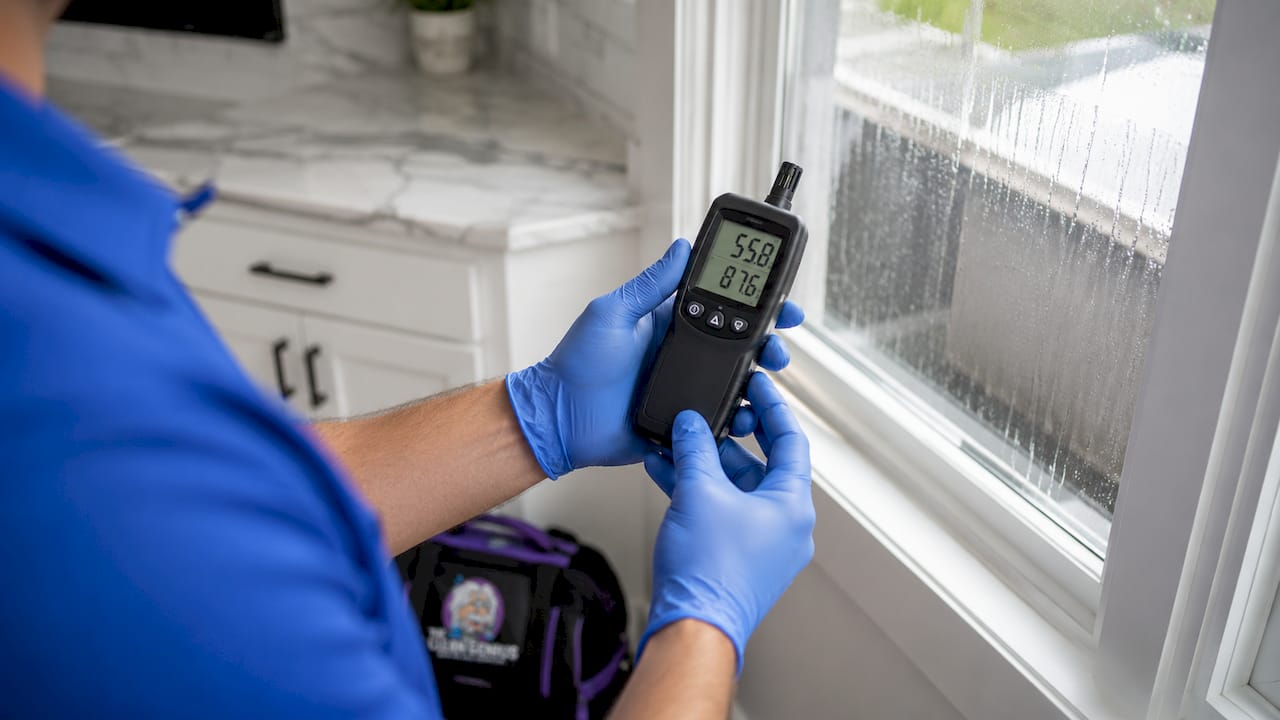
Relative humidity expresses how much moisture air holds compared to its maximum capacity at a given temperature. A reading of 60% RH means the air holds 60% of what it could hold before becoming saturated. RH alone can mislead you because warm air holds far more moisture than cool air, so a 50% RH reading at 90°F represents a much heavier moisture load than the same percentage at 65°F.
Dew point is the temperature at which air becomes fully saturated and moisture begins to condense. When air inside a drying structure cools below its dew point, condensation forms on surfaces and inside wall cavities. This causes secondary damage like mold and warping, which is why professionals monitor dew point continuously throughout the project.
Grain depression is the difference between the GPP entering a dehumidifier and the GPP leaving it. Effective structural drying targets a grain depression of 40 to 50+ GPP to confirm that the equipment is pulling meaningful amounts of moisture from the air. Hitting this target requires correctly sized industrial dehumidifiers matched to the room volume and moisture load.
- Vapor pressure differential drives moisture from wet materials into the air.
- Grains per pound (GPP) is the absolute moisture measure that confirms drying progress.
- Relative humidity (RH) shows moisture saturation relative to air temperature.
- Dew point marks the condensation threshold that triggers secondary damage.
- Grain depression validates dehumidifier performance against a measurable target.
Pro Tip: Ask your restoration contractor to show you the GPP readings from day one and day three. If the numbers are not dropping, the drying system needs adjustment.
How are psychrometric measurements conducted during restoration?
Professional documentation follows IICRC S500 standards, which require daily logging of dry-bulb temperature, relative humidity, and grains per pound across three zones: the affected area, an unaffected reference area, and outdoor conditions. This three-zone comparison is what proves drying is happening inside the structure rather than just reflecting changes in outdoor weather.
The tools used matter as much as the readings themselves. Calibrated thermo-hygrometers measure temperature and RH simultaneously. Moisture meters with pin and pinless modes measure water content inside wood, drywall, and concrete. Thermal imaging cameras reveal moisture trapped behind walls without requiring demolition. Each tool must be calibrated before use because uncalibrated sensors can produce 5 to 10% RH measurement errors, which is enough to declare a structure dry when it is not.
Here is how a professional daily monitoring cycle works:
- Record dry-bulb temperature, RH, and GPP in all three zones at the same time each day.
- Take moisture meter readings at pre-marked points on walls, floors, and ceilings.
- Compare today’s readings to the previous day’s baseline to calculate drying rate.
- Adjust dehumidifier settings, air mover positions, or temperature controls based on the data.
- Log all readings in a project file that will accompany the insurance claim.
Daily logs serve two purposes. They guide real-time equipment decisions, and they create a paper trail that insurance adjusters require to approve claims. Psychrometric logs prove that drying science was applied correctly, not just that equipment was present on site.
Pro Tip: Request a copy of the daily psychrometric log for your own records. If a contractor refuses, that is a serious red flag about their documentation practices.
What equipment uses psychrometric principles to control humidity?
Restoration equipment selection is not guesswork. Every piece of gear is chosen based on the psychrometric data collected at the site.
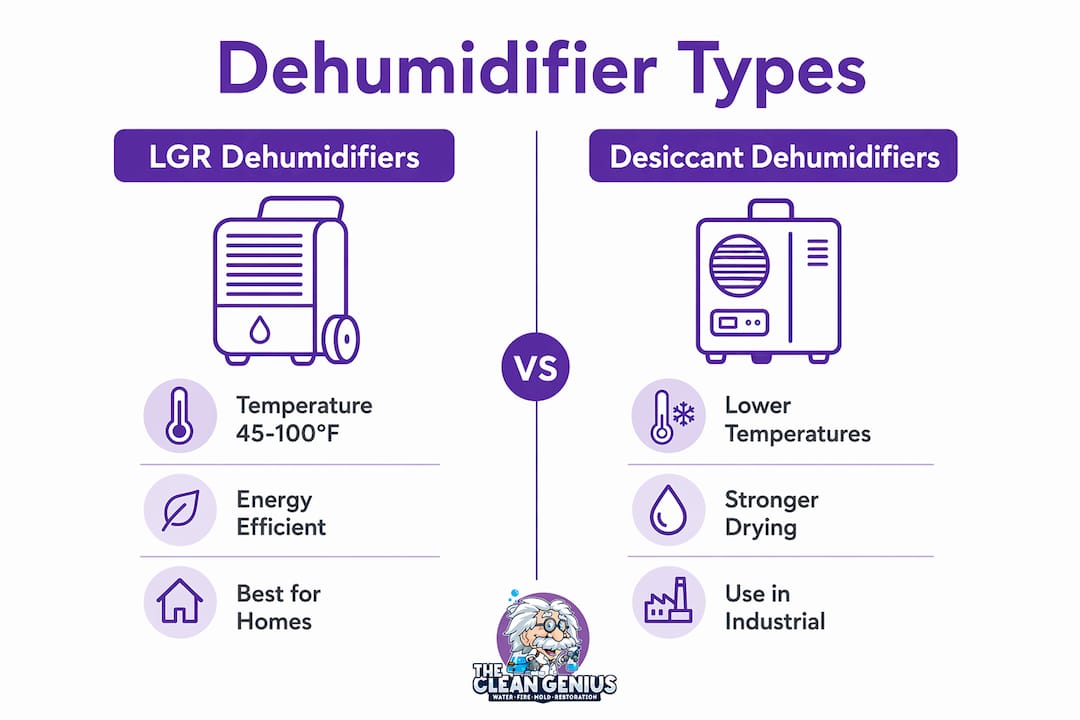
LGR vs. desiccant dehumidifiers
| Feature | LGR Dehumidifier | Desiccant Dehumidifier |
|---|---|---|
| Best operating temperature | 45°F to 100°F | Below 45°F or above 100°F |
| Grain depression capability | 40 to 50+ GPP | Extremely low GPP in cold conditions |
| Typical use case | Standard residential drying | Crawl spaces, attics, winter drying |
| Energy efficiency | High in moderate temps | Higher energy draw but broader range |
Low-grain refrigerant (LGR) dehumidifiers are the workhorse of residential water restoration. They cool incoming air below its dew point, condense the moisture out, and return dry air to the space. Desiccant dehumidifiers use silica gel or similar materials to absorb moisture chemically, making them effective in temperature ranges where LGR units lose efficiency.
Air movers work alongside dehumidifiers by disrupting the saturated boundary layer that forms directly against wet surfaces. Without airflow, a thin film of moisture-saturated air sits against the wet material and slows evaporation to a crawl. Air movers replace that stagnant layer with drier air, maintaining the vapor pressure differential that pulls moisture out continuously. However, running air movers without dehumidification simply recirculates humid air through the space, which can worsen moisture distribution rather than eliminate it.
Closed drying systems seal the affected area from outdoor air and recirculate dehumidified air internally. Open systems allow outdoor air to assist when outdoor dew point is significantly lower than indoor dew point. Professionals check outdoor psychrometric data before deciding which approach to use. Bringing in humid outdoor air during a Chicago summer, for example, would add moisture load rather than reduce it.
- Pair every air mover with a dehumidifier sized to handle the evaporated moisture load.
- Use closed systems when outdoor dew point exceeds indoor dew point.
- Avoid aggressive drying at very low RH, which can crack hardwood floors or warp trim.
- Position air movers to create a circular airflow pattern across wet surfaces for even drying.
What misconceptions about psychrometrics hurt homeowners most?
The most damaging misconception is that a surface feeling dry means the structure is dry. Moisture trapped in wall cavities and subfloors can persist for weeks after surfaces feel dry to the touch, creating conditions for mold growth that may not appear until months later. Psychrometric monitoring catches this hidden moisture because GPP readings and moisture meter data reveal what your hand cannot feel.
A second common error is assuming that more fans equal faster drying. Fans increase airflow, but airflow without dehumidification only moves humid air around. The vapor pressure differential that actually extracts moisture from materials requires the air to be drier than the material, and only dehumidification achieves that condition.
Homeowners also frequently underestimate the importance of documentation. A restoration project without daily psychrometric logs is a liability. If your insurance company disputes the claim or mold appears six months later, those logs are the evidence that proves the work was done correctly. A contractor who skips documentation is not just cutting corners on paperwork. They are removing your protection.
Finally, many homeowners accept a contractor’s verbal assurance that drying is complete without asking for the moisture meter readings that confirm it. Timber moisture content should reach 8 to 12% before a structure is declared dry. That number comes from a calibrated meter, not a visual inspection or a contractor’s estimate.
Key takeaways
Psychrometrics transforms water damage restoration from guesswork into a measurable, verifiable science that protects your home and supports your insurance claim.
| Point | Details |
|---|---|
| Vapor pressure drives drying | Dehumidification creates the differential that pulls moisture from wet materials into the air. |
| GPP is the progress metric | Falling grains per pound readings confirm drying is working; flat or rising numbers signal a problem. |
| Documentation protects you | Daily psychrometric logs are required by IICRC S500 and are essential for insurance claim approval. |
| Equipment must work together | Air movers without dehumidifiers recirculate humidity and can worsen moisture problems. |
| Surface dryness is not true dryness | Moisture in wall cavities and subfloors requires meter readings, not touch tests, to confirm removal. |
Why I take psychrometrics personally on every job
After years of responding to water damage calls across Chicagoland, I have seen what happens when restoration is done by feel rather than by data. A homeowner in Schaumburg once called us six months after a burst pipe because black mold had appeared behind her kitchen cabinets. The previous contractor had run fans for three days, declared the job done, and moved on. No moisture meter readings. No GPP logs. No dew point monitoring. The wall cavity had never dried below 20% moisture content.
What frustrates me most is that this outcome is completely preventable. Psychrometric science gives restoration professionals a precise, objective way to know when a structure is truly dry. It removes the guesswork that leads to mold claims, structural rot, and insurance disputes. When I see a contractor show up with fans and no calibrated hygrometer, I know the homeowner is being set up for a problem they will not discover for months.
The homeowners who fare best are the ones who ask questions. Ask for the GPP readings. Ask what grain depression the dehumidifier is achieving. Ask to see the moisture meter readings at the end of each day. A qualified contractor will welcome those questions because the data supports their work. A contractor who deflects those questions is telling you something important about how they operate.
You can also learn more about preventing mold after water damage by understanding how moisture control and remediation connect. The science is the same. The stakes are equally high.
— Jim
How Thecleangenius uses psychrometric science to protect your home
When water damage hits your Chicagoland home, the difference between a complete recovery and a mold problem six months later comes down to how precisely the drying is managed from day one.

Thecleangenius brings certified technicians, calibrated hygrometers, LGR dehumidifiers, and daily psychrometric logging to every water damage restoration project across Arlington Heights, Naperville, Schaumburg, and the greater Chicagoland area. Every project follows IICRC S500 documentation standards, so your insurance claim has the psychrometric data it needs for approval. Our team is available 24/7 for emergencies. If you want to see what a properly documented restoration looks like, review our successful restoration examples or call us now for an immediate assessment.
FAQ
What is the role of psychrometrics in water restoration?
Psychrometrics measures how air holds and moves moisture, guiding every drying decision in water restoration. It determines equipment selection, drying targets, and when a structure is genuinely dry rather than just surface-dry.
How does relative humidity differ from grains per pound?
Relative humidity shows moisture as a percentage of air’s maximum capacity at a given temperature, while grains per pound measures the absolute moisture content in the air. GPP is more reliable for tracking drying progress because it does not change with temperature fluctuations.
Why do restoration professionals monitor dew point?
Dew point marks the temperature at which air becomes saturated and condensation forms. Professionals keep air temperature above the dew point throughout drying to prevent moisture from recondensing inside walls and causing secondary damage like mold or warping.
How do I know if my contractor is using psychrometric monitoring correctly?
Ask to see daily logs showing dry-bulb temperature, RH, GPP, and moisture meter readings for affected, unaffected, and outdoor zones. IICRC S500 requires this documentation, and any certified contractor should provide it without hesitation.
Can I use a home hygrometer to check drying progress myself?
Consumer hygrometers are not calibrated to restoration standards and can produce errors large enough to misrepresent drying progress. Rely on readings from your contractor’s calibrated equipment, and ask for a copy of the daily log to review the numbers yourself.