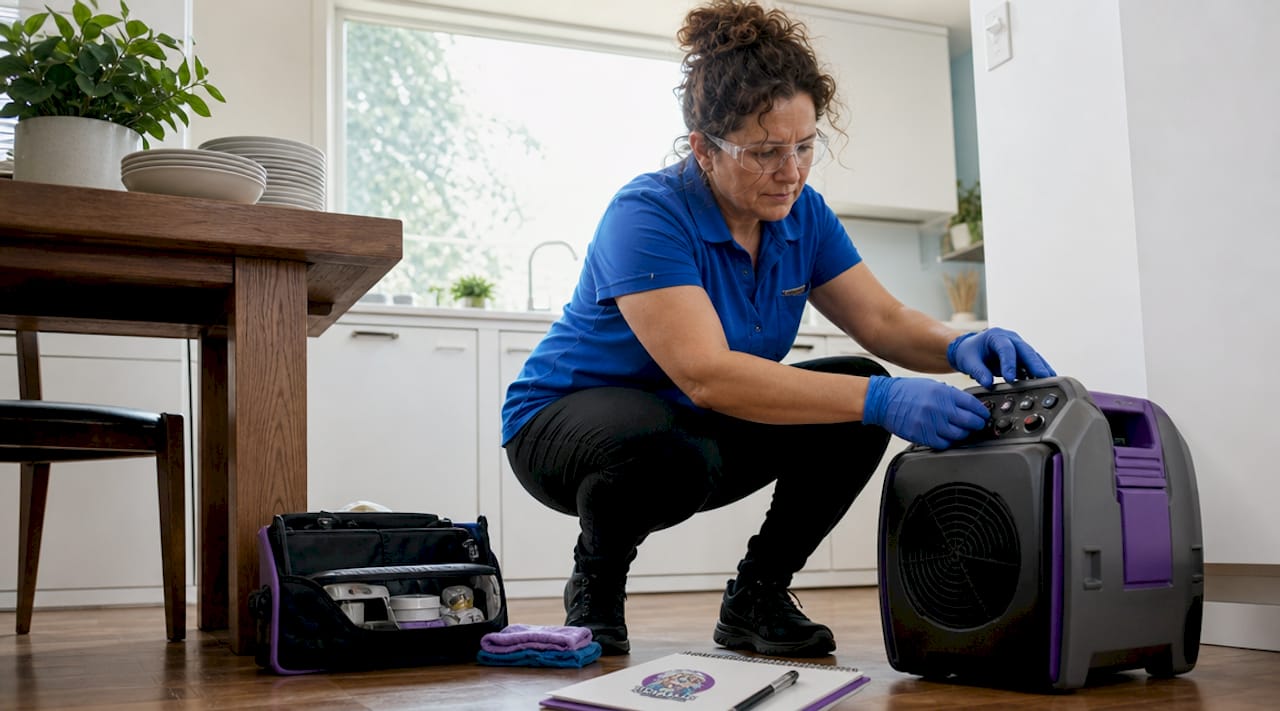

An air scrubber is a filtration device that pulls airborne mold spores through a HEPA filter, trapping them before they can settle on new surfaces or enter your lungs. The role of air scrubbers in mold removal is to control what you cannot see: the microscopic spore cloud that mold disturbances create. Without this step, cleaning visible mold growth while leaving the air contaminated is like mopping a floor while the ceiling is still leaking. This guide explains how air scrubbers work, where they fit in a professional remediation sequence, and what you should realistically expect them to do for your home.
How do air scrubbers work in mold remediation?
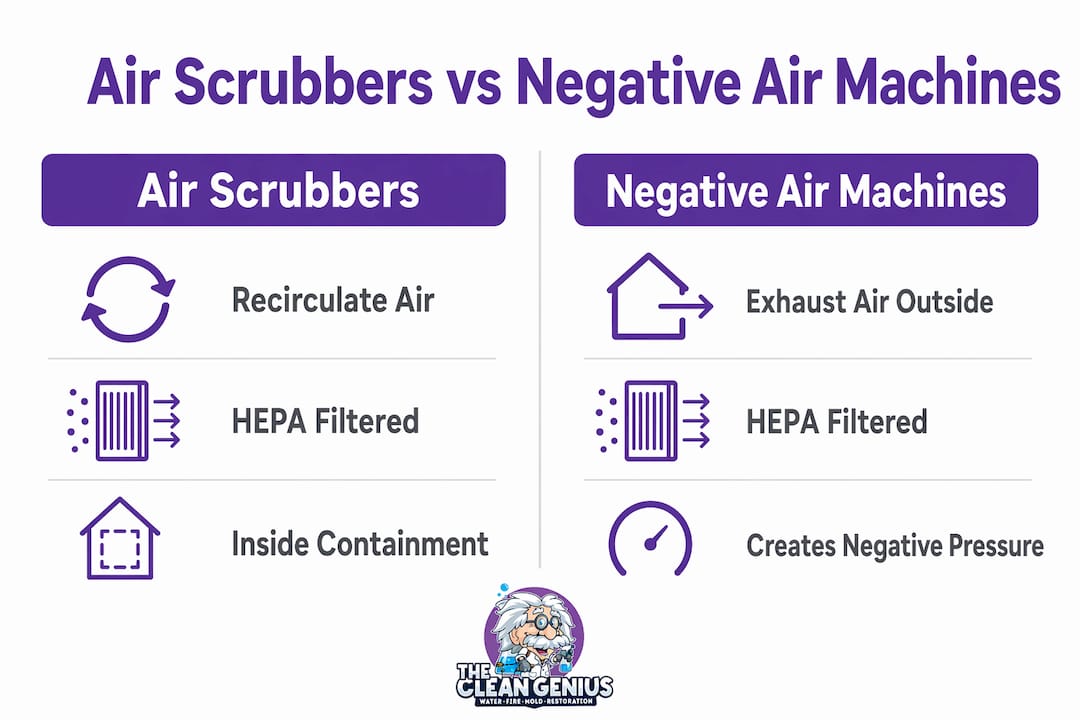
Air scrubbers and negative air machines are both used in mold remediation, but they serve different functions and are not interchangeable. Understanding the difference protects you from making a costly mistake during cleanup.
An air scrubber pulls room air through a series of filters, with a true HEPA filter as the final stage. HEPA filters capture 99.97% of particles 0.3 microns and larger, which covers the full size range of mold spores (1 to 30 microns). The cleaned air is then returned to the same space. This recirculation mode reduces the total spore count inside a contained area but does not change the air pressure in the room.
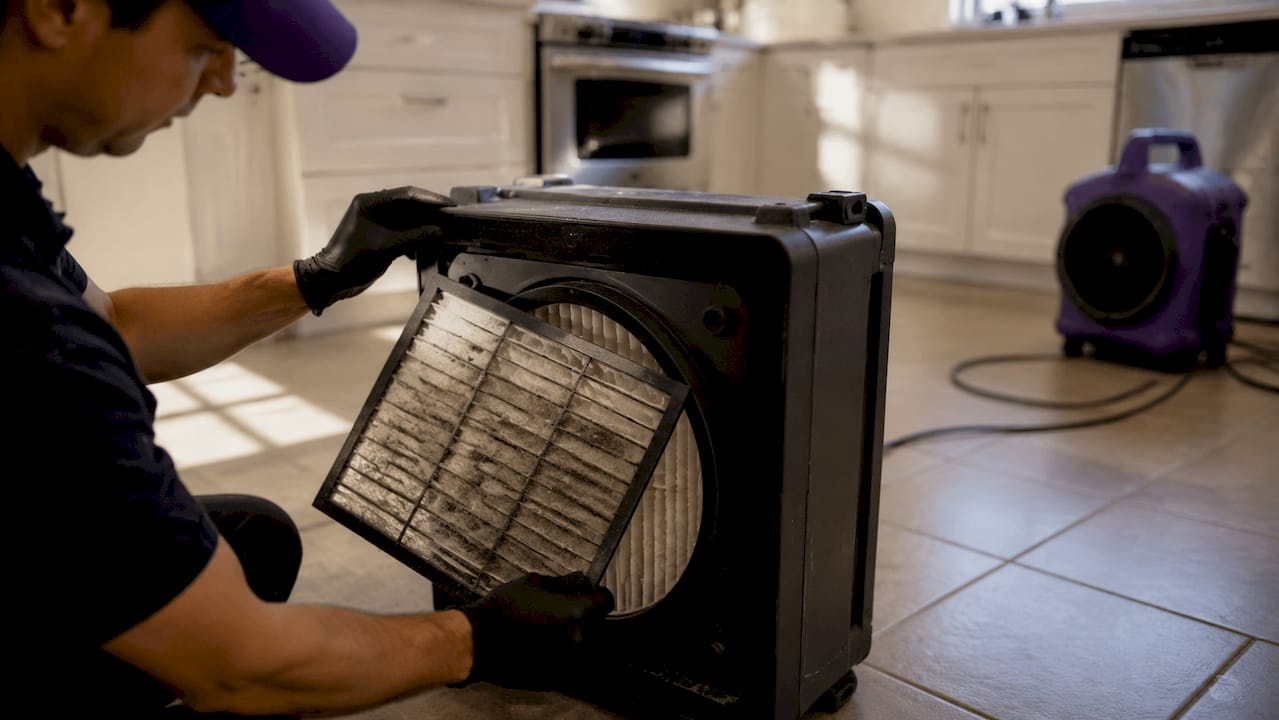
A negative air machine uses the same HEPA filtration but exhausts the filtered air outside the containment zone through ducting. This creates negative pressure inside the work area, meaning air flows inward rather than outward whenever a barrier is breached. Air scrubbers do not create negative pressure, so they cannot prevent spores from escaping through gaps in plastic sheeting when a worker enters or exits. For large or severe mold jobs, negative air machines handle pressure control while air scrubbers handle spore load reduction.
Air purifiers designed for home use are a third category. They share HEPA technology with professional air scrubbers but are built for lower airflow rates and lighter-duty continuous use. They are not rated for active remediation environments where spore concentrations spike dramatically during demolition or material removal.
| Device | Function | Creates negative pressure? | Best use case |
|---|---|---|---|
| Air scrubber | Recirculates and filters air within containment | No | Reducing spore load during and after remediation |
| Negative air machine | Exhausts filtered air outside, creates pressure differential | Yes | Preventing spore spread beyond containment barriers |
| Home air purifier | Filters air for everyday indoor air quality | No | Ongoing maintenance after remediation is complete |
Pro Tip: If a contractor shows up with only an air scrubber for a large mold job affecting multiple rooms, ask specifically how they plan to maintain negative pressure. Recirculation alone is not enough for serious infestations.
What is the role of air scrubbers in a complete mold remediation process?
Air scrubbers are one layer in a multi-step process. Treating them as a standalone fix is the most common and most expensive mistake homeowners make. The standard remediation sequence follows a specific order for a reason: skipping or reordering steps undermines the ones that come after.
Here is how a complete remediation unfolds, and where air scrubbers fit:
- Moisture source correction. The EPA prioritizes moisture control above all other steps, recommending that wet materials be dried within 24 to 48 hours to prevent mold establishment. No filtration device compensates for an active leak or chronic humidity problem.
- Containment setup. Plastic sheeting and zipper doors isolate the work area. This step is what makes air filtration meaningful, because without containment, running an air scrubber in an open room simply redistributes spores to adjacent spaces.
- Air filtration activation. Air scrubbers (and negative air machines on larger jobs) are turned on before any physical disturbance of mold-affected materials. This is the phase where the role of air scrubbers in mold removal is most direct.
- Physical removal. Mold-affected drywall, insulation, or other porous materials are bagged and removed. Spore counts spike during this phase, which is exactly why air scrubbers must already be running.
- Cleaning and HEPA vacuuming. Surfaces are cleaned with appropriate agents. HEPA vacuuming captures settled spores from surfaces that air filtration cannot reach, making it a critical complement to air scrubbing rather than a redundant step.
- Verification. Post-remediation testing confirms spore counts have returned to acceptable levels before containment is removed.
Understanding what mold remediation actually involves versus a simple surface cleaning is what separates a lasting fix from a temporary cosmetic patch.
Benefits and limitations of air scrubbers for home mold removal
Air scrubbers deliver real, measurable benefits during mold cleanup. They also have firm limits that no amount of runtime can overcome.
What air scrubbers do well:
- They reduce the concentration of airborne mold spores inside a contained work area, protecting both workers and building occupants.
- They improve indoor air quality during and after remediation by continuously cycling contaminated air through HEPA filtration.
- They capture mold fragments and other fine particulates that become airborne during demolition or cleaning.
- Running an air scrubber for 24 hours after final cleaning captures spores that settle slowly and would otherwise recontaminate cleaned surfaces.
What air scrubbers cannot do:
- They do not kill mold. Mold is a living organism attached to surfaces. Filtration removes spores from the air but has no effect on colonies growing inside walls or under flooring.
- They do not neutralize mycotoxins. Mycotoxins are non-living byproducts of mold metabolism, and trapping spores does not remove the toxins already present on surfaces. Source removal and cleaning are the only answers.
- They do not control moisture. Running an air scrubber in a basement with an active water intrusion problem will not prevent new mold growth.
- They cannot replace containment. Without physical barriers, an air scrubber in recirculation mode can actually pull spores from the work area into adjacent rooms through HVAC returns or gaps in walls.
Pro Tip: Filter maintenance matters more than most homeowners realize. A clogged pre-filter forces the HEPA stage to work harder and reduces airflow, cutting the device’s effectiveness significantly. Check pre-filters daily during active remediation.
How to use an air scrubber for mold removal effectively
Knowing how to use an air scrubber for mold correctly determines whether you get real protection or a false sense of security. These practical steps apply whether you are managing a small DIY cleanup or overseeing a professional crew.
- Start the air scrubber before disturbing anything. Mold spore counts increase dramatically the moment you cut into drywall or pull up flooring. The device needs to be running and filtering before that first disturbance.
- Size the unit to the space. Air scrubbers are rated by air changes per hour (ACH). Remediation environments typically require a minimum of 4 ACH. A unit too small for the room will not keep pace with spore generation during active removal work.
- Seal the work area first. Containment barriers are not optional. Without them, you are filtering air in an open system, which is far less effective than filtering within a sealed zone. Read more about why containment protects your home before starting any cleanup.
- Wear appropriate PPE. An N95 respirator, gloves, and eye protection are the minimum for any mold disturbance. An air scrubber reduces ambient spore levels but does not eliminate exposure risk for the person doing the physical work.
- Run the unit continuously. Do not turn it off between work sessions. Spores that settle overnight become airborne again when activity resumes the next morning.
- Know when to call a professional. The EPA recommends professional remediation for mold covering more than 10 square feet. Beyond that threshold, the spore load, structural involvement, and safety risks exceed what a homeowner with a rented air scrubber can safely manage. Knowing when to call the pros is itself a form of protection.
The difference between mold remediation and basic cleaning is not just technique. It is the layered use of containment, filtration, physical removal, and verification working together.
Key takeaways
Air scrubbers are a necessary part of mold remediation, but they work only when paired with containment, source removal, and moisture control.
| Point | Details |
|---|---|
| HEPA filtration is the core mechanism | True HEPA filters capture 99.97% of particles, including all mold spore sizes. |
| Air scrubbers recirculate, not exhaust | They reduce spore load inside containment but do not create negative pressure. |
| Moisture control comes first | The EPA identifies drying within 24 to 48 hours as the primary mold control step. |
| Air scrubbers have firm limits | They do not kill mold, remove mycotoxins, or replace physical source removal. |
| Runtime matters | Run continuously during remediation and for 24 hours after final cleaning. |
What I have learned after 25 years of mold jobs in Chicagoland
The homeowners I talk to most often fall into one of two camps. The first group thinks an air scrubber or a store-bought air purifier will solve their mold problem if they run it long enough. The second group has never heard of air scrubbers at all and is shocked to learn that professional remediation involves anything beyond bleach and a sponge.
Both misunderstandings cost people money and, more importantly, health. I have walked into homes where a family ran a consumer-grade air purifier for three months while mold continued spreading behind the drywall. The air quality readings looked better. The mold was worse than ever.
The ANSI/IICRC S520-2024 standard that guides certified remediators exists because mold is a systems problem, not a single-device problem. Air scrubbers are genuinely valuable. They protect workers, they protect occupants, and they are a non-negotiable part of any serious remediation. But they are one instrument in an orchestra, not a solo act.
My honest advice: if you can see mold covering more than a square foot or two, or if you smell it but cannot find it, stop shopping for equipment and start calling certified remediators. The cost of doing it right once is always lower than the cost of doing it wrong twice.
— Jim
Professional mold removal in Chicagoland that gets it right the first time
If you are dealing with mold in your home, Thecleangenius brings over 25 years of combined experience and a certified team that uses advanced remediation technology, including proper air filtration, containment, and moisture control, to every job.

Thecleangenius serves homeowners across Arlington Heights, Naperville, Schaumburg, Elgin, and the broader Chicagoland area with 24/7 emergency response. Our mold removal and remediation services cover everything from initial moisture assessment through post-remediation verification, so you know the job is finished and not just paused. If water damage is the source of your mold problem, our water damage restoration team responds around the clock to stop the moisture before mold takes hold.
FAQ
Do air scrubbers actually remove mold spores from the air?
Yes. Air scrubbers equipped with true HEPA filters capture 99.97% of particles 0.3 microns and larger, which includes the full size range of mold spores. They reduce airborne spore concentration significantly within a contained work area.
What is the difference between an air scrubber and an air purifier for mold?
Air scrubbers are rated for high-volume, high-contamination environments and are designed for active remediation use. Home air purifiers use similar HEPA technology but operate at lower airflow rates and are not built to handle the spore concentrations generated during mold removal work.
How long should an air scrubber run during mold remediation?
An air scrubber should run continuously throughout the entire remediation process and for at least 24 hours after the final cleaning phase. This captures spores that settle slowly and would otherwise recontaminate cleaned surfaces.
Can I use an air scrubber instead of calling a professional?
For mold areas smaller than 10 square feet, careful DIY cleanup with proper containment and PPE is feasible. The EPA recommends professional remediation for anything larger, where spore loads, structural involvement, and safety risks exceed what a homeowner can safely manage with rented equipment.
Will an air scrubber stop mold from growing back?
No. Air scrubbers filter spores from the air but do not address the moisture source that allows mold to grow. Without correcting the underlying water intrusion or humidity problem, mold will return regardless of how long the air scrubber runs.