
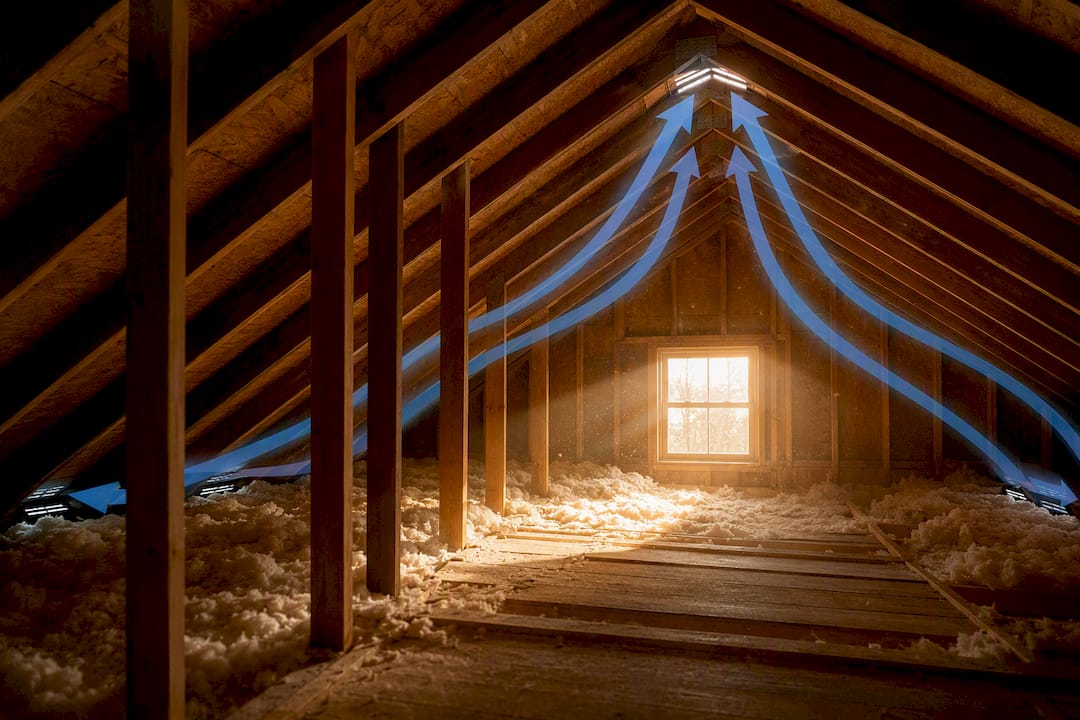
A properly sized continuous soffit intake paired with a continuous ridge exhaust creates the passive “low-in, high-out” loop that keeps attics dry and shingle life long. Cool air enters at the eaves, warm moist air escapes at the peak, and the attic stays close to outdoor conditions year-round.
If you check one thing today, check this: is your soffit intake actually open, and does your ridge vent’s length roughly match your soffit intake’s net free area? A ridge vent installed over blocked or undersized soffits does almost nothing.
- Feel for airflow at the soffits from inside the attic on a breezy day. No movement usually means blocked or missing intake.
- Compare the totals against the widely used 1:300 rule for balanced intake and exhaust.
- If you can’t tell what you’re looking at, that’s reason enough to call a roofer or restoration pro before winter.
Key Takeaways
Balanced airflow between soffit intake and ridge exhaust, sized to roughly the 1:300 NFVA rule, is what actually prevents attic moisture, mold, and ice dams.
| Point | Details |
|---|---|
| Airflow needs two working halves | Soffit intake and ridge exhaust must both be open; one without the other barely functions. |
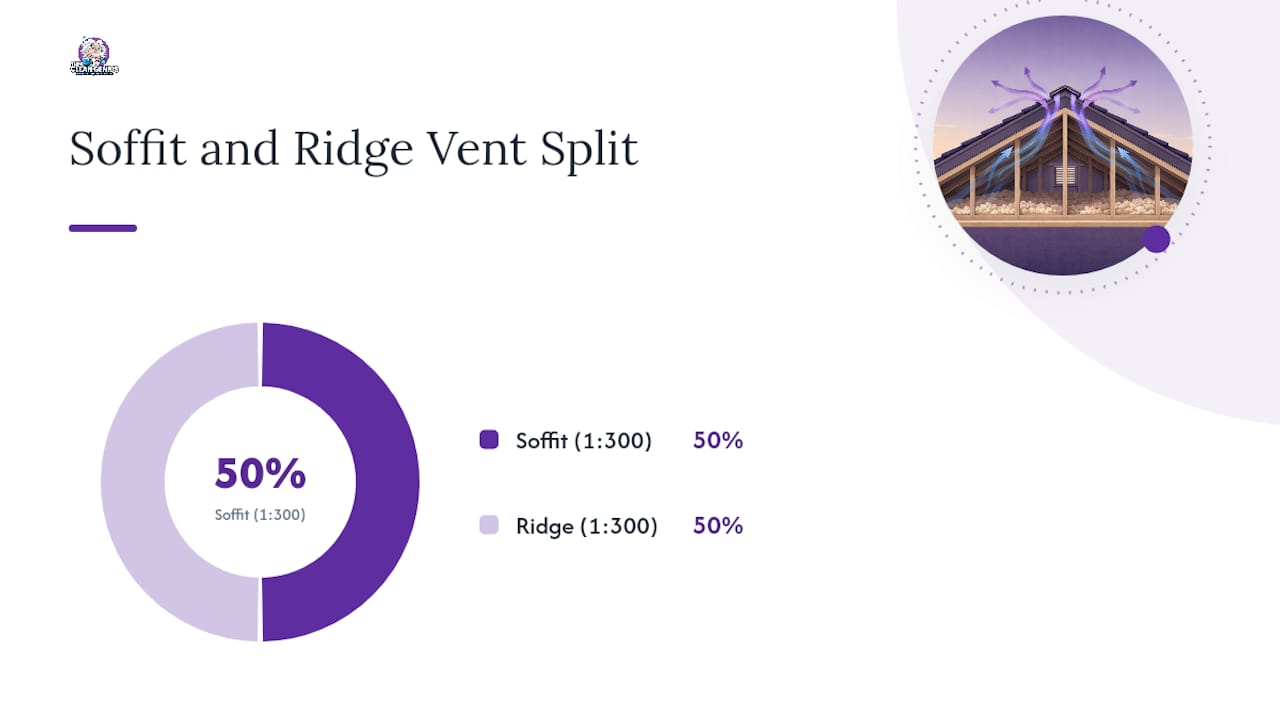
| Use the 1:300 rule to size vents | A typical code guideline suggests total net free ventilating area roughly proportional to the attic floor area, generally split evenly between soffit intake and ridge exhaust. |
| Baffles keep intake clear | Rigid rafter baffles stop blown insulation from blocking soffit openings over time. |
| Watch for short-circuiting | Static vents or powered fans near a ridge vent can pull air from the wrong path and leave soffits doing nothing. |
| Call a pro for active moisture problems | Thecleangenius provides moisture mapping, documented inspections, and Pure Cloud dry-fog mold remediation across Chicagoland. |
Table of Contents
- What Is a Soffit Vent and How Does It Work?
- What Is a Ridge Vent and Why Does It Matter?
- How Do Soffit and Ridge Vents Work Together?
- When Do You Need Both Soffit and Ridge Vents?
- How Do You Check Your Attic’s Ventilation Yourself?
- Why Isn’t My Attic Ventilation Working Right?
- How Often Should You Inspect Attic Vents?
- What Are the Alternatives to Soffit-and-Ridge Ventilation?
- When Should You Call a Restoration Professional?
- Get Professional Help for Attic Mold or Moisture Damage
- Frequently Asked Questions
- Sources
What Is a Soffit Vent and How Does It Work?
A soffit vent sits on the underside of your roof’s eaves, the horizontal overhang you see when you look up from your driveway. It’s the intake half of the system. Its only job is pulling in outside air at the lowest point of the attic so that air has somewhere to start its climb toward the ridge.
Three types show up on most Chicagoland homes:
- Continuous perforated soffit panels: vinyl or aluminum panels with evenly spaced holes running the full length of the eave.
- Individual round or rectangular grille vents: smaller, spaced-out vents cut into solid soffit material, common on older homes.
- Vented drip edge: a metal drip edge with built-in slots, sometimes added during a reroof when soffit space is tight.
Every soffit product carries a Net Free Area (NFA) rating, usually listed in square inches per linear foot. That number tells you how much actual open area exists for air to pass through, not just the size of the vent panel itself. A panel that looks generously perforated might carry a lower NFA rating than a plainer-looking one, so the number on the packaging matters more than appearance.
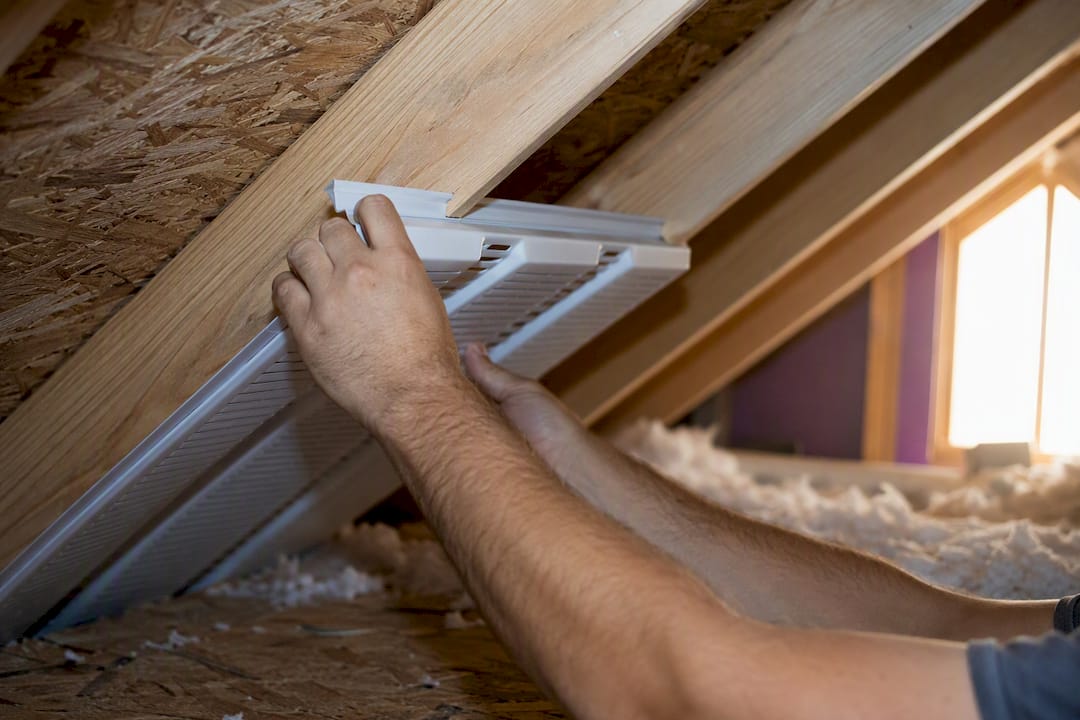
Pro Tip: Before you buy replacement soffit material, install rafter baffles (also called insulation chutes) in each bay first. Without them, blown insulation slides right down and blocks the vent from behind, even if the soffit itself looks wide open. Installing rafter vents properly is what keeps that path clear for the life of the roof.
What Is a Ridge Vent and Why Does It Matter?
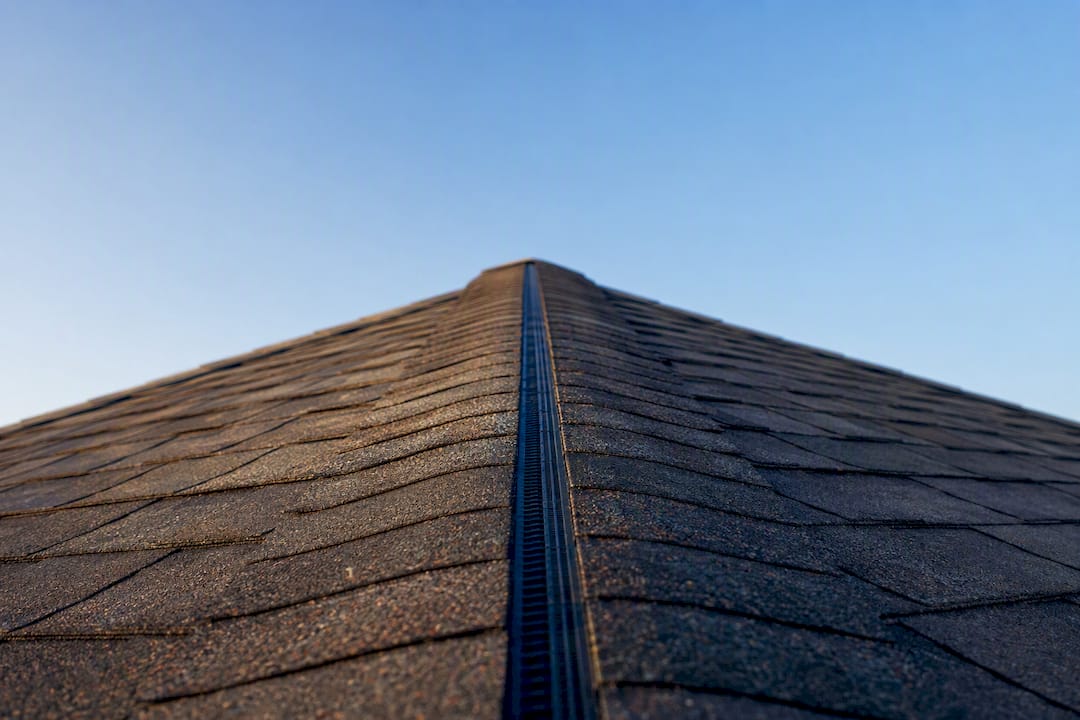
A ridge vent runs along the peak of your roof, exhausting the warm, moisture-laden air that’s risen from the attic below. It’s the half of the system most people notice, because it’s visible from the street as a slightly raised strip of shingle-covered material along the roofline.
Continuous ridge vents outperform individual static vents and turbines in most homes. A continuous run exhausts air evenly across the entire peak, while a scatter of static box vents or turbines leaves dead zones between them where hot, humid air just sits. Continuous ridge systems also tend to carry higher NFA ratings per linear foot, which matters when you’re trying to hit code minimums.
The slot cut into the sheathing before installation matters more than most homeowners realize. Cut it too wide and you risk weakening the roof deck near the ridge; cut it too narrow and airflow chokes. Roofers typically cut 1.5 to 2 inches per side, stopping short of gable ends to preserve structural integrity.
- Rigid-plastic baffle ridge products hold their rated NFA better over time than rolled mesh, which can compress during installation and lose capacity.
- Ridge cap shingles need to integrate cleanly over the vent baffle so wind-driven rain doesn’t find a way in.
- Never install a ridge vent over rafters that lack a clear soffit-to-ridge airway. It becomes a decorative strip, not a working vent.
How Do Soffit and Ridge Vents Work Together?
Warm air rises. Give it a high exit point and a low entry point, and it moves on its own, no fans, no power, no moving parts. That’s the entire mechanism behind soffit-to-ridge ventilation, and it’s why the system keeps working during a power outage or a decade after installation with zero maintenance beyond keeping the paths clear.
Two forces drive this loop. Stack effect is the temperature-driven pull: hot air in the attic is less dense than the cooler air outside, so it rises and escapes through the ridge, pulling replacement air in through the soffits. Wind adds a second push, creating negative pressure at the ridge that helps draw air upward even on cooler days when stack effect alone is weak. When intake and exhaust are balanced, these two forces work together consistently. When intake is undersized, the system leans almost entirely on wind, and performance gets inconsistent, strong on a breezy afternoon, dead on a still, humid night, which happens to be exactly when attic moisture causes the most damage.
The 1:300 rule, referenced in building codes and Building America Solution Center guidance, requires total net free ventilating area equal to at least 1/300 of the attic floor area, split roughly 50/50 between soffit intake and ridge exhaust.
Here’s how that math actually plays out on a real roof. Take a 1,200 square foot attic:
- 1,200 ÷ 300 = 4 square feet of total required NFVA (that’s 576 square inches).
- Split 50/50: 288 square inches at the soffits, 288 square inches at the ridge.
- If your soffit product is rated at 9 square inches per linear foot, you’d need roughly 32 linear feet of soffit vent to hit your intake target.
- If your ridge vent is rated at 18 square inches per linear foot, about 16 linear feet of ridge run covers the exhaust side.
Industry ventilation primers recommend keeping 40 to 50% of total NFVA within 3 feet of the ridge itself, rather than spread across scattered high vents, which is one more reason a continuous ridge run beats a handful of static vents scattered near the peak.
Picture a simple cross-section of your attic: air enters low at both eaves, rises along the underside of the roof deck, and exits through a continuous slot at the peak. Cold-climate builders sometimes tilt that balance slightly, favoring more intake than exhaust (something closer to a 3:2 soffit-to-ridge ratio) because extra intake volume helps prevent condensation from forming on cold sheathing during long winters. If you’re in a milder region, the straight 50/50 split works fine.
When Do You Need Both Soffit and Ridge Vents?
Almost every asphalt-shingle roof with a standard attic benefits from the pairing, but a few scenarios make it close to mandatory rather than just a nice upgrade.
The benefits stack up fast once the system is balanced: moisture control that keeps mold and wood rot at bay, fewer ice dams because the roof deck stays closer to outdoor temperature, shingles that run cooler in summer and last longer as a result, and lower humidity throughout the attic space overall.
You’re a strong candidate for a soffit-to-ridge upgrade if any of these apply:
- You’re installing a new roof or doing a full reroof, and the existing soffits are already in decent shape.
- Your attic insulation currently runs all the way to the eaves with no baffle keeping a clear air channel.
- Your roof has a long, continuous ridge run rather than a chopped-up hip design with limited peak length.
- You’re seeing early signs of moisture, like frost on nail heads or a musty smell, without any obvious leak.
Run through a quick checklist: continuous eaves with existing soffit material, a decent ridge length, and rafter bays that aren’t packed solid with insulation. Check most of those boxes, and soffit-plus-ridge is generally the preferred setup over gable vents or powered fans.
How Do You Check Your Attic’s Ventilation Yourself?
You don’t need a contractor to do a first-pass evaluation. Grab a flashlight, head into the attic on a mild day, and work through this sequence.
- Look for daylight at the eaves. From inside the attic, shine a light toward where the roof meets the exterior wall. You should see gaps or perforations, not solid blocked wood or a wall of insulation.
- Check that baffles are actually installed. Rigid or foam baffles should sit in each rafter bay at the eave, holding insulation back from the soffit opening.
- Feel for air movement at the soffits. Do this on a day with a light breeze. Cold air pulling in at the eaves is the system working; stagnant, still air suggests blockage.
- Measure your ridge run and compare it to your soffit intake. A long ridge vent paired with a handful of small, gappy soffit vents is a mismatch you’ll want to fix.
- Repeat the airflow check on a calm day versus a windy one. If airflow only happens when it’s windy, your system is leaning on wind alone, a sign intake is undersized relative to exhaust.
Working in an attic has real risks. Stick to the joists, never step directly on insulation (you can’t see the ceiling drywall underneath, and it won’t hold your weight), and use a stable attic ladder. If you spot signs of structural rot, sagging sheathing, or you’re not comfortable moving around up there, stop and call a professional instead of pushing further.
Pro Tip: Baffles that have slid out of place or gotten buried under blown insulation are the single most common intake failure I’ve seen described in restoration case files. A quick visual check from the attic floor, before you touch anything else, usually tells you if that’s your problem.
Why Isn’t My Attic Ventilation Working Right?
Most attic ventilation complaints trace back to one of a handful of root causes, and matching the symptom to the cause saves you from guessing.
- Hot shingles or a hot roof deck usually points to insufficient intake or dead zones between scattered static vents rather than too little exhaust.
- Condensation, staining, or mold on the underside of the roof deck almost always means blocked soffit intake or short-circuiting somewhere in the system.
- Ice dams forming along the eaves in winter signal a warm roof deck, which ties back to poor airflow letting heat build up under the shingles.
- A noisy ridge vent or water intrusion during wind-driven rain often means the wrong baffle product was chosen or installed for the local climate.
Short-circuiting happens when air finds a shorter path between two high vents instead of traveling the full route from soffit to ridge. A ridge vent combined with old static roof vents nearby is a classic setup for this: air just shuttles between the two high points and barely touches the lower attic at all, leaving the soffit intake essentially useless.
The fixes are usually straightforward once you know the cause: clear or enlarge blocked soffit openings, add or replace missing baffles, remove any powered attic fan that’s fighting the passive system, or add supplemental intake NFA at the eaves if your calculations show a shortfall. Powered attic fans deserve particular caution. ENERGY STAR notes that when soffit intake is blocked, a powered fan can create negative pressure strong enough to pull conditioned air out of the living space below, driving up energy bills instead of solving the moisture problem.
How Often Should You Inspect Attic Vents?
An annual check, plus a follow-up after any major storm or particularly harsh winter, catches most problems before they turn into a bigger repair.
Run through this list each time:
- Confirm soffit perforations are clear of paint, debris, insects, and pest nests.
- Check that baffles haven’t shifted or been buried under insulation.
- Inspect the ridge cap for loose or missing shingles and cleared-out debris.
- Look for condensation beading, dark staining, or a musty smell near the roof deck.
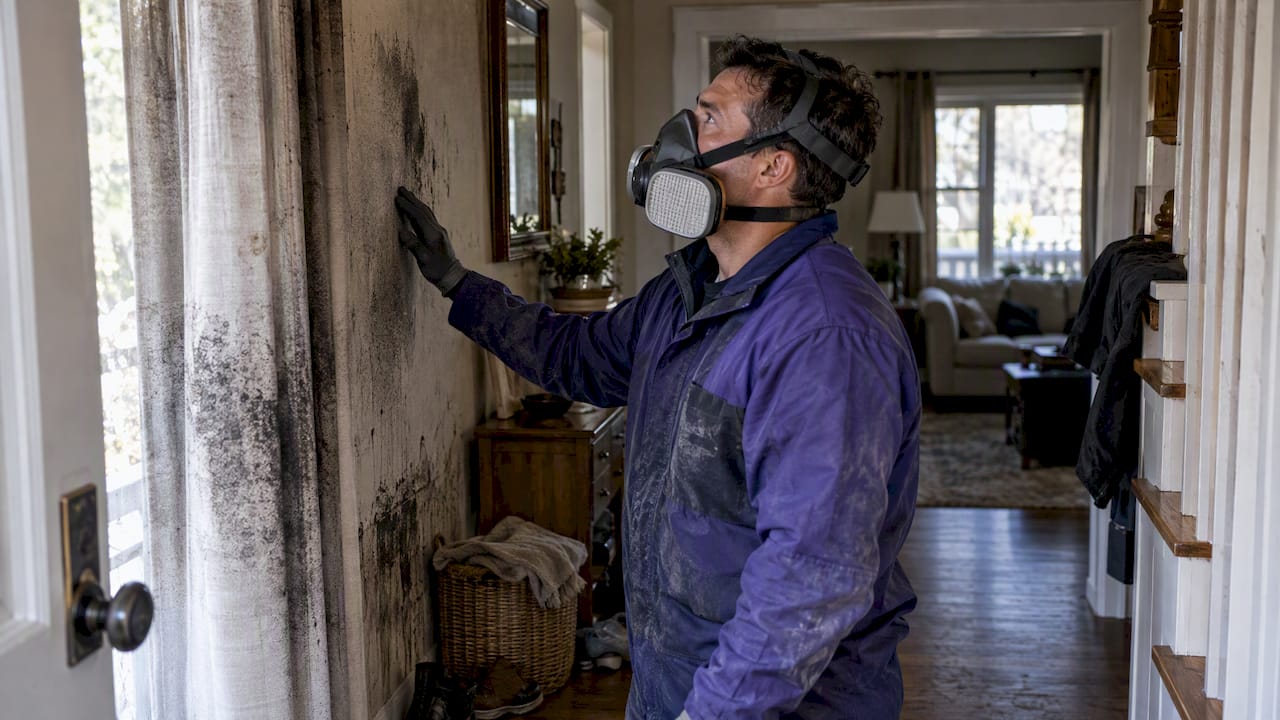
If you spot active mold growth, a roof leak that keeps recurring despite patching, or soft or discolored sheathing that suggests rot underneath, that’s your signal to bring in a professional rather than keep troubleshooting solo. Persistent moisture issues rarely resolve on their own, and attic moisture is one of the more common drivers of mold growth in homes that otherwise look fine from the outside.
What Are the Alternatives to Soffit-and-Ridge Ventilation?
Soffit-to-ridge is the standard for a reason, but it’s not the only option, and a few situations call for something different.
- Static box vents: cheaper and easier to retrofit, but they leave dead zones between units and rarely match a continuous ridge vent’s even airflow.
- Turbine vents: work well in consistently windy areas but go quiet on calm days, leaving you dependent on stack effect alone.
- Gable vents: useful on hip roofs or short-ridge designs where a continuous ridge run isn’t practical, though they can short-circuit a ridge vent if both are present without careful planning.
- Powered attic fans: solve airflow in specific hot-climate cases but carry real depressurization risk if intake isn’t properly sized first, as noted by home comfort specialists dealing with similar pressure-balance issues in HVAC systems.
- Conditioned (unvented) attics: skip traditional ventilation entirely but require spray-foam insulation and air-sealing changes that need professional design, not a weekend project.
When Should You Call a Restoration Professional?
Visible mold growth, condensation that won’t go away no matter how many vents you clear, active water intrusion, or any hint of soft, rotting sheathing are all reasons to bring in a professional rather than keep working the problem yourself.
A qualified restoration contractor should hand you a written inspection report with actual moisture readings, not just a verbal “yeah, that’s damp.” Ask for photo documentation, a clearly scoped remediation plan, and references you can actually call. If they can’t produce those deliverables, that’s a red flag worth taking seriously.
Expect a solid inspection to include:
- Moisture mapping across the attic deck and insulation.
- Photo documentation of affected areas before and after work.
- A written remediation scope with a timeline and cost breakdown.
A Homeowner’s Note on Getting This Right
I’ve seen the same mistake repeat across countless attics: homeowners fix the visible half, a shiny new ridge vent, and never touch the soffits underneath. Ventilation only works as a system. A ridge vent, clear baffles, and open soffit intake have to function together, or you’re just decorating your roofline.
Get Professional Help for Attic Mold or Moisture Damage
If your inspection turned up mold, persistent condensation, or water staining that goes beyond a simple vent fix, Thecleangenius handles what a soffit-and-baffle repair alone can’t. We’re a family-owned crew serving Chicagoland with over 25 years of combined restoration experience, and we’re available 24/7 when an attic problem turns into an active moisture emergency.

A professional inspection starts with moisture mapping across your attic deck and insulation, followed by photo documentation and a written remediation scope, not a vague verbal estimate. Our certified teams use Pure Cloud dry-fog technology for mold removal that gets into rafter bays and soffit cavities a DIY spray bottle never reaches, and we work directly with your insurance carrier on the paperwork. If your attic check turned up signs of mold rather than just a ventilation gap, schedule a mold inspection with our Chicagoland team and get a documented plan before the problem spreads further into your roof deck.
Frequently Asked Questions
Do I really need soffit vents if I already have a ridge vent?
Yes. A ridge vent without soffit intake pulls in whatever air is nearest, often conditioned air from the living space below through ceiling gaps, instead of fresh outside air. That’s the short-circuiting problem, and it can cause hidden moisture issues even though the ridge vent looks like it’s doing its job.
What is the 1:300 rule for attic ventilation?
It’s the code-referenced guideline requiring total net free ventilating area equal to at least 1/300 of your attic floor area, split roughly evenly between soffit intake and ridge exhaust. A 1,200 square foot attic needs about 4 square feet of total NFVA under that rule.
Can I add a ridge vent without adding soffit vents?
You can install one, but it won’t function as a real exhaust system without a matching intake source. Expect poor performance, possible short-circuiting, and little to no improvement in attic temperature or moisture control.
How do I know if my soffit vents are blocked?
Check from inside the attic with a flashlight on a breezy day. No visible daylight through the perforations, or no air movement when you hold your hand near the opening, usually means insulation or debris is blocking the path.
Is a powered attic fan better than a passive soffit-to-ridge system?
Not usually, and it can make things worse if your soffit intake is undersized. A powered fan can create enough negative pressure to pull conditioned air out of your living space, raising energy costs while doing little to fix the underlying moisture problem.
Sources
- Calculating Attic Passive Ventilation | Building America Solution Center
- Roof Ventilation: Types, How It Works, and Balance
- Attic Ventilation 101 | IIBEC