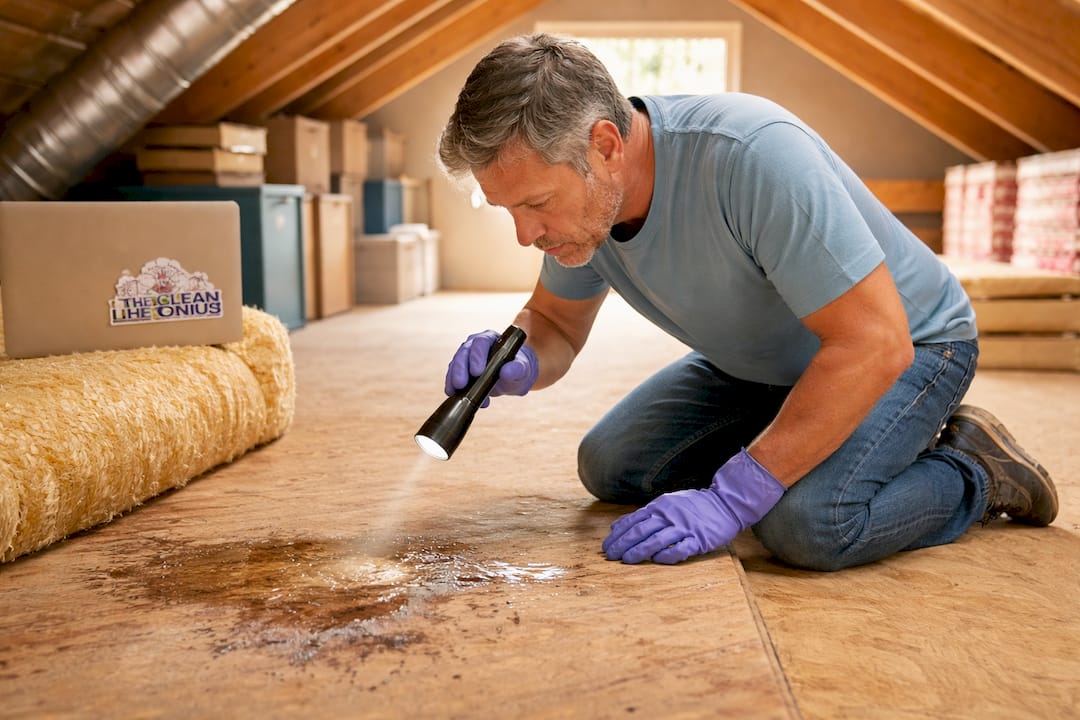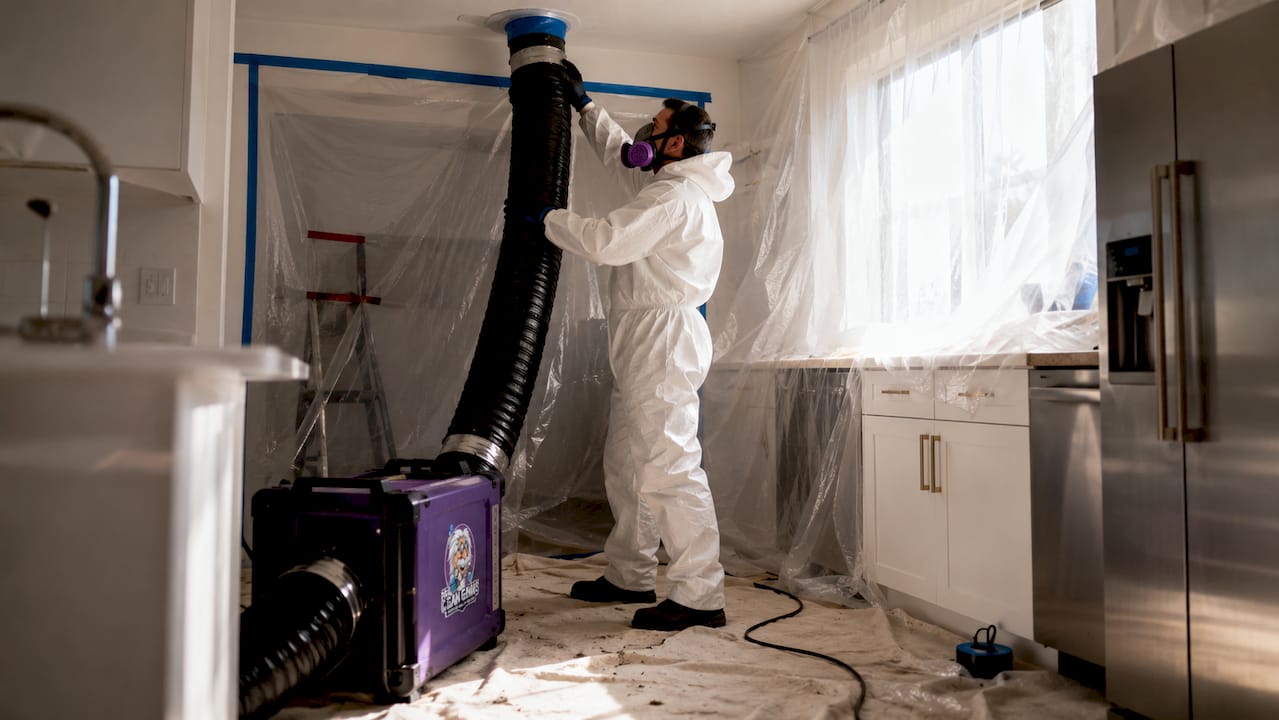

Negative air pressure in mold remediation is defined as a controlled pressure differential where the air inside a sealed work zone is kept lower than the surrounding spaces, forcing all airflow inward and preventing mold spores from escaping during cleanup. This engineering control sits at the core of the IICRC S520 standard, the industry’s governing protocol for mold remediation. Equipment like negative air machines (NAMs) and HEPA filtration systems make this possible by continuously exhausting filtered air outside the containment zone. Without this pressure differential in place, disturbing mold colonies during removal sends spores airborne into your living spaces, turning a localized problem into a whole-house contamination event.
How negative air pressure works to contain mold spores
The physics behind negative pressure containment are straightforward. When the air pressure inside a sealed remediation zone drops below the pressure in adjacent rooms, air naturally flows inward through any gaps or entry points. That inward flow acts as a one-way barrier: spores released during mold removal get pushed back into the contained zone rather than drifting out into your hallway or bedroom.
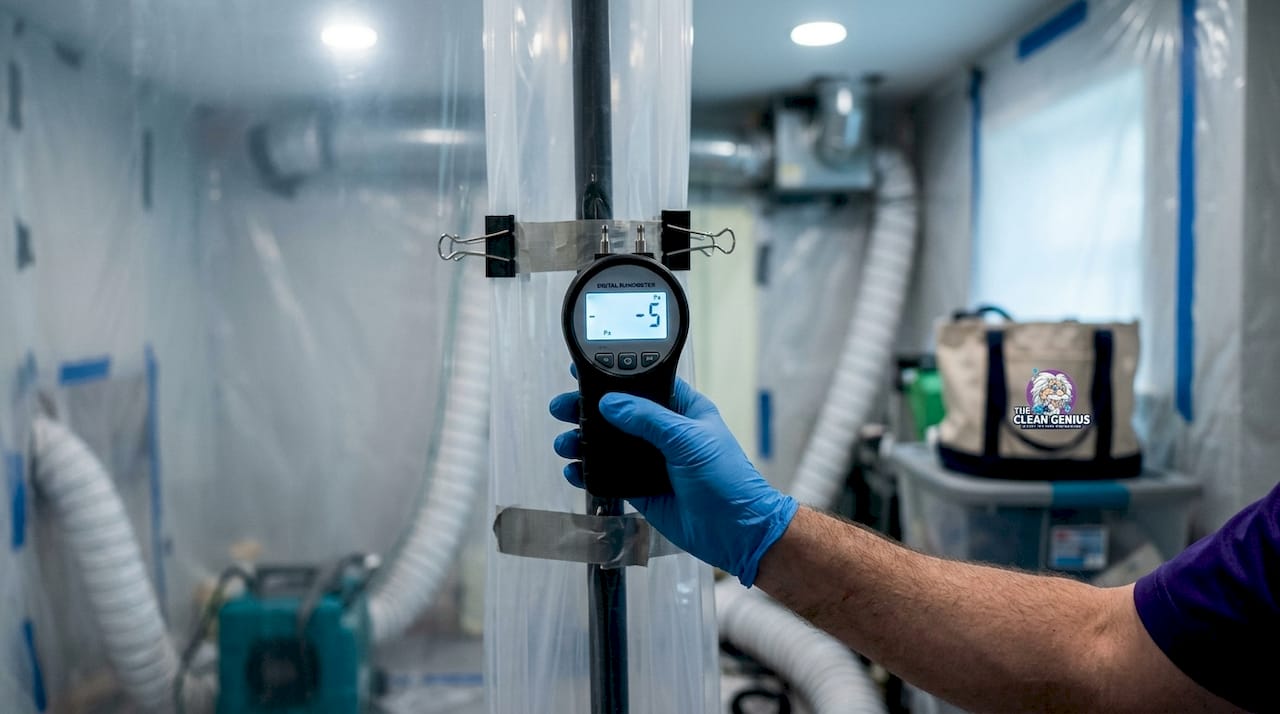
The IICRC S520 standard specifies a minimum pressure differential of 0.02 inches water column, which equals roughly -5 to -10 Pascals. That number sounds small, but it is enough to keep airflow consistently moving inward across every seam and gap in the containment barrier. Contractors verify this with a manometer or differential pressure gauge placed inside the work zone.
Negative air machines versus HEPA air scrubbers
These two pieces of equipment are not interchangeable, and confusing them is one of the most common mistakes in mold remediation setups. Negative air machines create pressure by drawing air out of the containment zone and exhausting it through ducting to the outside. That exhaust action is what drops the pressure inside. HEPA air scrubbers, by contrast, pull air through a filter and release it back into the same room. They clean the air inside the zone but produce no pressure differential at all.
Using only a HEPA air scrubber when a negative air machine is required gives you cleaner air inside the containment but zero protection against spores escaping into the rest of your home. Both tools have their place, but they serve different functions. You can read more about air scrubber limitations to understand exactly when each applies.
The containment zone also needs a dedicated intake pathway, such as an anteroom or a designed airflow gap, to control where replacement air enters. Controlled air entry prevents unpredictable pressure loss and stops contaminated air from escaping through unplanned openings.
Pro Tip: Ask your contractor to show you the manometer reading before work begins. A reading at or below -5 Pascals confirms the system is functioning. If they cannot show you a reading, the containment is not verified.
Standards, monitoring, and the mistakes that cost homeowners money
Negative pressure is not a condition you set once and walk away from. Pressure differential requires continuous monitoring because real-world conditions constantly threaten containment integrity. Every time a door opens, a worker enters the zone, or your HVAC system cycles on, the pressure balance shifts. Professional remediation teams log pressure readings throughout the project to document that containment held from start to finish.
The EPA and IICRC S520 both require containment with verified pressure differentials for projects involving mold growth over 10 square feet or work near HVAC systems and shared spaces. Here is what proper setup and monitoring looks like in practice:
- Seal the work zone completely using 6-mil polyethylene sheeting taped to walls, floors, and ceilings. Every seam, outlet, and vent gets covered.
- Install the negative air machine with ducting routed to an exterior window or door. The machine runs continuously throughout the project.
- Verify pressure with a manometer before any mold disturbance begins. The reading must hit the 0.02-inch water column threshold.
- Log readings at regular intervals throughout the workday, not just at the start. Door openings and equipment changes affect pressure constantly.
- Conduct a final post-remediation verification with a third-party inspector to confirm containment held and spore counts returned to normal levels.
Common errors that lead to failed containment and repeat remediation jobs include improper sealing around electrical outlets, running ducting back into the home instead of outside, and using undersized machines for large spaces. Poor sealing and incorrect ducting are the two most cited causes of cross-contamination in remediation failures. For larger or more complex floor plans, multiple negative air machines staged at strategic points maintain uniform pressure across the entire zone.
Pro Tip: Request a written pressure log from your contractor at the end of the job. Reputable firms provide this as standard documentation. It protects you if mold reappears and you need to make an insurance or warranty claim.
Comparing mold removal techniques: negative pressure versus alternatives
Not every mold situation requires the same response. The table below compares three common approaches so you can understand what level of protection each actually provides.
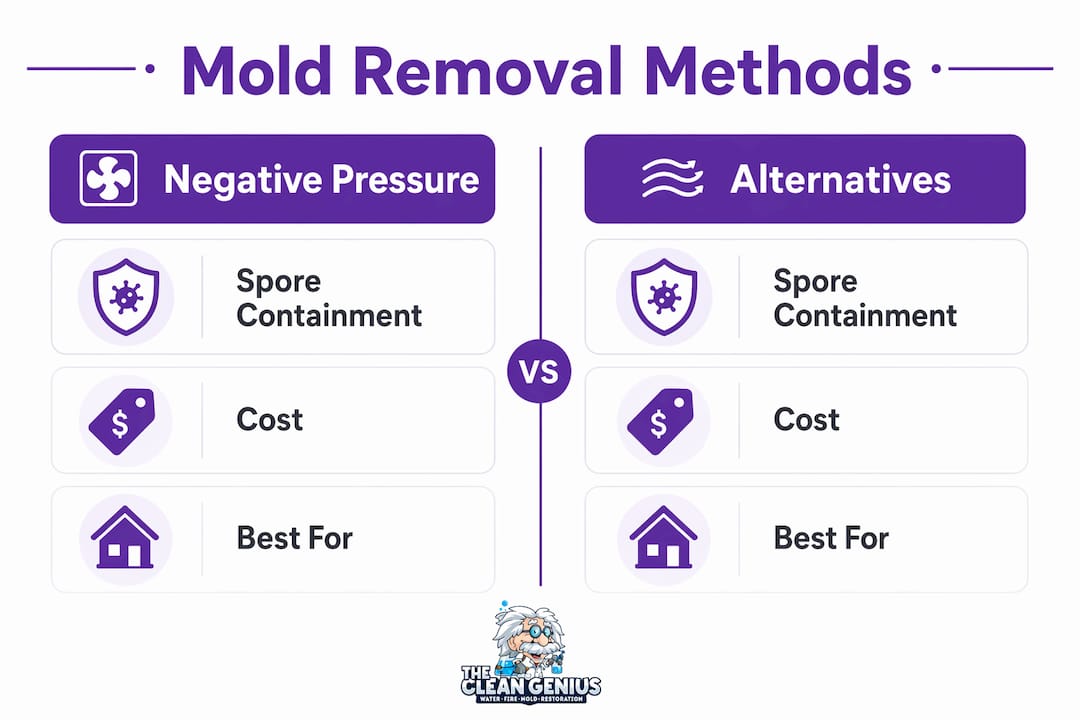
| Method | Spore containment | Equipment needed | Best for |
|---|---|---|---|
| DIY cleaning with bleach or biocide | None. Spores become airborne with no controls. | Spray bottles, scrub brushes | Surface stains under 10 sq ft in low-risk areas |
| HEPA air scrubber only | Partial. Air inside is filtered but no pressure barrier exists. | HEPA air scrubber, basic plastic sheeting | Small jobs where cross-contamination risk is low |
| Full negative air pressure setup | High. Inward airflow traps spores inside the containment zone. | Negative air machine, HEPA filter, sealed barriers, manometer | Any job over 10 sq ft, HVAC-adjacent mold, or multi-room contamination |
Negative pressure systems reduce aerosolized particles by approximately 75% to 78%, a margin that N95 respirators alone cannot match. That figure explains why professional standards treat negative air pressure as an engineering control rather than an optional upgrade. Personal protective equipment matters, but it protects the worker. Negative pressure protects your home.
The cost difference between a HEPA-scrubber-only setup and a full negative pressure containment is real, but so is the cost of a failed remediation. Repeat jobs, additional testing fees, and secondary contamination in previously clean rooms add up fast. Understanding why containment matters before you hire a contractor helps you ask the right questions and avoid the cheaper setups that cut corners on protection.
Practical considerations for homeowners managing mold remediation
Knowing when negative air pressure containment is required saves you from both over-spending on small jobs and under-protecting your home on large ones. Containment with negative pressure is required when mold growth exceeds 10 square feet, when mold is located near or inside HVAC systems, or when the affected area shares air with occupied living spaces.
Here is what you should observe and ask about before and during any professional remediation job:
- Visible containment barriers: Polyethylene sheeting should seal the entire work zone, including doorways, vents, and any wall penetrations.
- Ducting routed outside: The negative air machine’s exhaust duct must exit through a window or exterior door, not recirculate into your home.
- Audible machine operation: The NAM should run continuously. If it shuts off mid-job without explanation, ask why.
- Pressure gauge on site: A manometer or differential pressure gauge should be visible inside or at the entry point of the containment zone.
- Post-remediation air testing: Independent air quality testing after the job confirms spore counts have returned to acceptable levels.
One critical point many homeowners miss: negative pressure is a complement to source removal and moisture control, not a replacement for either. If the moisture source that fed the mold is not fixed, mold returns regardless of how well the remediation was contained. A mold inspection that identifies the moisture source is the logical first step before any remediation work begins. A resource like this homeowner’s mold inspection guide explains what that process involves and what to expect from a qualified inspector.
For a full picture of safety protocols during active remediation, the mold removal safety practices guide covers protective equipment, occupant displacement decisions, and post-remediation verification steps in detail.
Key takeaways
Negative air pressure is the single most effective engineering control for preventing mold spore migration during remediation, and it requires verified pressure differentials, proper equipment, and continuous monitoring to work.
| Point | Details |
|---|---|
| Pressure differential requirement | Maintain at least 0.02 inches water column (-5 to -10 Pascals) to keep airflow moving inward. |
| NAMs versus air scrubbers | Only negative air machines create the required pressure differential; air scrubbers alone do not. |
| Continuous monitoring is non-negotiable | Door openings, HVAC cycling, and worker movement all disrupt pressure and require real-time logging. |
| When containment is required | Any mold job over 10 square feet or near HVAC systems requires full negative pressure containment. |
| Containment does not replace moisture control | Fixing the moisture source is required alongside containment to prevent mold from returning. |
What 25 years of mold jobs taught me about negative pressure
I have walked into enough remediation jobs gone wrong to say this plainly: the containment setup is where most projects succeed or fail, and homeowners rarely know to check it. The most common scenario I see is a contractor who sets up plastic sheeting, turns on what looks like the right machine, and never verifies the pressure reading. The homeowner sees equipment and assumes the job is being done correctly. It often is not.
The confusion between negative air machines and HEPA air scrubbers is not just a homeowner problem. I have seen contractors with years of experience use an air scrubber in a situation that required a NAM, genuinely believing the setup was adequate. The difference in outcomes is significant. A properly contained zone with verified negative pressure keeps spore counts in adjacent rooms at background levels. An improperly set up zone with an air scrubber running can actually increase spore counts in surrounding areas by creating air movement without a pressure barrier.
The other thing I want homeowners to understand is that negative pressure is a living condition, not a checkbox. Pressure fluctuates constantly based on HVAC operation, how many times workers enter and exit, and whether any barrier seams have shifted. A professional who takes this seriously logs readings throughout the day and adjusts equipment as needed. If your contractor cannot tell you what the pressure reading was at 10 a.m. versus 2 p.m., that is a gap in their process.
My honest advice: treat the pressure log as a deliverable, the same way you would treat a written estimate or a final invoice. Ask for it before you sign off on the job. It is the clearest evidence that the containment actually worked.
— Jim
Protect your home with professional mold containment
Mold remediation done without verified negative air pressure puts your entire home at risk, not just the affected room. Thecleangenius brings certified, IICRC-standard mold removal to Chicagoland homeowners, with equipment and monitoring protocols that match what this article describes.

Our teams use advanced containment setups, continuous pressure monitoring, and Pure Cloud dry-fog technology to remove mold safely and completely. We are available 24/7 for emergency response across Arlington Heights, Naperville, Schaumburg, Elgin, and the greater Chicagoland area. If you are dealing with mold right now, explore our Chicagoland mold remediation services to see exactly how we protect your home from the first containment barrier to the final air quality test.
FAQ
What is negative air pressure in mold remediation?
Negative air pressure in mold remediation is a controlled pressure differential where the air inside a sealed work zone is kept lower than surrounding areas, forcing air inward and preventing mold spores from spreading to clean spaces during removal.
How do I know if a contractor is using negative air pressure correctly?
Ask to see the manometer reading before work begins. The pressure inside the containment zone should read at least -5 Pascals or 0.02 inches water column, and the contractor should provide a pressure log at the end of the job.
What is the difference between a negative air machine and an air scrubber?
A negative air machine exhausts filtered air outside the containment zone, creating the pressure differential that traps spores inside. An air scrubber filters air within the same room but produces no pressure differential, so it does not prevent spores from escaping.
When is negative air pressure containment required for mold removal?
Negative pressure containment is required for any mold project covering more than 10 square feet, any work near or inside HVAC systems, and any situation where the affected area shares air with occupied living spaces.
Does negative air pressure eliminate the need to fix the moisture source?
No. Negative air pressure controls spore spread during active remediation but does not address the underlying moisture problem. If the moisture source is not repaired, mold will return regardless of how well the remediation was contained.