
There is no official, government-issued mold clearance certificate in Illinois, and none at the federal level either. What people call a “clearance” is a report or letter from a professional who checked the work after mold removal. It is only worth the paper if the person who wrote it is independent of the company that did the removal and if the moisture problem behind the mold has been fixed.
That is the short version. Below is what a clearance report can and cannot prove, how post-remediation verification works, what to ask for before you move back in or close up walls, and how to avoid paying for paperwork that means nothing.
TL;DR
- No federal or Illinois law defines a “mold clearance certificate.” The EPA says no federal limits have been set for mold or mold spores, so a test cannot certify compliance with a standard.
- What you want is post-remediation verification (PRV): a visual and odor check, confirmation the moisture source is fixed, and, only if you choose, sampling by an independent professional.
- Be cautious of a certificate issued by the same company that removed the mold. Ask for a separate party to verify.
- Illinois has a mold remediation registration law on the books, but as of this writing the state-licensed remediator does not yet exist as a category. Vet companies by third-party credentials such as ACAC or IICRC.
Table of Contents
- What a mold clearance certificate actually is
- Why there is no “safe number”
- Post-remediation verification: a process, not a piece of paper
- The independence problem
- Who to hire in Illinois right now
- Steps to a clearance report you can trust
- Our perspective: a clean report starts with a dry house
- Health questions belong with a doctor, not a certificate
- When we come in
- What about taxes and insurance?
- FAQ
- Sources
What a mold clearance certificate actually is
Search results for this phrase are a mix of training course pages, state forms from other states and a few remediation company blogs. That is because “certificate” means different things to different people.
- A training certificate shows a technician completed a course. It says nothing about your house.
- A state form exists in a few states that license mold work. Illinois is not one of them yet.
- A clearance report or letter is written by an assessor after the job. It records what they saw, what they measured and whether, in their professional judgment, the work is done.
- A company’s own completion certificate is a marketing and warranty document. It can be useful as a record of what was done, but it is not independent proof.
The Illinois Department of Public Health says plainly that it does not test for mold and does not license mold remediators, and that no standards exist to judge acceptable mold levels. So nobody in state government stamps a certificate for your basement or attic.
Why there is no “safe number”
Mold spores are everywhere. The EPA notes it is impossible to get rid of all mold and mold spores indoors, because some are always floating in the air and settled in house dust. They only grow where moisture is present.
That is why a lab result alone cannot declare a home “clear.” The EPA explains that in most cases, if visible mold is present, sampling is unnecessary, and a single air sample is a snapshot that shifts with weather and activity in the house. When sampling is done after remediation, the usual goal is that indoor results look like the outdoor air, not that they hit a legal number.
Post-remediation verification: a process, not a piece of paper
The EPA’s guidance on evaluating a completed cleanup is written for schools and commercial buildings, but the logic carries over to homes. In plain terms, a sound verification covers these points:
- The water or moisture problem is fixed. Mold comes back if the leak, condensation or humidity source remains. The EPA’s own checklist for finishing a cleanup puts this first.
- Visible mold is gone. Surfaces are free of growth, dust and debris from the work.
- No musty odor remains. Your nose is a legitimate instrument here.
- Sampling, if used, is done by an independent professional and compared with outdoor conditions.
The EPA treats visual and odor inspection as the most reliable indicator of success, with sampling as an optional supplement. If someone tells you a clean air test alone proves your house is fine, that is a reason to ask more questions.
Visual inspection versus testing
| Visual and moisture check | Air or surface sampling | |
|---|---|---|
| What it tells you | Whether growth, staining, odor and damp materials are gone | Spore counts at one moment, in one place |
| Weaknesses | Depends on the inspector’s skill and access to hidden areas | Swings with weather, door traffic and time of day |
| Cost | Usually the lower-cost part of a verification | Adds lab fees per sample |
| Best for | Every job | Insurance disputes, real estate transactions, occupants with serious health concerns, or when you want a second opinion |
We have not listed prices because they vary by assessor and home size. Ask for a written scope and per-sample fees before you book.
The independence problem
The single most important question about any clearance document is: who wrote it? When the same company that removed the mold also declares the job passed, it is grading its own homework. That does not make the company dishonest, but it creates a conflict of interest, and an insurer, buyer or attorney may discount the paper.
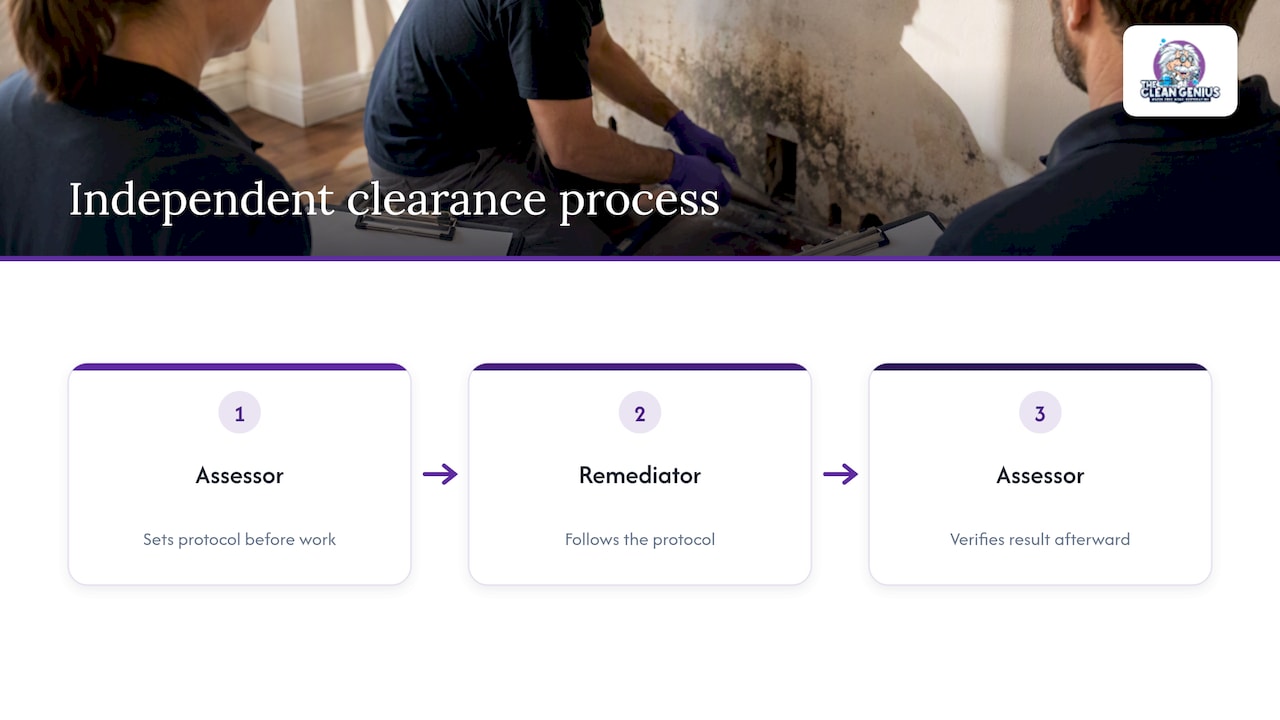
A cleaner arrangement is to hire a separate indoor environmental professional to set the scope before work starts and verify afterward. They write the protocol, the remediator follows it, and the assessor checks the result. Hiring the assessor yourself, not through the remediator, keeps the incentives clean.
Who to hire in Illinois right now
Illinois passed the Mold Remediation Registration Act and amended it with Public Act 103-0893. The IDPH registration page for businesses and professionals says rules are still being worked out. Our reading, as of October 2026, is that you should not assume any company is “state licensed” for mold. Check the IDPH registration page for the current status before you hire, because this can change.
In the meantime, IDPH points homeowners toward certifications from third-party bodies such as the American Council for Accredited Certification (ACAC) and the Institute of Inspection, Cleaning and Restoration Certification (IICRC), which require exams and documented experience. IDPH does not recommend specific contractors, so verification of credentials is on you.
When you interview an assessor or remediator, ask:
- Which certifications do you hold, and can I verify them with the issuing body?
- Are you insured, and will you show the certificate of insurance?
- Do you also perform remediation? (An assessor who sells remediation has the same conflict.)
- What will the written report include: photos, moisture readings, locations, protocol followed?
- What happens if verification fails?
Steps to a clearance report you can trust
- Find and stop the water source. A roof leak, plumbing leak, poor ventilation or a damp foundation. Document the repair with receipts and photos.
- Hire an independent assessor before remediation for a written scope, if the job is large, if an insurer is involved or if you may sell soon.
- Have the remediation done under containment where the scope calls for it, with the area kept under negative air and affected materials removed rather than painted over.
- Schedule verification after the work and before rebuilding. Walls open, surfaces visible and moisture readings taken. Verification after drywall goes back up hides the very things you want checked.
- Get the report in writing, with the assessor’s name, credentials, date, areas checked, methods and findings. Keep it with your insurance and home records.
- Keep humidity down afterward. The CDC advises keeping indoor humidity no higher than 50% all day, using an air conditioner or dehumidifier.
We cover the verification checklist from the remediator’s side in 3 post-remediation verification checks to demand before you move back, and the work itself in our certified mold remediation process for Chicagoland homes.
Our perspective: a clean report starts with a dry house
We are a family-owned restoration company serving Chicagoland, and we see the same pattern in houses from Arlington Heights to Naperville: homeowners focus on the paperwork while the leak that caused the mold is still dripping behind a wall or the attic is still poorly ventilated.
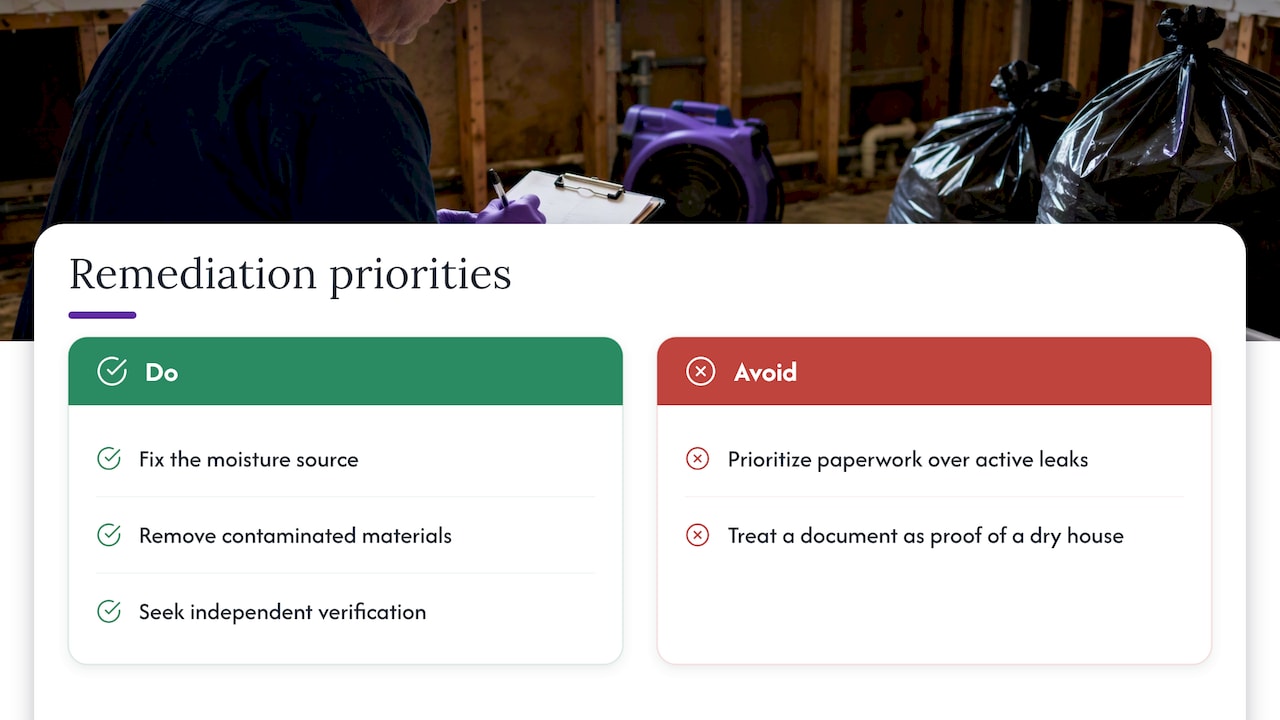
Our view is simple. Mold removal that skips the moisture source is a repeat bill. Any document, ours or anyone else’s, is secondary to a dry structure, removed contaminated materials and a house that smells like a house. We would rather you ask hard questions about scope and verification before signing anything, including with us.
We also think independent verification is reasonable, and nothing in how we describe our work should be read as a substitute for it when you want a neutral opinion. Our job is to remove mold and fix the damage it caused. If you want a third party to confirm it, that is a fair request. For more on why the process matters, see why certified professionals make mold remediation safe and why remediation fails when the cause is left alone.
— Jim
Health questions belong with a doctor, not a certificate
A clearance report is not a health document. The CDC says exposure can cause symptoms such as coughing, wheezing or skin irritation in some people, especially those with asthma or mold allergies, but there is no standardized environmental test that diagnoses “mold illness”. If someone in your household has breathing problems, a weakened immune system or symptoms that you think are tied to the house, talk to your physician or an allergist. Do not rely on a contractor or a lab report to answer a medical question.
When we come in
If you have visible mold, a musty area you cannot trace or damage from a leak or flood, our team handles mold removal and remediation across Chicagoland, including attic mold, using Pure Cloud dry-fog technology. We are available 24/7 for water emergencies, work directly with your insurance, and can walk you through what documentation to keep. If water caused the problem, start with our water damage restoration service so the structure is dried properly first. Estimates are done on site, since the scope drives everything.
What about taxes and insurance?
Costs for mold remediation on a personal residence are generally not deductible as ordinary repairs. In a federally declared disaster area, a personal casualty loss may be possible, and the IRS describes safe harbor methods for measuring that loss. The deduction is limited, requires itemizing and depends on your income, so check with a tax professional before counting on it. Keep every invoice and photo regardless.
For insurance, coverage depends on the cause of the water damage and your policy language, so read it and call your agent early. Our water damage insurance claim checklist lists what to document.
FAQ
Is a mold clearance certificate required in Illinois?
No law requires one, because none defines it. A lender, buyer, landlord or insurer may ask for a post-remediation report, so check what your specific situation needs. If a report is requested, it should come from an independent assessor.
Is mold clearance testing the same as a mold inspection?
Not quite. An inspection looks for mold and moisture problems, while clearance (post-remediation verification) checks that a completed cleanup worked. Both rely on the assessor’s visual and moisture findings, with sampling as an optional addition.
Do I need a license to do mold remediation in Illinois?
Not as a state-licensed category today. The registration law exists, but implementing rules were still pending in the latest IDPH information we found. Verify third-party credentials such as ACAC or IICRC and check the IDPH page for updates.
Can the remediation company give me the clearance?
It can give you a completion record of what it did. For a neutral clearance opinion, use a separate professional with no stake in the removal work. That is the version insurers and buyers tend to trust.
Does a passing air test mean my home is safe?
It means the sample from that moment looked acceptable. The EPA cautions that air samples are snapshots, so pair any test with a visual check and confirmation the moisture source is fixed.
Sources
- EPA: Mold Testing or Sampling
- EPA: A Brief Guide to Mold, Moisture and Your Home
- EPA: Mold Remediation in Schools and Commercial Buildings, Chapter 3
- EPA: Mold Course Chapter 7
- Illinois Department of Public Health: Mold FAQ
- Illinois Department of Public Health: Mold Remediation Registration
- Illinois General Assembly: Public Act 103-0893
- CDC: Mold
- CDC: About Invasive Mold Infections
- IRS: Rev. Proc. 2018-08