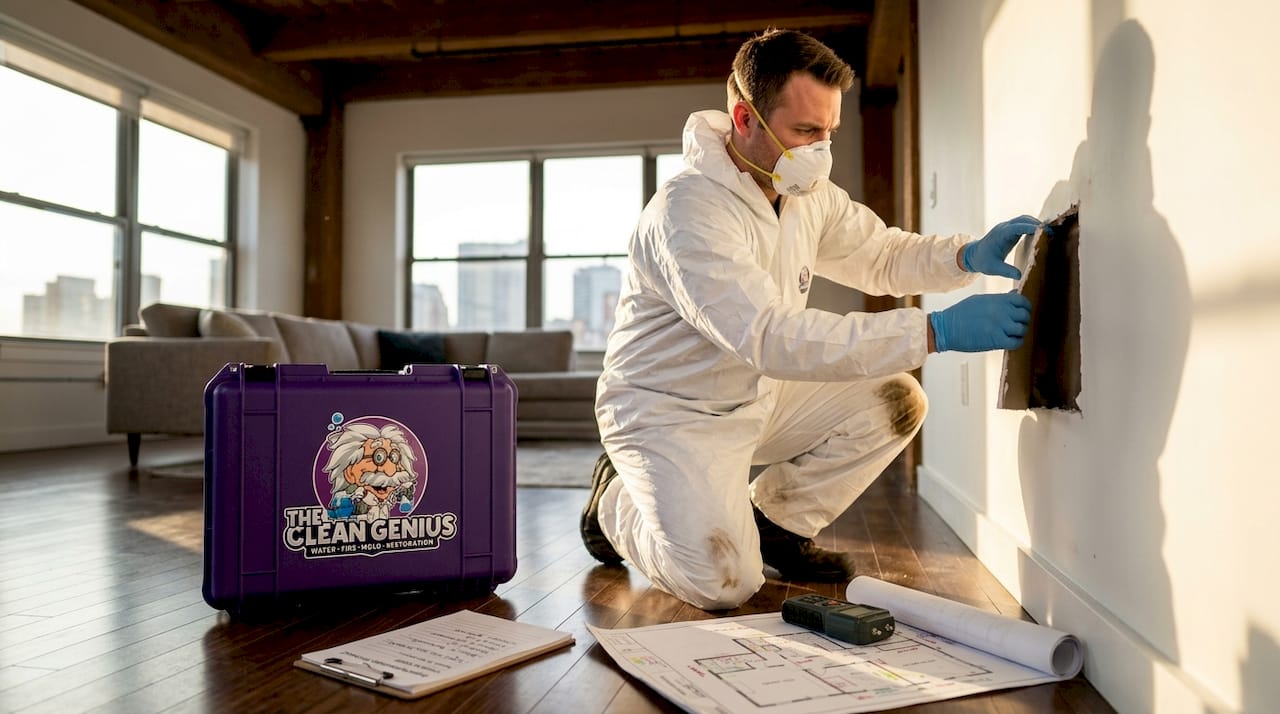

Finding mold in your home is unsettling enough. Realizing you have no idea whether the company you hired actually knows what they are doing makes it worse. The certified mold remediation process for your home is not just about removing visible mold. It follows a structured protocol that protects your family during cleanup and prevents mold from returning weeks later. Professional remediation is typically required when contamination exceeds 10 square feet on hard surfaces. If you live anywhere in Chicagoland, from Naperville to Crystal Lake, this guide walks you through every stage so you know exactly what to expect and what to demand.
Table of Contents
- Understanding when to hire certified mold remediation professionals
- Certifications and standards that ensure proper mold remediation
- Step-by-step certified mold remediation process for your home
- How to verify successful remediation and avoid common pitfalls
- Why relying solely on certifications is not enough and what homeowners should insist on
- Get certified professional mold remediation services in Chicagoland
- Frequently asked questions
Key Takeaways
| Point | Details |
|---|---|
| Know the threshold | Mold covering more than 10 square feet typically requires certified professional remediation. |
| Check certifications | Choose remediation technicians with IICRC AMRT certification for standardized expertise. |
| Follow the process | Certified remediation includes assessment, containment, removal, cleaning, moisture correction, and clearance testing. |
| Demand independent verification | Post-Remediation Verification must be done by a third party to ensure unbiased results. |
| Control moisture | Effective mold prevention depends on fixing water issues and maintaining indoor humidity between 30 and 50 percent. |
Understanding when to hire certified mold remediation professionals
Not every mold spot requires a professional crew in hazmat suits. A small patch on a bathroom tile? That may fall within what you can address yourself. But knowing where that line sits makes a real difference for your health and your wallet.
Mold covering less than 10 square feet on hard, non-porous surfaces like tile or sealed concrete can generally be addressed by a careful homeowner using proper protective equipment and EPA-registered antifungal cleaners. That is roughly the size of a standard ceiling tile.
The moment conditions cross into any of the following territory, you need certified mold remediation companies on the phone:
- Mold covering more than 10 square feet on any surface type
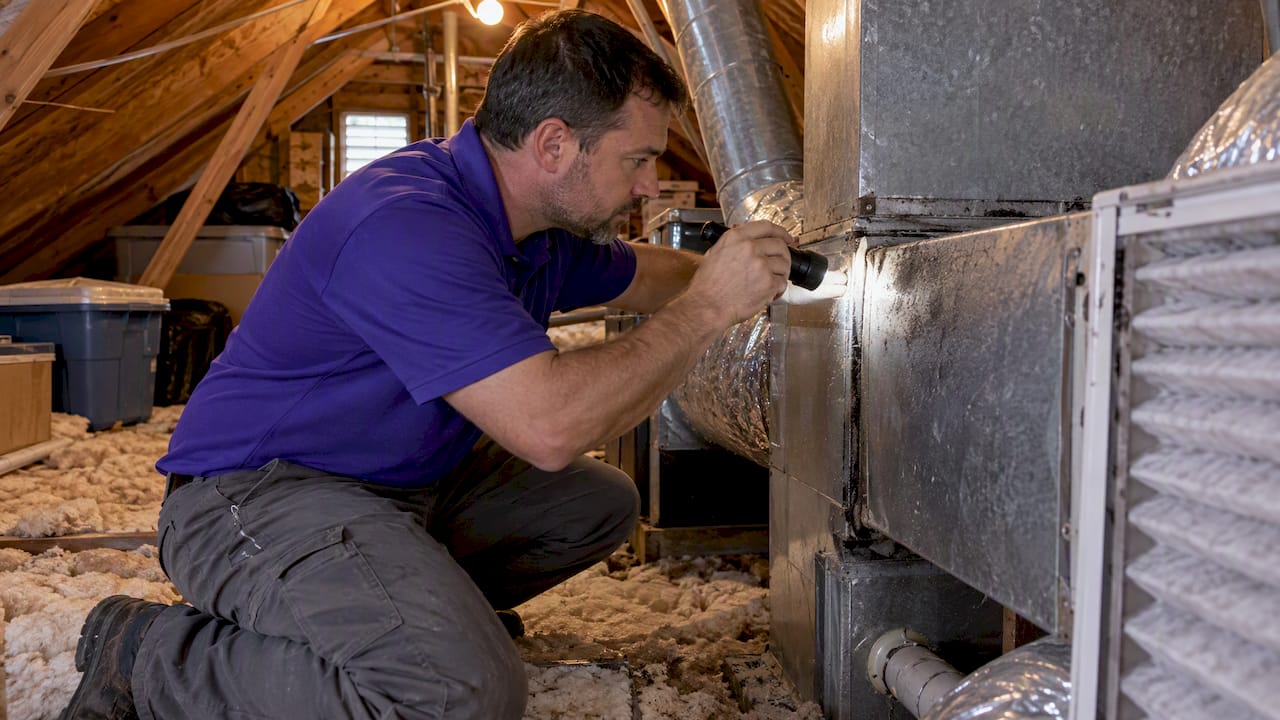
- Contamination in HVAC systems, which can spread spores throughout every room in your home with every cycle
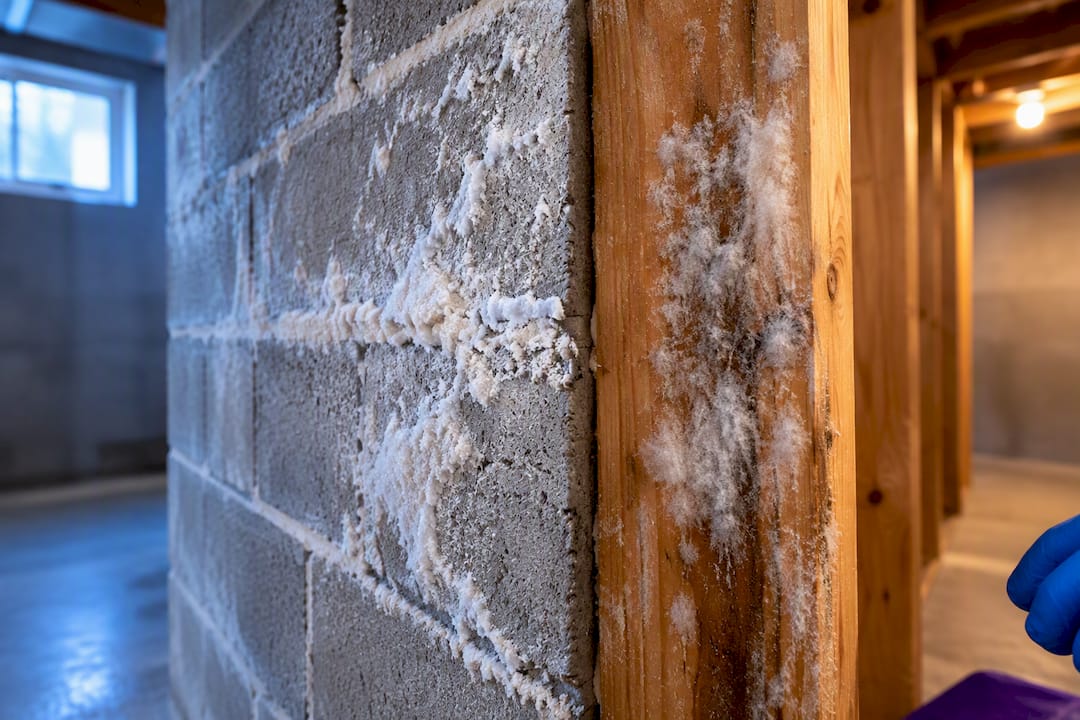
- Mold on porous materials like drywall, insulation, carpet, or wood framing
- Suspected black mold (Stachybotrys chartarum) or any toxic species
- Hidden mold behind walls, under flooring, or in crawlspaces
- Anyone in the home with respiratory conditions, compromised immune systems, or mold allergies
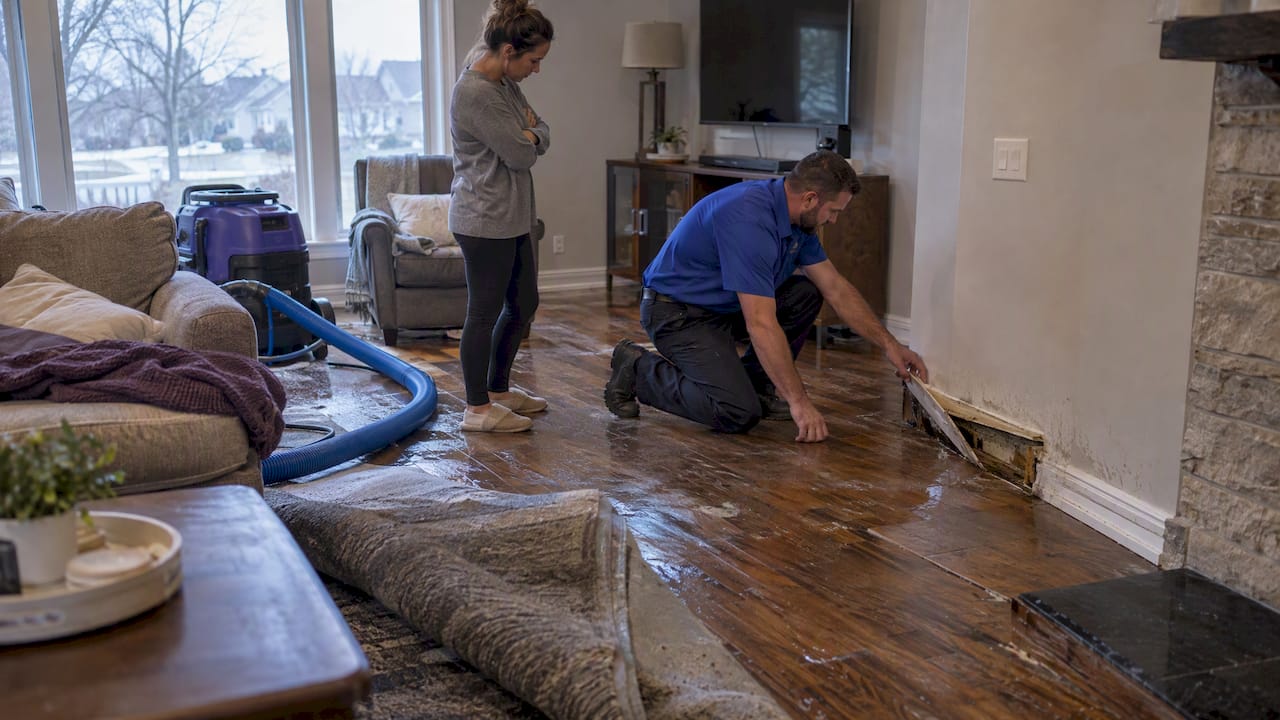
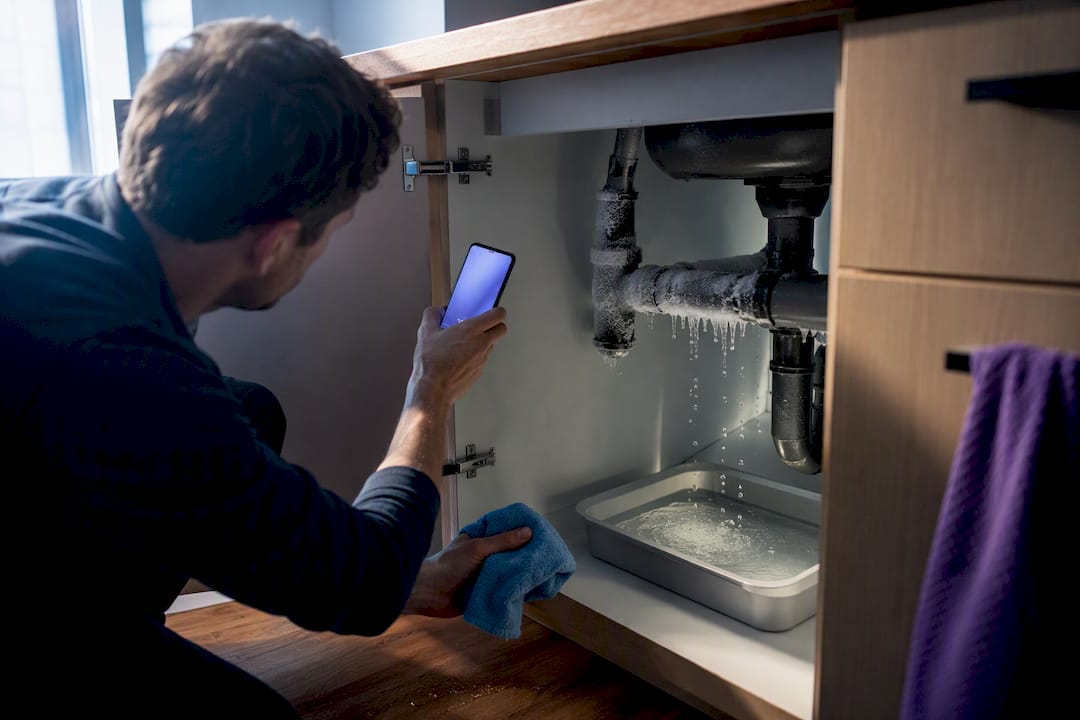
- Mold following water damage from floods, burst pipes, or sewage backups
Contamination involving HVAC or toxic species requires professional containment regardless of visible size. Chicago-area homes face particular risk after basement flooding and freeze-thaw cycles that drive moisture into wall cavities without obvious signs until mold is already established.
Certifications and standards that ensure proper mold remediation
Knowing a company is certified is not the same as knowing what that certification actually means. Here is what separates a qualified crew from someone with a truck and a bottle of bleach.
The IICRC AMRT (Applied Microbial Remediation Technician) is the primary credential for mold remediation professionals. AMRT certification requires hands-on training spanning 2 to 4 days, a prerequisite Water Restoration Technician (WRT) credential, and a proctored exam. It is not a certificate you buy online.
The standard those certified technicians follow is the IICRC S520. Think of it as the rulebook for the entire job. The IICRC S520 standard governs every phase of remediation including assessment protocols, containment construction requirements, required personal protective equipment (PPE), cleaning procedures, and final verification. Without it, a contractor is improvising.
Here is what S520 compliance looks like in practice:
- Written scope of work referencing specific contamination conditions
- Defined containment levels based on contamination severity
- PPE requirements including respirators (minimum N95, often full-face supplied air for severe cases)
- Documentation of negative air pressure readings throughout the project
- Post-Remediation Verification (PRV) clearance testing before containment is removed
Understanding the importance of certification means you can ask the right questions before signing anything. Ask to see the technician’s AMRT card. Ask which contamination condition level the S520 scope references. If a company cannot answer those questions, move on.
Our certified mold removal services at The Clean Genius are built on exactly these credentials, so Chicagoland homeowners never have to guess.
Step-by-step certified mold remediation process for your home
The home mold cleanup process typically runs 1 to 5 days depending on contamination size and severity. Here is every stage explained clearly, so you know what a professional crew should be doing at each step.
1. Initial mold inspection and assessment
A certified inspector identifies all contaminated areas, collects air and surface samples if needed, and locates the moisture source driving mold growth. No reputable company skips this step.
2. Containment setup
Workers build physical barriers using polyethylene sheeting to isolate the work zone from the rest of your home. Negative air pressure at -0.02 inWC with HEPA filtration is the engineering standard, ensuring airborne spores cannot migrate into clean areas.
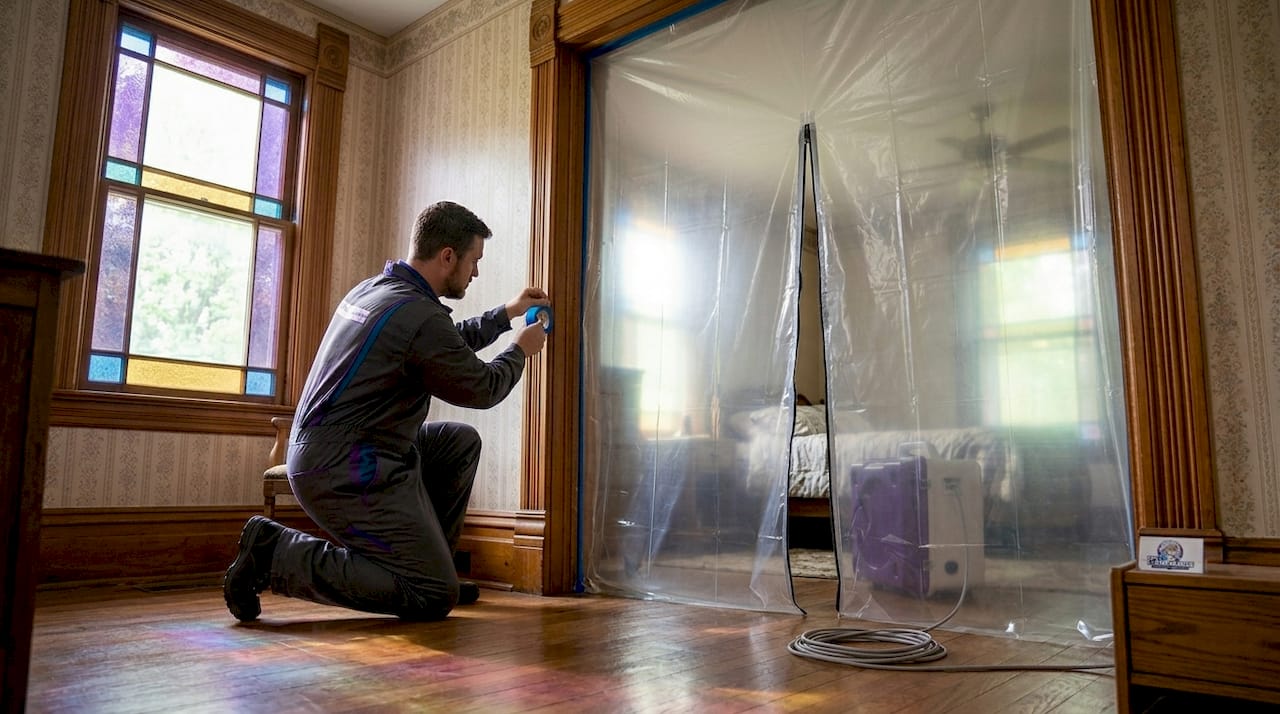
3. Personal protective equipment
Technicians suit up in disposable coveralls, gloves, and respirators rated for the contamination level. This protects both the workers and prevents cross-contamination.
4. Removal of contaminated materials
Porous materials that cannot be effectively cleaned, such as drywall, insulation, and carpet, are removed and double-bagged. Non-porous surfaces are cleaned in place.
5. Antifungal cleaning and HEPA vacuuming
All surfaces within the containment zone are cleaned with EPA-registered antimicrobial agents, then HEPA-vacuumed to capture residual spores that cleaning alone cannot eliminate.
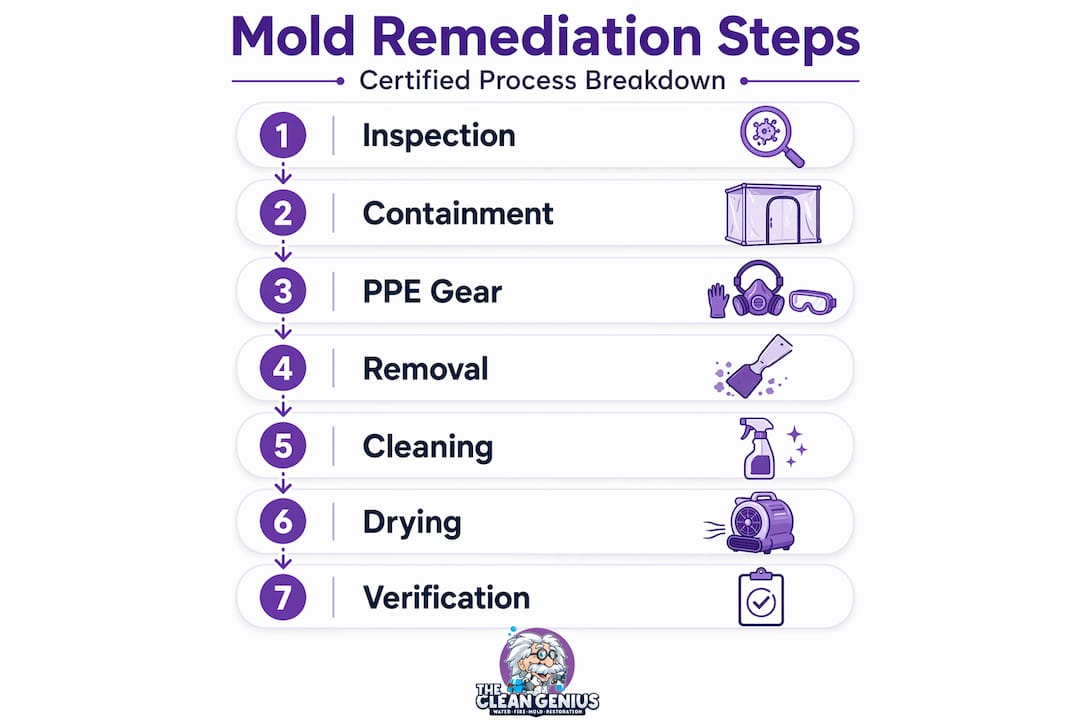
6. Moisture source correction
This is the step many companies rush or ignore entirely. Without fixing the leak, condensation problem, or drainage issue that fed the mold, you are paying for temporary results.
7. Drying and environmental stabilization
Industrial air movers and dehumidifiers bring affected areas to target moisture levels. This typically runs 2 to 3 days after material removal.
8. Post-Remediation Verification (PRV)
An independent PRV is critical for project integrity. Clearance testing confirms mold levels have returned to normal background conditions before the containment comes down.
Here is a quick reference for each stage:
| Stage | What happens | What to ask for |
|---|---|---|
| Assessment | Sampling, moisture mapping | Written inspection report |
| Containment | Poly barriers, negative pressure | Pressure readings from manometer |
| Material removal | Drywall, insulation, carpet bagged | Itemized scope of work |
| Cleaning | Antimicrobials, HEPA vacuuming | Product names and EPA reg numbers |
| Moisture correction | Leak repair, dehumidification | Documented moisture readings pre and post |
| PRV clearance | Air and surface sampling | Third-party lab report |
Pro Tip: Ask your remediation company for the manometer logs every single day during active containment. These pressure readings are not just internal paperwork. They are your proof that spores were not spreading through your home while work was underway.
For a deeper look at each phase, our mold remediation process breakdown explains what Chicagoland homeowners specifically face based on regional climate and common home construction types.
How to verify successful remediation and avoid common pitfalls
Clearance testing is where the entire job either holds up or falls apart. This phase gets rushed more than any other, and homeowners pay for it months later when mold reappears.
The most important rule: the company that performs your remediation should not perform your clearance testing. Post-Remediation Verification must be done by an independent third party to eliminate conflict of interest. When the same company does both, they are essentially grading their own exam.
“Mold will re-colonize damp building materials if the underlying moisture source is not corrected within 24 to 72 hours of remediation.” The moisture problem is always the real problem.
Here are the red flags to watch for during and after the process:
- No daily pressure logs: Daily manometer logs demonstrating negative pressure are required documentation under S520. If a company cannot produce them, containment compliance is unverifiable.
- Verbal-only clearance: A legitimate PRV produces a written lab report with spore counts. “It looks clean” is not clearance.
- No moisture documentation: Insist on written before-and-after moisture readings confirming the source was actually fixed.
- Unrealistic guarantees: Companies that promise a completely “mold-free” home are misrepresenting reality. Mold spores exist everywhere in the environment. The goal is returning your home to normal background conditions, not sterility.
- Bundled assessment and remediation: Ideally, your inspector and your remediator are separate entities. At minimum, your clearance tester must be.
Pro Tip: Before hiring any company, search for their technician’s AMRT certification on the IICRC’s public verification database. It takes 30 seconds and immediately separates legitimate crews from unqualified operators.
Understanding how to prevent recurrence long-term means addressing mold recurrence prevention before the containment even comes down. Mold re-colonizes damp materials when moisture is not corrected, sometimes within just a few days.
Why relying solely on certifications is not enough and what homeowners should insist on
Here is something the industry rarely admits: a technician can hold a valid AMRT card and still run a sloppy job. Certification does not guarantee project-level compliance without documentation to back it up. The credential proves knowledge. It does not prove execution.
After more than 25 years of combined experience serving Chicagoland homeowners, we have seen what the gap between certified and documented looks like. A technician who knows the S520 standard can still skip manometer logging when no one is watching. They can still rush drying cycles to close a job on Friday. Certification is the floor, not the ceiling.
What actually protects you as a homeowner is insisting on paper trails. That means a written scope referencing specific S520 contamination conditions before work begins. It means daily pressure logs you can review. It means a third-party PRV report from a lab, not just a verbal thumbs-up. These documents are not bureaucratic extras. They are the record of what actually happened in your home.
The other thing worth saying plainly: some contamination will always be present in any home after remediation. Mold spores are in outdoor air. They come in through windows, doors, and HVAC intakes. The standard is not elimination. It is returning to pre-event conditions with moisture sources corrected. Any company promising you a permanently mold-free home is either uninformed or not being straight with you.
The companies that operate with the most integrity are the ones that welcome your questions, hand you documentation without being asked, and have no issue with you hiring a separate tester for clearance. That willingness to be transparent is the real signal of quality. Credentials from the importance of certified professionals matter, but documentation is what holds them accountable.
Get certified professional mold remediation services in Chicagoland
When mold shows up in your home, you deserve more than a quick spray-and-paint response.

At The Clean Genius, our IICRC AMRT-certified technicians follow the full S520 protocol on every job, from written scopes and daily pressure logs to coordinating independent PRV clearance testing. We identify and repair moisture sources so remediation actually holds. Our certified mold remediation services use advanced Pure Cloud dry-fog technology to reach areas standard cleaning cannot. We serve Arlington Heights, Schaumburg, Naperville, Elgin, Wheaton, and dozens more Chicagoland communities, with 24/7 emergency response when you cannot wait. Learn more about preventing mold from returning with the right professional approach from the start.
Frequently asked questions
What size mold contamination requires professional remediation?
Professional remediation is typically needed when mold covers more than 10 square feet on any surface, or when it involves HVAC systems, porous building materials, or suspected toxic species regardless of visible size.
Why is the IICRC AMRT certification important for mold remediation technicians?
AMRT certification confirms that a technician has completed 2 to 4 days of hands-on training and passed a proctored exam, meaning they have practical knowledge of safe, standards-based remediation rather than just on-the-job guesswork.
What is Post-Remediation Verification and why must it be independent?
PRV is a clearance test confirming that mold levels have returned to normal background conditions. Independent PRV avoids conflicts of interest that arise when the same company remediates and then declares its own work successful.
How can I prevent mold from coming back after remediation?
Fixing the moisture source is the only thing that prevents recurrence. Mold re-colonizes damp materials quickly when leaks or humidity problems go unresolved, so keeping indoor humidity between 30 and 50 percent and repairing all water intrusion points is essential.